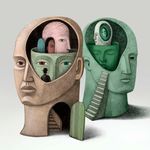
Platitude, a noun, is a remark or statement often with some moral content, used to mask real meaning. Politicians use platitudes to sound interesting or thoughtful. But it is often devoid of the deep explanations or solutions to the issues at hand. Here is one example.
Economic growth in the second quarter of 2025 was 5.0 percent, up from 4.0 percent in the third quarter of 2024. This, combined with low inflation and a stable exchange rate, is good news for businesses. It means better times ahead.

It is no surprise, then, that the September Purchasing Managers Index was 51.9. That is, a slim majority of purchasing managers of Kenya’s leading companies expect that business will be better in the months ahead. They also reported increases in output and more hiring.
After four years (2020-23) of declines in real wages, the improvements in 2024 were a much-welcome relief for citizens.
Still, it may be too soon for a full-blown celebration. The recovery of real wages in mining and quarrying, manufacturing, construction, wholesale, retail and repair of motor vehicles, information and communication, did not extend to agriculture and financial services. In any case, it was modest and did not recover all the lost ground. That may take several quarters of sustained high growth.
While all this is positive news, serious issues remain at home and abroad. Not only do we need to reverse the decline in real wages, but we also need to continue a high growth trajectory and bring up those previously left behind.
That is in addition to reducing inequality. So what can be done to increase growth? Why are lending rates not coming down fast enough? How can we accelerate growth in credit to the private sector? What about social protection?
The answers to these questions require more than social media posts. Perhaps as a result, many politicians have abandoned any pretence of thinking very hard about, or seeking answers to these questions.
Instead, they have found refuge in framing these pressing issues as “us” vs “them” contests. In this framing, every action or word is being interpreted as a sinister plot to finish one ethnic group or another.
Defining us versus them allows politicians to rally ethnicities, to fight with generally imaginary, but seemingly mortal enemies. In Europe and America, “them” is the supposedly hordes of poor, murderous, drug-peddling immigrants, who are taking jobs from the natives.
But for all the supposed crises that fuelled Brexit and the election of right-wing political leaders across Europe, the reality is that annual global migration has remained around three percent of the total population since at least 1960.
At home, the divide is framed as opposition versus government, but more eerily, pitting ethnic groups against each other, or income groups against one another. The language is incendiary – “they are out to finish us”. Sociology provides useful tools to understand the mechanics and dynamics of social identification that can help us make sense of it all.
The social identity theory became popular in the 70s. Research found that even arbitrary, meaningless groupings create prejudice. Here is the spooky truth. Supposing you ask a group of Kenyans to estimate the percentage of their ethnic group in the total population.
Since estimates will vary, you can then arbitrarily call some of them over-estimators and others under-estimators. That definition alone will cause them to behave differently. The “over-estimators” are more likely to see themselves as defenders of the tribe!
Astonishingly, prior conflict and competition are not prerequisites for prejudice and discrimination between groups of human beings. Once you define “us” and “them”, however arbitrary that might be, prejudice immediately emerges.
Named the minimal group paradigm, this powerful social psychology idea demonstrates that people, once divided into groups based on arbitrary criteria, including, for example, a coin toss, the categorisation leads to discrimination.
This happens even without personal interaction or shared history. The simple categorisation is enough to trigger ingroup favouritism and outgroup derogation.
Why do humans behave this way? Social categorisation seems necessary for us to feel good about ourselves, but sometimes with devastating effects. Politicians, it seems, know and exploit this weakness to great advantage.
Methinks we should fight for ideas, not fellow Kenyans. The high-decibel slugfest, where very harsh words are being used with reckless abandon, leaves little room for building consensus or persuasion.
Talking at each other does not solve the problems. Neither does name-calling. We need better answers from politicians.
The writer is an economist and Partner at Ecocapp Capital, an advisory firm. He is also the chairman of KRA and former governor of Laikipia County. email [email protected]
Unlock a world of exclusive content today!Unlock a world of exclusive content today!