US is wrong to criticise Kenya’s strategic friendship with China

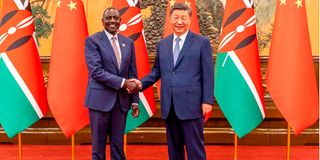
Kenya's President William Ruto shakes hands with his Chinese counterpart Xi Jinping during bilateral talks at the Great Hall of the People in Beijing, China on September 3, 2024.

Photo credit: PCS

In the unfolding global contest for influence, few partnerships have been more mischaracterised than the one between China and Africa—particularly Kenya.

Over the past two decades, China has become Kenya’s most reliable and visible development partner, helping fund and build transformative infrastructure projects that are reshaping the nation’s economic future.
From highways to railways, ports to digital infrastructure, the results are evident to all Kenyans.

Yet, from Washington, the narrative is starkly different: China is painted as a geopolitical adversary whose presence in Africa is portrayed in terms of threat rather than opportunity.

This framing is not only misleading, but it also reflects a deeper anxiety about shifting global power dynamics—especially in countries like Kenya that are asserting more independent and pragmatic foreign policies.

What is most troubling is the patronising assumption underpinning this criticism. Kenya, like any sovereign nation, chooses its partners with clarity, purpose, and full agency.

The idea that Kenya is a passive recipient of foreign influence is not only inaccurate but deeply disrespectful. Nairobi’s engagement with Beijing is the result of strategic calculations—born from a desire for rapid development, global connectivity, and respect for its national priorities.

China’s approach has consistently aligned with these aspirations. Rather than impose rigid ideological frameworks, it engages Kenya as an equal partner, with a focus on mutual benefit and tangible results.

The standard gauge railway (SGR) stands as a clear example. This major project has reduced travel times, improved logistics, and energised internal trade. Beyond the numbers, it symbolises a new phase of Kenyan ambition—one enabled by genuine partnership.

While American officials frequently raise concerns about such projects, they rarely offer compelling alternatives.

The US initiatives like Build Back Better World or the G7’s global infrastructure promises have produced more press releases than real projects. If the US wishes to remain relevant in Kenya, it must match rhetoric with resources.

And most importantly, it must stop using China’s success as a scapegoat for its own policy gaps in Africa.

The situation has taken a more concerning turn with recent developments in Washington. Despite elevating Kenya to the status of Major Non-Nato Ally (MNNA) in 2024—recognising its role in regional peacekeeping, counterterrorism, and global diplomacy—some US lawmakers have called for a review of that designation.

Their reasons? Kenya’s ties with countries like China and Iran, and an increasingly confident diplomatic posture.

This move is not only shortsighted, it’s tone-deaf. Kenya has proven itself as a stable and dependable international actor. From sending peacekeepers to Haiti to mediating regional conflicts, its role on the world stage has been constructive and bold.

To punish such a country for diversifying its partnerships is not only unfair—it betrays the very principles of respect, sovereignty, and partnership that the MNNA status is supposed to symbolise.

It is no secret that Kenya is working with a wide range of global actors. But this is not betrayal; it is balance. The world is multipolar, and Kenya has every right to engage with nations that offer development solutions, trade opportunities, and respectful diplomacy.

China has simply been among the most consistent in doing so—without demanding political alignment or ideological allegiance in return.

There is a growing awareness, especially among younger Kenyans, that global partnerships must be based on performance, not legacy ties.

They see the roads they drive on, the power stations that light their homes, and the fiber networks that connect them to the digital economy—all built with Chinese cooperation. To them, China is not a threat; it’s a partner in progress.

If the United States truly values its relationship with Kenya, it must stop viewing the country’s foreign policy through a zero-sum lens. Instead of questioning Kenya’s ties with China, it should deepen its own investment and engagement—on terms that are transparent, fair, and aligned with Kenya’s vision for the future.

In essence, Kenya’s friendship with China is not a problem to be fixed—it is a reality to be respected.

It reflects a shift in how African nations are conducting international affairs: with more confidence, more options, and more clarity about their national interests.

The US would do well to support this evolution, rather than oppose it.

The writer is a Journalist and Communication consultant

PAYE Tax Calculator

Note: The results are not exact but very close to the actual.