Time flies with great content! Renew in to keep enjoying all our premium content.
Prime
Unlocking the full potential of small businesses
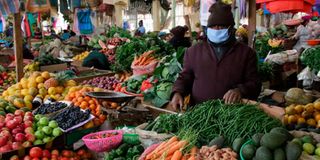
A trader arranges groceries at the Nyeri market. MSMEs power Kenya’s economy—driving job creation, boosting GDP, and holding the key to inclusive growth and sustainable development across Africa.
Every day at 4:30am, in a small town in Thika near Nairobi, Njeri opens curtains of her food kiosk to welcome her early customers. As usual, she will be serving tea with cassava, sweet potatoes, mandazi, or chapati. And once she starts her daily work, it goes on until 6pm.
By the end of each day, she will have made a net profit of Sh1,300. And every month, after deducting what she has used to pay her rent, school fees for her three children and buy food, she has some saving. This is how she survives in the current harsh economic times.
Njeri is not alone. She is among millions of Micros, Small and Medium Enterprises (MSMEs) in Kenya and throughout the world, whose continued efforts, cumulatively, lead to the creation of job opportunities and the economic growth development. But from every MSME to benefit, there is need to have a proper empowerment plan in every country.
According to a publication by the United Nations, globally, MSMEs currently accounts for 90 percent of all businesses and investments. They also employ between 60 to 70 percent populations in every nation. And they take care of almost 50 percent of Gross Domestic Product (GDP).
It further indicates that in the emerging markets, most formal jobs are generated by MSMEs, which create almost seven out of 10 jobs within the younger populations.
Therefore, unlocking the full potential of these MSMEs requires a rethinking of policies or an overhaul of some laws and regulations in those countries that have made it difficult to do business with them.
Additionally, there is a need to ensure that MSMEs operate in supportive environments where they receive advisory and training services on formalising their businesses and can access credit.
According to a 2021 survey report by the Kenya Bankers Association, MSMEs employ over 15 million people and contributes about 30 percent of the GDP.
Besides this, the Kenya National Bureau of Statistics (KNBS), also confirms that MSMEs contribute to more than 35 percent to the GDP. This accounts for over 85 percent of all jobs in the country. A look at the statistics, it further confirms that this sector is critical in the realisation of Kenya’s Agenda 2030 goals.
And a lot needs to be done to realise MSMEs full economic potential. Both national and at county governments must invest heavily in digitisation, such as the e-commerce, mobile money and internet connectivity and tools that support business operations and growth.
There is also a need to empower young people and women who are always left behind in every sector. And ensuring elaborate mentorships, targeted funding, and policy incentives to provide better avenues for them to come on board and thrive as MSMEs.
But shifting economic trends because of the shrinking donor funding has put countries especially in the Global South under more pressure, necessitating new, unique, and novel ideas from MSMEs.
This has continued to reposition MSMEs as central to any meaningful economic growth of any country. Luckily, African nations have recognised the opportunities available in connecting MSMEs throughout the continent through the African Continental Free Trade Area (AfCFTA).
Capitalising on a rich market of close to 1.4 billion people across 55 countries and a combined GDP of over $3.4 trillion, AfCFTA has been designed to elevate the status of businesses in the continent by easing trade processes such as barriers.
The writer is a Communication Specialist at Strathmore University Business School.
Unlock a world of exclusive content today!Unlock a world of exclusive content today!