Time flies with great content! Renew in to keep enjoying all our premium content.
Strategic lessons for Kenya from the US-Iran conflict, Hormuz disruption
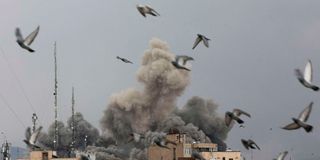
Birds fly as smoke rises following an explosion, after Israel and the US launched strikes on Iran, amid the US-Israel conflict with Iran in Tehran, Iran on March 2, 2026.
The US–Iran conflict and the disruption of the Strait of Hormuz has shown us how modern conflicts spread their effects far beyond the battlefield. Iran’s use of the Strait in its neighbourhood as a weapon, and how trade, finance, food, energy and supply chains have become casualties is a big wake-up call for the globalised economy.
The first lesson is that globalisation and reliance on imported goods, which expose you to shocks beyond your control, is risky. It is worse if you have no power to resolve its cause, like in the US-Iran war.
Obviously, Kenya can't and couldn’t send its Navy to open the Strait.
Instead, Kenya's response should be to strengthen domestic production of as many strategic goods as possible. In energy, this means expanding renewable power, building strategic petroleum reserves and diversifying supply sources.
The second lesson is the link between economics and politics. In Kenya, "tumbocrat" is a common word that represents pursuit of livelihoods, and loosely describes politicians with a strong tendency to pursue politics for their own selfish interest.
But in all of human history this is not anything out of the ordinary. Most military and political conflicts are ultimately about economic interests. Governments derive legitimacy from their ability to provide jobs, incomes and economic stability.
The US–Iran conflict worsened an already difficult global economic environment. Higher energy costs raised prices and squeezed households and businesses. In the United Kingdom, Labour Party has just seen its popularity fall against a backdrop of economic dissatisfaction and rising pressure on living standards.
When economic conditions deteriorate, public support weakens regardless of the cause. Governments that ignore economic distress often pay a political price.
The third lesson is military preparedness. Peace often rests on credible deterrence. Last week, the Russian government spokesman Dmitry Peskov issued a remarkable state of the affairs statement, saying: "In many respects, apart from nuclear deterrence, we have nothing left in the world. It is the only thing that is protecting the world from a global war’’.
This is a lesson for Kenya to invest in defence readiness and strategic capabilities.
Is it time for Kenya to also consider a nuclear weapon? Additionally, preparedness for war needs to be institutionalised. Is it time every youth goes through paramilitary training at NYS? The military strength from soldiers and equipment will not be enough. Kenya needs to interrogate and invest in its industrial capacity, logistics, technology. How resilient is Kenya's military-industrial ecosystem?
Dependence on foreign suppliers becomes a major weakness during crises. Kenya should encourage local production of defense and security supplies while positioning itself as a regional manufacturing hub.
Such investments would strengthen national security, create jobs and build technical expertise. Can a policy mandate that military suppliers must manufacture in Kenya? How else can we secure military supply chains?
The fourth lesson is national cohesion. In times of crisis, countries depend on unity as much as military power. National identity, shared purpose and patriotism strengthen resilience against both external threats and internal pressures.
Civic education, national service, inclusive growth and trusted institutions help build this cohesion. The recent GenZ’s uprising has shown that a Kenyan identity, beyond tribe, is possible.
The ongoing conflicts and the disruption of trade routes, like the Strait of Hormuz, are reminders of nation-state fragility in an interconnected world. Economic shocks, supply disruptions and geopolitical tensions can quickly affect domestic stability.
To withstand both internal and external pressures, nations must strengthen food and energy security, military preparedness, industrial capacity, social cohesion, and prudent economic management.
Kenya's national security stakeholders must analyse and strengthen these pillars to ensure the country can absorb shocks, protect its sovereignty, and secure long-term prosperity.
The writer is the CEO, Metropol Credit Reference Bureau.