Time flies with great content! Renew in to keep enjoying all our premium content.
How community enterprise can reduce human-wildlife conflict
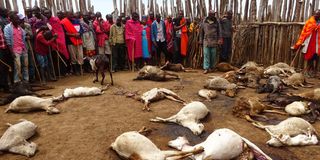
Enraged residents gathered at Mr Parmuat Kool sheep on November 22, 2016 after a hyena broke into the sheep enclosure and killed 50 sheep injuring more than six others.
For millions of Kenyans living at the edges of wildlife habitats, conflict with humans is a perennial threat, attributed to the loss of lives and millions of shillings in damages to infrastructure and agricultural resources.
While official statistics are scant and largely outdated, animal conservation groups estimate that between 200 and 400 Kenyans have lost their lives in encounters with rogue wildlife in the past decade. Many more have been injured or maimed, and the cost to livestock and farmland has been equally devastating.
Analysts point to climate change, with its residual effects of prolonged droughts and floods that have decimated wildlife resources and brought humans and wild animals ever closer together.
The Kenya Wildlife Service last month attributed flooding in the Rift Valley lake ecosystem to rising hippo attacks in the adjacent human settlements, while the drought months of May-June have stoked human-wildlife conflict from elephants and leopards among other animals around large game reserves and forests.
At the same time, compensation has traditionally been slow, in part owing to the cumbersome process of chasing payments that impoverished victims are often subject to, and the lengthy claims verification exercise by state agencies.
In the last financial year, President William Ruto and officials from the tourism and wildlife sector released Sh950 million in compensation payments for victims of human-wildlife conflict, with the government pledging to fast-track future disbursements.
Victims of human-wildlife conflict sometimes wait for years before receiving compensation from the state, and the government pledged to reduce this to a maximum of 90 days.
In the current financial year and into the medium term, the Treasury has further set aside millions of shillings to construct or rehabilitate tens of kilometres of fencing around game reserves, sanctuaries and forests.
While these and other initiatives by the private sector and conservationists are a step in the right direction, they do little to address the underlying causes and long-term impact of human-wildlife conflict.
According to data from the Kenya National Bureau of Statistics, recent wildlife conservation efforts have shown positive outcomes. The population of elephants, Mountain Bongo, Black Rhino and Southern White Rhino has risen significantly from 36,300 thousand in 2021 to 42,100,in 2025.
The endangered 0 populations reached 1,059 and 1,041, respectively, in the same period.
Such numbers ensure that Kenya’s globally renown and rich wildlife diversity is maintained and continues to reap billions in tourism revenue for the country. However, all stakeholders need to adopt a more deliberate and strategic effort to ensure that wildlife resources also benefit the communities living next to them.
In 2024, a parliamentary committee found that rising cases of elephant and leopard attacks around the Rimoi Game Reserve in Keiyo North Constituency for example were exacerbated by inadequate community engagement and awareness in existing wildlife management strategies.
While the community had surrendered their land to set up the game reserve to benefit both the local population and wildlife conservation efforts, these benefits were yet to bear fruit.
Without tangible benefits to the local communities, farmers and homeowners resort to snares, poison and retaliatory killings of rogue wildlife to safeguard their crops and livestock.
This response is however considered more detrimental to the ecosystem while doing little to protect the community from future cases of HWC.
Another strategy that is increasingly becoming popular and gaining traction is building community enterprise resources to create a socio-economic buffer between humans and wildlife in areas prone to conflict.
One such example is the Predator’s Den initiative by regional lender I&M Bank together with partner organisations including German development agency GIZ and the Maa Trust at the Maasai Mara National Reserve.
The Predators Den is a rolling initiative to identify and provide business support to entrepreneurs so they can better position themselves to earn a decent income from resources within their communities such as the Maasai Mara National Reserve.
In the first edition of the initiative, 115 entrepreneurs were taken through training in business planning and financial literacy out of which 20 were shortlisted to pitch their business plans to a group of judges for a chance to secure funding.
Initiatives like this help to bolster community enterprises and address a crucial catalyst for HWC; supporting enterprises linked to conservation and thereby provide an economic incentive for communities living around wildlife resources to safeguard the same.
Other initiatives have seen communities living in areas prone to elephant attacks set up bee-keeping ventures at the edges of their farms.
This capitalises on the elephants' aversion to bees and provides the community a viable economic opportunity in honey production.
According to data from the Kenya National Bureau of Statistics, KNBS recent wildlife conservation efforts have shown positive outcomes.
Kenya’s elephant population has risen significantly from 36,300 thousand in 2021 to 42,100 thousand in 2025.
Yvonne Nkirote is the Senior Communications Manager, I&M Bank