Hidden cost of waste in Africa’s food economy

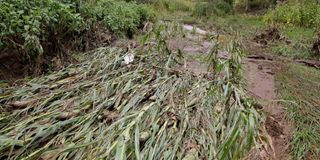
A section of a maize farm that was flooded following heavy rains that pounded in Elburgon, Nakuru County on September 09, 2023. 

Photo credit: File | Nation Media Group

Africa’s food economy is a cornerstone of the continent’s development and future prosperity.

The agri-food sector in Africa employs 65–70 percent of the workforce, supports the livelihoods of 90 percent of the population, and contributes about a quarter of the continent’s gross domestic product (GDP).

It drives exports from coffee to cocoa to fresh vegetables and keeps millions of small traders and processors in business, contributing to about a quarter of the continent’s GDP. Yet, beneath this vibrant picture lies a pressing challenge: a significant portion of the food we produce is lost or wasted.

Globally, the Food and Agriculture Organisation (FAO) estimates that one-third of food is lost or wasted. In Africa, where margins are thinner and hunger is widespread, the impact is more severe.

These losses diminish farmer incomes, drive up food prices for consumers, and drain billions of dollars from national economies each year. They also undermine Africa’s efforts to fight climate change because rotting food in fields, warehouses, and dumpsites significantly contributes to greenhouse gas emissions.

A new report by the World Resources Institute (WRI) highlights the scale of food loss in Kenya in compelling detail. The country loses up to nine million tonnes of food annually, valued at Sh72 billion ($578 million).

The biggest losses come from foods that form the backbone of Kenyan diets and exports: maize, potatoes, fruits, and fish.

The numbers are staggering: 20–36 percent of maize, 19–22 percent of potatoes, 17–56 percent of mangoes, 15–35 percent of avocados, and around 34 percent of fish in some regions.

In essence, a substantial share of the food meant to nourish Kenyans and support livelihoods is lost long before it reaches the table.

Kenya’s experience mirrors challenges the rest of the continent faces. Across Africa, similar patterns of food loss and waste are well documented.

In Nigeria, tomato farmers often watch truckloads of produce spoil before reaching Lagos, mainly because of poor roads, intense heat and lack of cold storage.

In Tanzania and Uganda, fishers face persistent challenges in preserving their catch due to inadequate ice and cold-chain infrastructure. These losses rarely make headlines, yet collectively they represent one of Africa’s most entrenched development failures – undermining food security, livelihoods and economic resilience.

The costs are often hidden, but they are enormous. For farmers, food loss can mean the difference between breaking even and falling into debt. A smallholder who loses a fifth of their maize to pests cannot recover the cost of fertiliser, let alone afford school fees for their children. For traders, discarding half a truck of mangoes means not only losing income, but also damaging trust with buyers. For governments, food shortages and rising food prices fuel public frustration and disrupt economic planning. And for ordinary families, wasted food translates directly into empty plates and persistent hunger.

Environmental costs of food loss compound the problem. Every tonne of food wasted means wasted water, land, fertiliser, fuel, and labour, resources that are already highly stretched. It also contributes to greenhouse gas emissions, as decomposing food releases methane, a potent climate pollutant.

According to the WRI report, if Kenya cut food loss and waste by half, it could reduce more than seven million tonnes of carbon emissions by 2030—equivalent to taking 1.5 million cars off the road for an entire year.

The tragedy is that solutions already exist, and they are not experimental. Many have been tested and proven effective. Hermetic storage bags protect grain from pests, ventilated crates reduce bruising of fruits, cold rooms preserve fish, and training on better harvesting and handling techniques have all delivered results in Kenya and beyond. The real challenge is scale.

Most farmers cannot afford these technologies independently, and markets rarely reward them for improved storage or quality. That is where government policy, finance and private sector investment must step in to bridge the gap and unlock impact at scale.

The WRI report points to what is possible. If Kenya halved its food loss and waste by 2030, it could feed seven million more people annually, inject Sh36 billion back into the economy, and build resilience against climate shocks.

Now imagine that across Africa: more food without expanding farmland, more income without increasing debt, and lower emissions without slowing growth.

 Dr Mbeche  is the Director of the Food Programme at World Resources Institute Africa.

PAYE Tax Calculator

Note: The results are not exact but very close to the actual.