Time flies with great content! Renew in to keep enjoying all our premium content.
Prime
Here’s what really ails Nairobi Hospital
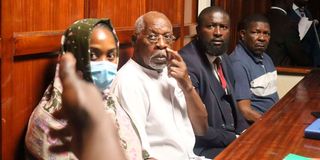
Directors of The Nairobi Hospital from left, Dr Valerie Akinyi Gaya, Dr Samson Mbuthia Kinyanjui, Dr Job Lukuru Obwaka and Dr Chris Bichage Nyamaratandi appear at the Milimani Law Courts on March 16, 2026, where they were charged with conflict of interest and receiving benefits amounting to more than Sh8 million.
The most powerful headline number from Nairobi Hospital's latest financial and operational performance is that the net deficit has narrowed by nearly 63 percent in just one year.
Crucially, this happened despite a major headwind: the temporary insurance suspension between August and November 2025, which alone caused Sh527 million of that deficit. Strip that out, and the underlying governance deficit was only Sh283 million, a fraction of where the hospital was.
But the strongest signal of structural recovery is operational demand, not just accounting. When you look at key metrics such as admissions, bed occupancy, radiology, pharmacy, lab tests, and oncology volumes, what you see is steady growth.
On the debt situation: the hospital is actively paying its creditors. Outstanding payables were reduced by Sh234 million between December 2025 and March 2026, dropping from Sh1.95 billion to Sh1.716 billion. This shows the hospital is not just generating income, it is deploying it responsibly to repair its balance sheet.
It also holds a diversified portfolio including government treasury bonds yielding 13.44 percent coupon rates and bank deposits totalling Sh1.349 billion, giving it both resilience and an income stream to buffer against future shocks.
So, what is all the noise about?
In the cacophony of claims and counter-claims playing out at Nairobi Hospital today, it is hard to separate truth from fiction. You only get to the bottom when you strip away personalities and look at the major pressure points, interests, and power blocs. The fights are not random, they reflect competing networks trying to control a high-value, high-prestige institution.
Three factions are worth mapping out. The first are the governance purists, mostly doctors who are long-time members of the Kenya Hospital Association (KHA) and the Admitting Staff Association. When you engage them, you discern largely altruistic motives. They want to limit external, especially political, interference and to strengthen clinical autonomy. What they fear most is that the hospital is being turned into a politically captured asset.
The second faction are well-connected businessmen with links to the state , powerbrokers operating largely behind the scenes. Their interests are strategic: procurement, financing decisions, and the prestige that comes with association to a premier institution. Though rarely articulated in public, it is an open secret that one of the bitterest controversies pitting the board into hostile camps involves the procurement of a multimillion-shilling hospital management ICT system.
The third category are the activists, ordinary KHA members who form the swing force at Annual General Meetings (AGM) and often decide the outcomes of AGMs, special general meetings, and board removals.
The resignations, board fights, and court cases you are seeing are the points where these bloc interests intersect and clash. Currently, the group in the driving seat is the well-connected businessmen with strong ties to government and access to the levers of power at State House and the Ministry of Health.
In other circumstances, the government would have chosen to consult more broadly and engaged with a body carrying a genuine mandate, such as the Admitting Staff Association, instead of acting on representations made by a loosely convened group calling itself "senior doctors." On whose mandate were these senior doctors acting?
The biggest danger right now, however, is not that one faction is winning. It is that this unnecessary, ego-driven fight between self-absorbed elites threatens to precipitate a governance paralysis in an institution of genuine national importance. Nairobi Hospital faces real risks: reputational damage, strategic drift, and the loss of clinical talent. Compounding everything is a torrent of alternative facts. A claim is made, repeated, and soon treated as truth.
Let us be clear: Nairobi Hospital is not for sale. It is a member-owned institution governed by an elected board — no different in structure from Muthaiga Golf Club, Nairobi Club, or Impala Club. You cannot simply "buy" such an entity.
The government should butt out and let the hospital be governed under its own articles and memorandum of association. If crimes have been committed, let them be investigated and prosecuted transparently. If the problem is the integrity of the membership register, the debate should focus on how to clean it up.
Instead, what we have seen is the State imposing nominees onto the board, creating two hostile camps, and, predictably, stories of doctors being summoned to high offices and intimidated into resigning. From there, the propaganda wrote itself: invoke the President's name, manufacture a takeover narrative, and muddy the waters.
There is no takeover. What exists is a power struggle, nothing more.
The governance of Nairobi Hospital is now ripe for disruption. Not through political intrigue or manufactured narratives, but through deliberate, credible reform. The real battle is not about ownership. It is about control, integrity, and the future of one of Kenya's most important healthcare institutions.
Unlock a world of exclusive content today!Unlock a world of exclusive content today!