President William Ruto's announcement of a Sh5 billion livestock investment initiative targeting 21 arid and semi-arid counties gives the sector a new impetus.
The money will seed establishment of County Livestock Investment Companies, enabling pastoralists to form and own production firms. Similar to tea factories, the companies will give herders greater control over marketing, financing, insurance and value-addition opportunities.
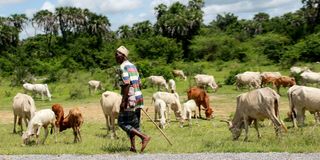
This will be good news for the more then eight million Kenyans whose livelihood is based on pastoralism. Madaraka Day celebrations at Wajir was the perfect backdrop for government to formally apologise for regional marginalisation of yesteryears, and to back it with concrete support to the livestock sector.
As the Constitution of Kenya 2010 was crafted, resolving the marginalisation question was a regular debate in corridors of the 10th parliament. Many intellectuals saw it as the primary driver of the political upheaval surrounding the 2007 General Election results. Devolution and the equalisation fund were in part, remedies.
The intellectuals, such as my friend Ekwee Ethuro, who later become speaker of the Senate, argued that because the promised redistribution – the gains from focusing in high potential areas were to be used to develop the low potential ones - never happened, the unintended consequence of Sessional Paper No. 10 of 1965 was to make marginalisation official policy. Further, the definition of potential was fatally flawed.
To support their arguments, my sparring partners compared the outcomes in the tea and livestock sectors. By 2010, Kenya Tea Development Agency (KTDA) had enabled small scale tea farmers to own 54 tea processing factories. In solving the aggregation problem, it enabled them become global leaders in tea production.
Until now, there has been no equivalent effort for the livestock industry. The Kenya Meat Commission (KMC) inherited from the colonials, has struggled in most years. However, recent government interventions have yielded some early results. Kenya's meat exports have risen by 84 per cent, increasing from Sh8.9 billion in 2022 to Sh16.4 billion in 2025.
The pre-dominant red meat production system is pastoralism, where animals move in search of pasture.
A few counties such as Laikipia and Taita Taveta have large scale ranches. Mini feedlots (up to 200 animals), where animals are fattened over an intensive three to four-month period are increasingly popular.
Looking ahead, government has promised expanded livestock restocking programmes, enhanced vaccination campaigns, improved breeding initiatives, support feedlots and stronger drought resilience measures.
In addition, there is a pledge to effect the Livestock Enterprise Development Fund, and establish a National Strategic Fodder Reserve.
Government is already implementing the De-Risking, Inclusion and Value Enhancement programme. The program is offering index-based fodder insurance through ZEP-RE. In addition, the Kenya Development Corporation is using investment funds from the programme to finance private sector projects in the livestock value chain.
With the President’s announcement, the talk of an even bigger programme is moving to action. The fine details of the new initiative remain scanty. However, the key element appears to be the anchor enterprises owned by tens of thousands of pastoralists, run by a management agent that they also own.
The estimated marketed value of livestock was Sh286 billion in 2024, making it a key economic sector. This is farm gate value of the cattle (2.24 million), and sheep and goats (10.7 million), slaughtered that year. The leather value chain added another Sh203 billion in the same year.
Businesses are based on property rights. An asset qualifies as such because its ownership is defined, and it creates cashflow. How to identify livestock and therefore recognise the property rights is established by the Branding of Stock Act.
Enacted in 1907, the law has been amended several times over the last century, but is needs urgent updating and modernisation. This important law creates a livestock property registry. Properly used, the registry will unlock the full potential of livestock as valuable assets.
For instance, in the collateral registry at the Business Registration Service (BRS), livestock is the fourth most commonly used movable asset to secure credit. In addition, high-end fashion houses which produce leather articles are now demanding traceability of the raw material, a prospect now made possible by technology. Apps such as Anitrac and Flockr, make this possible.
Flockr, built by Craft Silicon and Ranch Experts, provides an all-inclusive digital marketplace for livestock, products and services. It also has a web-based app for modern livestock production under feedlot conditions. Anitrac is government driven, digital livestock registry.
Ndiritu Muriithi is an economist and partner at Ecocapp Capital. He is also the chairman of KRA and former governor of Laikipia County. Email: [email protected]
Unlock a world of exclusive content today!Unlock a world of exclusive content today!