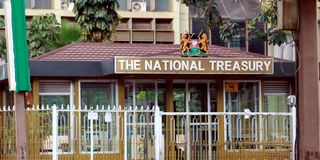
Holders of domestic bonds, including commercial banks, insurance firms, pension funds and households, will earn nearly Sh1 trillion in interest in the financial year starting July 1, highlighting the impact of local borrowing on taxpayers.
Debt service on domestic debt is set to rise by Sh103 billion, reaching Sh986.7 billion in the financial year ending June 30, 2027, from Sh883.7 billion in the current fiscal year.
Interest on internal debt has risen in tandem with the State’s increasing reliance on domestic borrowing to plug the annual budget deficit as access to external financing remains volatile.
Domestic interest payments are projected to hit a record Sh1 trillion in the financial year starting July 1, 2028, as internal borrowing remains prevalent.
Domestic interest payments have trended upwards, rising from Sh622.5 billion in the 2023/24 cycle to Sh784.1 billion in FY 2024/25.
The National Treasury estimates domestic debt service at Sh883.7 billion in the current fiscal cycle to June 30.
The rise in domestic debt service for the financial year starting July 1 comes amid an escalation in borrowing, which is set to contribute 81.8 percent of deficit financing.
“Fiscal deficit including grants for the FY2025/26 is therefore projected at Sh1.22 trillion, up from Sh901 billion, and will be financed by net external financing of Sh225.8 billion and Sh998.6 billion in net domestic financing,” the Treasury said.
Investor gains
The Treasury primarily borrows through Treasury bonds in the domestic market, although a smaller share is held in short-dated Treasury bills.
Financial corporations, including commercial banks, pension funds and insurance companies, hold the bulk of government domestic debt at 79.9 percent as of April 24, 2026, making them the largest beneficiaries of the increased interest payout.
Households hold 6.3 percent, followed by non-residents at 4.3 percent, non-financial corporations at 1.6 percent and non-profit institutions at one percent.
Total domestic debt stood at Sh6.8 trillion at the end of January 2026, exceeding external debt of Sh5.5 trillion.
The outsized domestic debt stock is expected to keep pushing up debt service costs even as the Treasury anticipates some relief from falling interest rates.
“Short-term interest rates declined in line with easing monetary policy, with the 91-day Treasury bill rate falling to 7.8 percent from 10.3 percent as of December 2025,” the Treasury said in its latest quarterly economic and budget report.
“Similarly, the 182-day Treasury bill rate declined to 7.8 percent in December 2025 from 10.4 percent previously, while the 364-day Treasury bill rate fell to 9.3 percent from 11.8 percent over the same period.
The decline in interest rates on the government’s short-term borrowing instruments has led to lower domestic borrowing rates, thereby contributing to a reduction in government debt-servicing costs.”
Funding pressure
The government is expected to rely on domestic borrowing over the medium term, with the share of internal funding set at 72 percent against 28 percent for external financing.
Access to external financing has been volatile amid global shocks, which have increased the pricing of instruments in international capital markets such as Eurobonds.
Concessional financing from multilateral lenders such as the World Bank and the International Monetary Fund (IMF) has also been limited as Kenya struggles to meet key conditions such as revenue targets and debt sustainability.
Kenya did not receive financing from the World Bank and the IMF in the 2025 calendar year, resulting in a squeeze that saw the government double down on domestic borrowing to plug the fiscal deficit.