Diaspora remittances lose steam on Iran war fallout

Diaspora remittances remain one of Kenya's largest and most reliable sources of foreign exchange, supporting household consumption, education, healthcare, housing and small business investment while helping finance imports and underpin the shilling.

Photo credit: Pool

Kenyans living and working abroad cut the amount of money sent back home by $29.1 million (about Sh3.77 billion) in the first five months of 2026, marking the first drop since 2023.

Official numbers captured by the Central Bank of Kenya show diaspora remittances fell to $2.066 billion between January and May from $2.095 billion over the same period last year, ending two consecutive years of growth.

The 1.39 percent drop suggests Kenya's diaspora earnings are beginning to feel the strain of a more challenging global economy, including the effects of the war in the Middle East, after proving resilient through recent years of uncertainty.

The latest downturn mirrors the 2023 decline, when remittances in the review period contracted 1.8 percent as elevated global inflation, driven by post-pandemic supply chain disruptions and higher food and energy prices, eroded the purchasing power of migrant workers.

The United States, Kenya's largest remittance source, has accounted for the biggest drag on overall inflows in the opening months of this year.

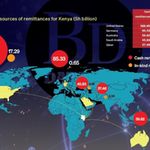
The CBK data shows Kenyans in the US slashed the cash they wired back home by 8.4 percent to $813.6 million (Sh105.36 billion) in four months to April from $888.4 million (Sh115.05 billion) a year earlier, reducing inflows by $74.8 million (about Sh9.69 billion).

The decline is significant because the US accounts for more than half of Kenya's annual diaspora remittances, making changes in migrants' earnings and household budgets there critical to overall inflows.

Saudi Arabia recorded the second-largest decline among Kenya's major remittance markets in the four months—the latest period with official data on diaspora remittances by sources.

Transfers from the kingdom fell 24.8 percent to $88.7 million (Sh1.49 billion) from $117.9 million (Sh15.27 billion), cutting inflows by $29.2 million (Sh3.78 billion) as labour market adjustments and slower economic activity weighed on migrant workers.

Saudi Arabia has also been tightening labour market policies aimed at increasing the employment of citizens, creating a more competitive environment for foreign workers, including thousands of Kenyans.

Germany, which has a deal with Kenya for recruitment of skilled and semi-skilled workers, also posted weaker inflows, with remittances declining 15.5 percent to $41.3 million (Sh5.35 billion), although its relatively small share limited the impact on Kenya's aggregate receipts.

The losses were partly offset by stronger inflows from the United Kingdom and Australia.

Remittances from the UK rebounded 26.9 percent to $133.3 million (about Sh17.26 billion), reversing last year's decline, while Australia extended its rapid growth, with inflows rising 19.7 percent to $88 million (Sh11.4 billion).

The gains were, however, insufficient to offset the steep declines from the US and Saudi Arabia, resulting in Kenya's first overall remittance contraction in two years.

The slowdown came as the CBK warned that the Middle East conflict was fuelling inflation and slowing global economic growth, squeezing household budgets in countries hosting large Kenyan diaspora communities.

“The conflict in the Middle East has disrupted global supply chains and led to a sharp increase in prices and transportation costs, resulting in higher inflation and moderated global growth,” the CBK's Monetary Policy Committee said after leaving the benchmark lending rate unchanged at 8.75 percent on June 9.

The committee raised its global inflation forecast for 2026 to 4.4 percent from 3.8 percent, saying higher energy prices linked to the conflict had prompted major central banks to keep interest rates unchanged as they assessed risks to inflation and economic growth.

The inflationary pressures are expected to reduce disposable incomes among migrant workers, limiting the amount of money available to support relatives back home.

“Headline inflation for the US, Eurozone and China has increased whereas the UK headline inflation has declined partly as a result of lower electricity and gas prices,” CBK Governor Kamau Thugge told reporters in Nairobi on June 10, quoting figures for May.

The latest downturn follows a strong recovery after 2023, when remittances rebounded 19 percent in 2024 before growth slowed to 4.4 percent in 2025.

Diaspora remittances remain one of Kenya's largest and most reliable sources of foreign exchange, supporting household consumption, education, healthcare, housing and small business investment while helping finance imports and underpin the shilling.

Unlike portfolio investment and commercial borrowing, remittances have historically proved resilient during economic downturns because they are driven largely by family obligations rather than investor sentiment.

The latest figures, however, underline that Kenya's most dependable external income stream is becoming increasingly vulnerable to geopolitical shocks that weaken economic growth and raise living costs in countries employing large numbers of Kenyan migrants.

Follow our WhatsApp channel for the latest business and markets updates

PAYE Tax Calculator

Note: The results are not exact but very close to the actual.