Time flies with great content! Renew in to keep enjoying all our premium content.
Prime
India imports cross Sh100bn-mark in three months as China tightens grip
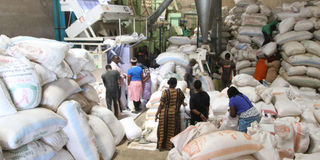
Farmers mill their rice at Golden Grain Rice Millers in Mwea on December 18, 2025, highlighting the growing role of private mills in improving market access and value addition for local rice farmers.
Imports from India crossed the Sh100 billion mark for the first time in the opening quarter of a year, underlining the growing influence of the South Asian nation as a source of goods for Kenya.
Data from the Kenya National Bureau of Statistics (KNBS) shows that imports from India rose by 52.6 percent to Sh102.5 billion in the three months to March, from Sh67.2 billion in the same period last year.
The jump made India Kenya’s second-largest source market for goods after China and the fastest-growing among Nairobi’s major trading partners, adding Sh35.4 billion worth of exports to the local market compared to the first quarter of 2025.
The latest provisional numbers, based on customs records as captured by the Kenya Revenue Authority, show India accounted for 13.8 percent of Kenya’s total imports of Sh740.8 billion in the first quarter, expanding from 10.4 percent a year earlier.
Kenya’s key purchases from India include pharmaceutical products, rice and refined petroleum fuels.
India is a major source of semi-milled and wholly milled rice consumed locally, medicines used in hospitals and pharmacies, and premium motor spirit sold at filling stations as the country serves as a strategic loading zone whenever there are disruptions in the Middle East.
The composition of imports points to India’s growing importance in sectors tied to food security, healthcare and energy, making it one of Kenya’s strategic trading partners.
The data shows India leapfrogged the United Arab Emirates, with only China supplying more goods to Kenya during the quarter.
Imports from China rose by 29.2 percent to Sh192 billion, reinforcing the Asian giant’s grip on the Kenyan market and extending its lead over all other trading partners.
China accounted for 25.9 percent of Kenya’s total imports of Sh740.8 billion during the quarter, meaning that roughly one shilling out of every four spent on the purchase of goods from abroad went to Chinese suppliers.
China’s dominance is underpinned by its position as a key provider of industrial machinery, construction materials and telecommunications equipment such as smartphones that support Kenya’s infrastructure, manufacturing, construction and digital economy.
Some of Kenya’s leading imports from China include crushing and grinding machinery used in mining, quarrying and construction activities, hot-rolled steel products used across the building sector, and telecommunications equipment used in the transmission and routing of voice and data services.
The KNBS numbers reveal an increasingly concentrated import structure in which China and India occupy a commanding position.
Combined imports from the two countries stood at Sh294.5 billion in the first quarter, equivalent to 39.8 percent of Kenya’s total import bill.
In practical terms, nearly Sh4 out of every Sh10 Kenya spent on imported goods during the quarter flowed to suppliers in either China or India.
The growing influence of the two countries has cemented Kenya’s trade tilt towards Asia, which has become the principal source of manufactured goods, industrial inputs, pharmaceuticals, fuel products and consumer merchandise.
China’s dominance has strengthened steadily in recent years. Beijing’s share of Kenya’s import market has risen from 18.6 percent in the first quarter of 2024 to 22.9 percent in the same period last year before climbing to 25.9 percent this year.
India has also expanded its footprint, with its share of imports increasing from 10.6 percent in the first quarter of 2024 to 13.8 percent this year, reflecting stronger demand for Indian products and deeper trade ties between Nairobi and New Delhi.
India’s rise mirrors its growing status as a global manufacturing and refining hub that supplies competitively priced products ranging from medicines and agricultural commodities to petroleum products and industrial raw materials.
Apart from China and India, Saudi Arabia emerged as another major beneficiary of Kenya’s import demand. Imports from the kingdom surged by 158.5 percent to Sh49.4 billion, lifting its share of Kenya’s import market to 6.7 percent from 3.0 percent a year earlier.
In contrast, imports from the United Arab Emirates fell by 20.9 percent to Sh72.9 billion. The reduced share of UAE is in part tied to disruptions at Abu Dhabi National Oil Company (ADNOC), a major player in Kenya’s government-to-government (G2G) fuel supply arrangement, whose refinery was among the first oil facilities in the Gulf to be hit by Iranian drones.
The KNBS data shows purchases from the United States also dropped by 34 percent to Sh23.1 billion, reducing America’s share of Kenya’s import bill to 3.1 percent. Imports from Japan grew modestly by 3.7 percent to Sh32.1 billion.