China and Ukraine pay highest price for Kenyan coffee

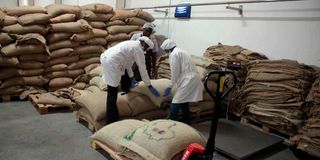
Staff at African Coffee Roasters industry in Export Processing Zone Athi River on July 26, 2018.

Photo credit: File | Nation Media Group

China and Ukraine paid the highest average price for Kenyan coffee sold directly to buyers abroad in the quarter to March 2026, toppling Singapore and Hungary in a fresh shift that signals opportunities for local producers targeting premium markets.

Kenyan coffee, which is much sought-after by roasters and blenders, is marketed either through the weekly Nairobi Coffee Exchange (NCE) or sold directly to buyers abroad. The bulk of Kenya’s coffee is marketed through the NCE.
Analysis of fresh data by the Agriculture and Food Authority (AFA) on Kenyan coffee directly sold abroad showed that China paid the highest average price of $646.07(Sh83,601.45) per 50kilogramme bag over the three months to March 2026, followed by Ukraine ($598.18 or Sh77,404.49), Australia ($597.63 or Sh77,333.32) and Hungary ($578.49 or Sh74,856.60).

The premium prices by China signal an opportunity for Kenyan coffee producers even as the giant Asian market continues to woo agricultural imports through preferential deals.

China is presently recording a significant surge in demand for coffee imports, fueled by growing urban consumption, a zero-tariff arrangement and a booming café culture. The zero-tariff framework, which took effect on May 1, 2026, eliminated import duties on diverse imports of tea, coffee, avocados and macadamia nuts from Africa.

According to China’s General Administration of Customs, Beijing will also allow qualified coffee bean imports from 53 African countries starting July 20, 2026, under a unified continental framework, replacing country-by-country approval processes.

“Somalia recorded the lowest average price at $250(Sh32,350) per bag. Premium markets in Asia and Eastern Europe continued to offer attractive prices for speciality Kenyan coffees, despite their small volume shares,” the regulator said.

During the quarter to March 2026, direct sales were heavily concentrated in Switzerland and the United Kingdom, representing 50.2 percent and 44.6 percent of the total volume, together accounting for nearly 95percent of total volume.

Records show that the Kenyan coffee directly sold to markets abroad in the quarter to March 2026 was mainly dominated by three central Kenya counties: Kirinyaga, Kiambu and Murang'a, representing 52.7 percent, 16.9 percent and 12.3 percent of the total volume, respectively, and jointly accounting for over 82 percent of the total volume.

Kirinyaga directly exported 1,678,770.80kg in the quarter at an average price of $408.27(Sh52,830.13), fetching growers Sh1.77billion ($13,707,909.04). Kiambu directly exported 538,225kg at an average price of Sh54,069.79($417.85) per bag, fetching Sh582.03million ($4,497,920.76), while Murang’a netted Sh423.30million ($3,271,304.70) from the sale of 392,941kg averagely priced at Sh53,864.04($416.26) per bag.

“Among smaller-volume coffee-producing counties that had the highest average prices were Embu, Migori and Nandi,” AFA said.
During the quarter, direct sales amounted to 3.19 million Kg valued at Sh3.42billion ($26.45million). 

Kenya’s coffee calendar runs on two distinct harvests. The main crop, which produces the bulk of the country’s premium beans, is picked between October and December before heading to the NCE for auction from January to April.

Mid-year, farmers turn to the fly crop, a smaller but still significant harvest gathered between June and August and traded at the exchange from August to October.

Together, the dual seasons keep Kenyan coffee flowing to international buyers almost year-round, sustaining the country’s reputation for high-quality Arabica.

Follow our WhatsApp channelfor the latest business and markets updates.

PAYE Tax Calculator

Note: The results are not exact but very close to the actual.