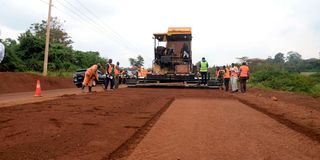
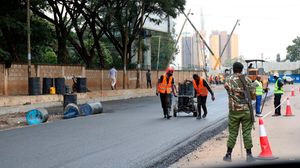
The Kenya Roads Board (KRB) has trimmed its roads bond target to Sh120 billion from Sh175 billion, revealing a reduced quantum of funding to reimburse bank loans taken to compensate contractors for pending bills.
The National Assembly Committee on Transport has revealed the reduced roads bond target but has not disclosed timelines for the floating of the securitised instrument.
The KRB had been expected to raise Sh175 billion from a bond by the first quarter of 2026, to repay commercial bank loans, which were obtained as a bridge facility to fast-track the clearance of road sector pending bills.
The government has turned to securitisation to clear the significant pile of unpaid funds to contractors amid a fiscal straitjacket, which has seen the majority of tax revenues channelled to debt service.
“The committee noted that the securitisation process supported by the Sh5 per litre from the fuel levy has commenced,” the Budget and Appropriation Committee observed, referencing submissions by its Transport counterpart, in a report considering the final 2026-27 budget estimates.
“Once the bond is floated, it is expected to mobilise approximately Sh120 billion.”
The committee did not give the timelines for the bond, while the National Treasury also failed to disclose timelines for the paper’s issuance from recent enquiries by this publication.
President William Ruto, in March, said the government planned to sell the bond to the public and list the securities on the Nairobi Securities Exchange (NSE).
The KRB had previously proposed to mobilise funds for the bond from investment clubs.
Proceeds from the bond will settle a portion of an estimated Sh175 billion in bank loans, which helped clear historical road sector pending bills up to December 2024.
Investors in the bond are to receive payments from the securitised Road Maintenance Levy Fund (RMLF), where Sh7 of every Sh25 from the sale of a litre of petrol and diesel is hived off.
“In the course of this year, we will be bringing to the market the road maintenance levy fund securitisation bond, which has enabled us to settle the pending bills crisis that had stalled road projects everywhere in Kenya,” President Ruto said in March.
“The RMLF has raised for us Sh175 billion, and we will be bringing it here (to the Nairobi Securities Exchange) so people can trade it as well.”
President Ruto also failed to set a date for the bond’s issuance.
Four commercial banks, including the Trade and Development Bank, KCB Bank Kenya, Absa Bank Kenya and UBA Kenya Bank, provided financing to clear the contractors’ arrears ahead of the issuance of the roads bond programme.
The Sh175 billion bond was to be the first of two, with the government mulling a second paper to raise Sh125 billion to cover future arrears to contractors in the sector.
The Cabinet approved the setting aside of Sh12 from the Road Maintenance Levy Fund (per sale of a litre of petrol or diesel) to facilitate payments to investors in the two bonds.
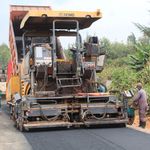
The settlement of road sector pending bills has enabled contractors to resume works, contributing to the rebound of the construction sector in 2025.
The construction industry grew by 6.8 percent in 2025, recovering from a 0.7 percent contraction in 2024 as per data from the Kenya National Bureau of Statistics (KNBS).
“Cement consumption increased by 20.3 percent to 10,300 tonnes. The length of paved roads stood at 25,400 kilometres in 2025, while residential housing units completed by the State Department for Housing and Urban Development more than quadrupled, from 1,655 units in 2024 to 6,738 units in 2025,” the KNBS said in its 2026 Economic Survey report.
The National Assembly has pushed for powers to inspect the securitisation of government revenues as the State leverages the innovation as a new avenue for projects’ cash.
Securitisation refers to the ring-fencing of specific revenue streams to pay lenders funding various government projects, with the money acting as collateral.
The Public Debt and Privatisation Committee has previously warned that the reliance on alternative funding approaches may create additional debt risks while hiding shortfalls in the availability of mainstream financing, like external debt.
The International Monetary Fund, meanwhile, wants Kenya to include funds raised from securitisation as part of the public debt stock.
The stock of national government pending bills stood at Sh471.7 billion in March 2026, rising slightly from Sh468.5 billion in December 2025.
Kenya plans to further securitise the yearly Sh32 billion Railway Development Levy Fund to help fund the extension of the standard gauge railway from Naivasha to Kisumu, and onwards to Malaba on the border with Uganda.