KPC now sixth largest NSE firm after listing

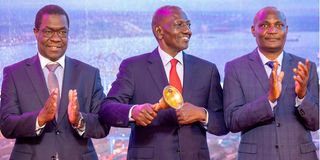
President William Ruto rings (centre) the bell to mark the start of share trading for the Kenya Pipeline Company IPO at the Nairobi Securities Exchange. With him is National Treasury Cabinet Secretary John Mbadi (right) and Energy Cabinet Secretary Opiyo Wandayi.

Photo credit: File | Nation Media Group

Kenya Pipeline Company Plc (KPC) is now the sixth largest firm at the Nairobi bourse after its share traded marginally higher on the firm’s stock market debut on Tuesday, giving options to investors keen on blue chip companies.

The stock closed trading on Tuesday at Sh9.18 a piece, compared to the initial public offering (IPO) price of Sh9 per share, valuing the firm at Sh166.8 billion.
This made it the sixth largest company at the Nairobi Securities Exchange (NSE) behind Safaricom at Sh1.19 trillion, Equity Group (Sh279.2 billion), KCB Group (Sh250.6 billion), EABL (Sh201.6 billion) and Co-operative Bank of Kenya (Sh173.1 billion).

The Kenyan government sold a 65 percent stake in the pipeline company, raising Sh106.3 billion in what made the transaction country's first major IPO in nearly two decades. Foreigners, local retail investors and oil marketers shied away from the oversubscribed IPO that was saved by Uganda and local institutional investors.

Analysts reckons that the KPC share price movement was marginally because the bulk of stocks are held by institutional investors.

Previous IPOs including Safaricom saw greater price volatility on the first day of trading owing to the larger numbers of retail investors who participated in the shares offer. KPC however attracted just 73,000 retail investors who took up 2.56 percent or Sh4.1 billion worth of shares against their allocation of Sh21.2 billion.

Local institutional investors splashed Sh67 billion on the offer, surpassing their allocation of Sh21.1 billion by 216 percent.

“Investors waiting for the share to fall to say Sh6 will have to wait for a long-time. Mark my words. That dream is gone,” Kenne Belgrade, the lead transaction advisor for the IPO from Faida Investment Bank said in an interview last week.

“Institutional investors buy and hold shares for a long time. Without a big pool of retail investors, we expect little volatility in the traded price. We expect stability and maybe even a rally in the share price.”

The counter traded 2.08 million units of shares during its first trading session, ranking KPC in sixth position by volume after Kenya Airways (KQ), Equity Group, KCB Group, Safaricom Plc and Eveready East Africa.

Investor bids for the shares ranged from Sh8.66 to Sh9.50 while sellers were asking for between Sh9 and Sh9.60 for their units.The addition of KPC to the Nairobi bourse will increase options for investors who largely favour trading in large cap stocks.

Market concentration by the top five companies by value (as a share of total market turnover) averaged 66.42 percent in the quarter to December 2025 as per data from the Capital Markets Authority (CMA).The five firms include Safaricom, Equity Group, KCB Group, EABL and NCBA.

Foreigners and high-net worth investors are attracted to the counters because of the steady dividend payouts and ease of exit and entry.A concentration surpassing 50 percent is deemed as high.

“This quarter (Q4 2025) trading activity became increasingly dominated by a few large-cap counters, mainly Safaricom and major banking stocks,” CMA said in its quarterly market soundness report.

Lower valuations by some banks, an extension of the offer period and reports that investors were apathetic shadowed the IPO in Kenya’s first big deal since the sale of Safaricom shares in 2008. The government has said it will use Sh15 to 20 billion of the proceeds ⁠from the IPO to expand the Jomo Kenyatta International Airport (JKIA).

KPC’s expected reduction in its dividend payout ratio and future capital expenditure commitments (Capex), including laying a new pipeline between Mombasa and Nairobi led to investor scrutiny of the offer.

But 465 local institutional investors led by National Social Security Fund (NSSF) and the Public Service Superannuation Fund (PSSF) and Uganda’s State-owned oil company, Uganda National Oil Company (UNOC), snapped up the shares that other categories of investors had left on the table.

Without a strong showing from Uganda and the few high-net-worth investors, the IPO would have collapsed and hurt the State’s drive to diversify its sources of revenue from taxes and public debt.

The IPO needed to raise at least Sh53.1 billion from more than 250 investors for it to proceed.Uganda, under the East Africa category, bought shares worth Sh34.7 billion against their allocation of Sh21.2 billion.Local institutional investors splashed Sh67 billion on the offer, surpassing their allocation of Sh21.1 billion by 216 percent.

Employees of KPC bought shares worth Sh98.1 million against an allocation of Sh5.3 billion. But they bought more shares than foreigners and the oil marketers.

KPC’s expected reduction in its dividend payout ratio and future capital expenditure commitments (Capex), including laying a new pipeline between Mombasa and Nairobi, led to investor scrutiny of the offer.

KPC share sale offer documents show the firm will reduce its average dividend payout from 94.5 percent of profits to 50 percent.

Analysts at Standard Investment Bank (SIB) issued a buy recommendation to investors with a long horizon on KPC, arguing that there was less attraction for short-term-oriented investors.

Burdened by high national debt, limited room to raise taxes and annual loan repayments that consume 40 percent of government revenues, the State has sought new funding models, including divestiture from state companies.

Follow our WhatsApp channel for the latest business and markets updates.

PAYE Tax Calculator

Note: The results are not exact but very close to the actual.