Don’t sweat the small stuff, Newton Siele, the CEO of Phillips Therapeutics, will tell you. “And it’s all small stuff.” That’s his prescription for life. He is turning 50, and while it’s a fallacy to denote age with wisdom, in Siele’s case, he’s been there. Done that. “What have I not seen?” he says.
He’s seen a lot, that’s for sure, all recorded under leadership and fatherhood roles, as his own life was recorded on the greying stubble on his face. He’s read 100 books, written one, and you can hear it because after he speaks, you are a year older and a touch tougher. He is a poet that way.
He wants to be proud of his eulogy, he says, out from behind the tombstone of his thoughts. He is enjoying where he is now, what he’s built, thinking about whatever the end of his life might mean.
[chuckles] My morning is okay. I’m used to starting early, so normally I am in the office by 7am.
Why?
I think it’s a habit. It structures my day before the many other agendas come.
You wake up and come here?
That’s what I usually do. But I read a lot. I founded a book club 10 years ago, and it has really grown. Now we have about 700 members, and we’ve read about 100 books purely on leadership and management.
I think people in the book club are often lazy readers. At the beginning of a new book, we put up four books and vote for what people want to read, and that’s what we start with. This April, we are reading “Strengths-Based Leadership” by Tom Rath and Barry Conchie.
What’s the most audacious book you’ve read?
“Don't Sweat the Small Stuff and It's All Small Stuff” by Richard Carlson. Until you've read the book, you don’t realise the practicality that Carlson talks about in everyday things. A lot of people sweat a lot of everyday stuff that they shouldn’t. We've also read a book on brain health, which was an outlier because it looks at the relationship between what you eat and your brain health, which subsequently impacts your performance.
(George) Orwell said that the best books are those that tell you what you know. What would that book be for you?
“The Seven Habits of Highly Effective People” by Stephen R. Covey. It led me to pursue certification as an emotional intelligence coach. I first read the book in 2007 when I was just a young sales rep, and later, while doing a course on Seven Habits and then getting certified as an EI [emotional intelligent] practitioner, I now realise why that book is one of the most highly recommended in self-growth and management.
From those seven habits, which is the most prevalent and the one you struggle with the most?
Habit number two, which is beginning with the end in mind. Most people don’t realise the mortality we live with and where we want the end to be, and what we should be doing now. When you wake up and realise that you need to have clarity about the end in mind, it helps you to structure. And of course, the last one, which is habit number seven, sharpen the soul. The one thing that helps me to stay focused is knowing that you never know everything.
Is it safe to assume you also read “The 8th Habit” [also by Stephen R. Covey]?
I have. It didn't resonate as much with me, but I understood, because Covey talks a lot more about his son. I appreciate the book, but maybe not as much as the seven habits.
People talk about writer's block, but what do you struggle with as a reader?
Balance, life balance. When I started as a sales rep in 1999, there was hardly any connectivity. The moment you left the office, there was hardly any reason why anybody would look for you. Nowadays, the office is with you in your mobile phone and laptop. It feels like we are always working.
Everyone is “locked in”...
Yes, actually, one of the best books we ever read as a book club is “Switch Off” by Prof Mark Cropley. And I didn’t even know that there’s a whole degree that is taught on how to switch off. [chuckles]
Have you transferred the same reading culture to your children?
I would say yes. My son is reading “The 48 Laws of Power” by Robert Greene, which is not easy, because he has to juggle between the balance of technology. But they know about the book club, and they appreciate it.
“The 48 Laws of Power” is an interesting choice. How did he land there?
He’s in Year 10, and reading the book is among the challenges he has given himself this holiday. I’m looking forward to hearing him tell me what he has learnt. My other son is reading “The 7 Habits of Highly Effective Teens” by Sean Covey.
If you were to recommend a book to your children to shape their career or life, which one would that be?
“The 7 Habits”, but there’s one book that we’ve also done by John C. Maxwell, which is called “Failing Forward”. The book brought in a very interesting perspective about appreciating failure, not in the context of being afraid, but looking at what you can learn. Most of us grew up in an education system where, if you are not seen to be performing, you are perceived to have failed. And that gets ingrained in people so much that they tend to measure life as either failure or success.
What has reading taken from you, and what have you taken from reading?
I think I am who I am because of reading. If I weren’t reading, I don’t think I would be able to grow. I’ve not only been able to sharpen, but also pass on the knowledge to the people I mentor and lead. I actually have one published book, Eddy. When I was younger, I always considered myself a writer and a poet, and published a book in 2010. It's called “Life’s Prescription.”
You don't seem very proud of it...
Haha! It’s been such a long time! Yes, it’s now available in digital format, although at that time I had some hard copies. I have an audio version of it, too.
Poetry, can we blame it on youth, or is this who you really are?
[chuckles] It is who I am. I was in Moi High School Kabarak, and we were known for drama, and I happened to have done quite a bit of public speaking and drama. It was an honour that I carried beyond high school.
Do you think that as we grow older, we shave bits off our personalities to fit in?
Absolutely. Children are born with something called presence. And you think of presence as this light you are born with, which is why you see children as enthusiastic and very charged. They always want to explore. But you're right, life happens, and somehow it feels like that life tends to be doomed [chuckles].
What’s your most attractive quality?
Probably leadership. And I would say that is also linked to mentorship. I think a leader’s true worth is measured by the people he can grow into similar positions.
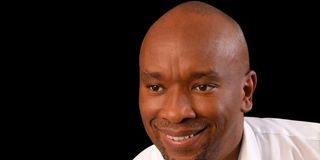
Newton Siele, the CEO of Phillips Therapeutics, is also an emotional intelligence coach.
Photo credit: Pool
You are a certified emotional intelligence practitioner. Define that for me as a poet?
The balance you have that allows you not just to relate with yourself, but with the people around you. In a way that enhances relationships, so you’re a better communicator, you’re a much more trusted or authentic person when you’re with people. I always find it easier, when it comes to teaching people, to look at the opposite: What don’t you want?
If your younger self met you today, what would surprise him the most?
I am turning 50 this year, so would I have thought that I would be where I am today? But I’ve looked at life as an opportunity to write a chapter, as you said, or maybe as a poet, an opportunity to perform. And you do the best that you can, because somewhere along the way, you have to also exit the stage for other people. I never want to look back and regret because of an opportunity I didn’t take.
50 is half a century. Does it feel like that?
It’s fulfilling. In this chapter of my life, I hope that I can be remembered as somebody who inspired, lived their passion, and made a difference. That to me is most important. Imagine today was your funeral, and somebody was reading your eulogy. What would they read? I want to be proud of what I read.
What would they be reading on yours?
It is in one of my poems [chuckles]. I do not want it to read… ‘That here lies Newton Siele, whose life journey was too much to bear; though born with dreams and aspirations, sadly we bury him with dreams intact and none ever opened to the world.’
Is it true that the older you get, the less you care?
I think there is an element of truth in that. Maybe the one would be, what have I not seen? Haha! I read a book by Robin Sharma, “The Everyday Hero Manifesto”, and one of the things he talked about was the top regrets that people have on their deathbed. One of them is ‘I wish I had taken a better perspective of life.’ ‘Or being daring and doing the things I want.’
It’s rare for one to be on their deathbed worrying about things that other people say. And I think that’s what you realise as you grow older, that sometimes we carry a lot of unnecessary burdens.
What have you become more ruthless about in this stage of your life?
I think purpose. I probably look at intent much more ferociously. If you’re not so clear about your purpose, there’s always a risk that you will be drawn into purposeless people, and you stand a chance of being purposeless. If there's one thing that I appreciate now is the fact that you never know exactly how much time you have.
Speaking of, which of the decades in your life really tested you?
Probably my 30s. My dad, since deceased, was diabetic and hypertensive, and having studied pharmacy, I felt like God gave me a chance to be there for my dad. That was tough. I was also bringing up a young family then.
Were you close to your dad?
Yes. A lot of what I am is a reflection of him; my dad was a teacher. We didn’t grow up with phones, but just the books my dad had, hence our reading culture.
What have you picked from him that you’d like to pass to your sons?
It is possible to succeed without necessarily fighting. My dad was never the confrontational type. And what I’ve seen is that you don’t have to always be angry or raise your voice; you can still pass on your message. Your own personal peace is much more important. And my dad was present; I don’t remember any day that I felt like my dad was not present in any way.
What would you teach him about fatherhood?
Haha! My dad is from the silent generation, born just after the great depression. And they perhaps didn’t appreciate how much technology has changed, or the way we as fathers are supposed to behave and communicate. They grew up in a culture where there’s a lot of male dominance. I would teach him that generations really do change a lot of things.
Looking back now, what is a piece of advice you wish you had not listened to?
That’s a tough one. I grew up in a rural place in Bomet, and sometimes you get this feeling that you can be defined by where you come from. It’s a hoax; you’re not defined by where you come from. In fact, nothing is further from the truth.
Where do you go when you want to be with yourself?
Apart from reading, my job allows me to work with a number of hospitals across the country. So sometimes I’m on the road, but being on the road and plugging into my playlist allows me to really switch off. I value my playlist and books.
What have you finally come to terms with?
That I am growing old [chuckles]. Actually, even my eyes are straining to read tiny letters, but I’m still pushing back haha! Me, in eye glasses? Let’s check back in a year. [chuckles]
What are you no longer chasing?
That’s another good question. Fame. I would substitute that with purpose. Our world is filled with people seeking high-dopamine events and activities, including social media. I am not interested in that.
What do you wish you had learned sooner in life?
Beginning with the end in mind. Nothing is impossible when you do that.
What’s that end for you?
Let this quote answer that: “Life should not be a journey to the grave with the intention of arriving safely in a pretty and well-preserved body, but rather to skid in broadside in a cloud of smoke, thoroughly used up, totally worn out, and loudly proclaiming ‘Wow! What a Ride!’” [Attributed to Hunter S. Thompson].
What tips do you have for surviving adulthood?
For every barrier and obstacle that you face, there is always an opportunity. Sometimes we spend energy on the barriers rather than finding the opportunities. Find it.
What are your weekend and Easter plans?
I am going to spend a lot of it with my sons. My work is quite engaging, so sometimes even after work, there is a lot that needs to be done. I am looking forward to watching one or two series with them.
What are you into?
I like Blacklist [chuckles]. I watched all 21 seasons. Or Designated Survivor. My second-born is usually on his PlayStation, playing GT or Roblox. The other likes playing NFS.