Time flies with great content! Renew in to keep enjoying all our premium content.
Prime
Kenyan sisters who chose a quiet life in rural Philippines
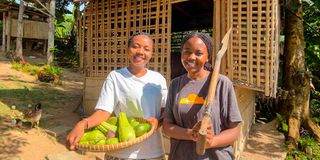
From left: Moreen Kagendo Kivuti 28 and Naomi Wanjiru Kivuti 35 pose for a picture at Lake Sebu in South Cotabato Province, the Philippines in February 2026.
You could say that Naomi Wanjiru, 35, and Moreen Kagendo, 28, have beaten the matrix. They have found peace in slow living in a remote corner of Lake Sebu Municipality, South Cotabato Province in the Philippines.
Between them, they have no more than five pairs of shoes; everything they own can fit in a seven kilogramme carry-on bag. Everything in their lives is stripped down to functionality. They live in a bamboo house on a farm where they grow everything they eat, get water from an on-site spring, sleep at 7 PM every day, and won't wake up until the sun is up.
Living in a completely different environment has a way of holding up a mirror to your life, making you see your own situation in a new light. For the two sisters, their time in the Philippines has been exactly that: a mirror, a teacher and, in many ways, a reset button.
Their story didn't begin in the Philippines. The sisters had been living all over the world for years before they ever set foot in Southeast Asia. Wanjiru left Kenya in her early 20s to work as an au pair in Denmark.
"I lived and worked across various parts of Europe during my 20s, moving between countries like Spain, Denmark and the Netherlands as an au pair."
At the time, she believed that was the path forward: work hard abroad, save money and eventually return home to settle.
That seemed to work for a while. "My journey across Europe was a real eye-opener. There's so much you don't learn or get to see if you stay in your own country. For a decade or so, I tried to resettle in Kenya but was always met with hurdles."
She returned to Kenya determined to slow down. “I invested in land and started building a home. After my busy life in Europe, I wanted a quieter life based on farming and self-sufficiency.”
However, reality frustrated her. “The land used to flood, making it almost impossible to grow food on it. Then the house that I had commissioned through trusted people was poorly built.”
Six months after her failed attempts to settle down, she sold the property and set off on a backpacking trip around Asia, with no fixed destination in mind. “I realised that the idea I had in my head was different to the reality,” she says.
Free house to live in
Wanjiru first went to Manila in the Philippines and spent two months backpacking around the country. “During this trip, I made friends who offered me a free place to stay in Lake Sebu.”
The land they currently live on is family-owned, and for years the house they live in was unoccupied. Their friends readily gave it to them.
However, Wanjiru, being an eternal sojourner, went on a trip to Thailand. She settled temporarily in rural Buriram, where another friend owned land. “Together we built a base near the border with Cambodia. The idea was that it would be a place where I could always come back to whenever I visited the country.”
Her experience in Thailand would shape everything that followed: living close to the land. She helped to plant trees and experiment with growing food.
“It was the first time I felt truly connected to the land,”she adds. “I realised I didn’t just want a house somewhere. I wanted a lifestyle, and Thailand was offering me that.”
Kagendo, on the other hand, left Kenya at the age of 19 and returned five years later from Spain to study for a degree in psychology. “The end of my studies coincided with my sister’s brief stay in Buriram. When she offered to pay for my air ticket, I joined her.”
However, Thailand wasn’t a long-term option. Visa restrictions, costs and instability near the border made staying difficult. When tensions in the region escalated, the sisters decided to move to the Philippines. “Compared to Thailand, Lake Sebu has a cooler climate and a pace of life that reminds us of rural Kenya,” says Wanjiru.
Naomi Wanjiru Kivuti, 35 poses for a picture at Lake Sebu in South Cotabato Province, the Philippines in February 2026.
Photo credit: Pool
They found it easy to settle in the Philippines because the country has relaxed visa regulations. “You can come on a tourist visa and then apply for extensions over time, so it's easier to settle here,” says Wanjiru.
For Kagendo, deciding to stay felt like the most natural thing to do. “When you arrive somewhere and feel at peace, you don’t want to leave,” she says.
Community life
The two have immersed themselves in their local community. They have an oversupply of groceries from their garden. “When we don’t have what we need, the community will have it. In return, we share what they lack.”
They attribute this potluck lifestyle to the culture of the Philippines.
“There is great hospitality here. Everyone is so hospitable, and we have felt at home ever since we arrived. Healthcare is free. We went to a local facility and received treatment at no cost.”
On their YouTube channel, Mii Adventures, they rarely talk about their activities; instead, they showcase a slow glimpse into their daily lives.
“Our content is monetised, but it's nothing we can claim to be sustainable. It helps with the small bills we have incurred on our travels, such as visa charges. We live off our savings. I started off with about $10,000, after purchasing a one-way ticket to the Phillipines,” says Wanjiru.
“But living here has also taught us that you don't need much to survive. So much of life involves carrying unnecessary baggage, and this has been a much-needed reset,” adds Kagendo.
Living in a remote village far from the hustle of city life has taught them the value of stillness and of getting their hands dirty. “We can make our own cooking oil from coconuts, for example. The soil provides everything you need. The environment heals you,” says Wanjiru.
Family pressure
When Kagendo left Kenya to join her sister in Thailand, one of her relatives was against it. “They said I was misleading my sister, who was a fresh graduate at the time and was ‘supposed’ to find a ‘serious’ path in life,” says Wanjiru.
Their family and the society they grew up in have disapproved of their lifestyle. As the older sister, Wanjiru has often been asked when she will settle down and get married.
“It's not something I'm obsessed about. If it happens, it happens. If it doesn't, that's fine too. I think our relatives keep praying for me to settle into the expected family setup. But I am in no hurry,” she adds.
This attitude also reflects the lofty ambitions that her peers may be pursuing in other cities around the world. They have both adopted contentment and a life of gratitude.
“We often associate simplicity with poverty,” says Wanjiru. “But actually, a simple life is peaceful. It’s healing.”
New understanding of success
This challenges society’s definition of success. From the outside, their choices might appear to be a step backwards: no corporate careers, no striving for property or promotions. Wanjiru admits that she initially struggled with this perception.
“My friends are buying houses and cars and getting big jobs. When they ask what I am doing with my life, I update them with things like, ‘The pumpkin has grown’. Of course, this is not as impressive as the world expects.”
Moreen Kagendo Kivuti, 28 poses for a picture at Lake Sebu in South Cotabato Province, the Philippines in February 2026
Photo credit: Pool
However, time has changed her perspective. “The gift of time here is priceless,” she says. “We sleep with the sunset, wake with the sunrise and eat seasonal fruit. For me, this is true wealth.”
Does this mean that her ambitions have disappeared? Far from it. “I think they’ve shifted. I still want to build something meaningful. But now, that means growing food, creating a peaceful home and living intentionally.”
Kagendo's ambitions have also evolved. Rather than rushing into practice, she now wants to focus on psychoeducation, helping people to understand the impact of lifestyle on mental health. “I don’t just want to treat problems as and when they arise. I want to help prevent them.”
Intentional living
She believes that real understanding comes from lived experience. “When I eventually start practising, I want to draw on my experience, not just textbooks, and I believe I am gaining a lot of that here.”
Wanjiru and Kagendo emphasise that their freedom to live this way partly comes from having fewer responsibilities right now.
“Not everyone can move to the countryside. Some people have families, bills and obligations that they can’t just ignore by leaving their country. Not having children at the moment is one of those things. Children, and by extension family, change life's dynamics a lot,” says Wanjiru.
They aren't trying to convince people to abandon their lives, but rather to rethink how they live within them. “It’s about intentional living,” says Kagendo. “You can live meaningfully wherever you are.”
This philosophy even shapes their relationship with possessions. “We don't own much. Our earthly possessions can be carried by hand.” “It sounds extreme,” laughs Wanjiru. “But it’s freeing. The less you carry, the lighter you feel.”
Lessons in the journey
The lessons have been coming in fast. “I realised how much my previous lifestyle was working against me. The stress, the diet, the pace — I didn’t even question it before. I just thought that was normal life.”
Food has become one of her biggest revelations. She laughs, remembering how disconnected she once felt from her food. “In Kenya, I never bought cassava. I barely paid attention to root crops or anything grown straight from the soil,” she says. “But here, everything makes you think.”
Growing her own food transformed her relationship with it. “When you grow something, you stop seeing it as a product and start seeing it as life,” she says.
Living close to nature also changed her perception of time. “When you give things time, they become something beautiful,” she explains.
“ We learn from everything around us. I have noticed that chickens only eat what is good for them. If something’s spoiled, they leave it. This made me wonder why we humans ignore what our bodies are telling us,” Wanjiru adds.
She now questions what she eats, how she sleeps and how she spends her energy. “It’s been life-changing,” she says. “I’ve realised that lifestyle dictates everything: your health, your mental state and your relationships.”
So, will they live in Lake Sebu until old age?
“I definitely plan to move back to Kenya at some point,” says Wanjiru. “I will try to recreate everything I have done here in my next life. I will also teach people what I know. That should explain how I intend to earn a living in my next chapter.”
Kagendo intends to set up a practice based on what she has learned at university and in Lake Sebu. “When I start practising again, I will be an authority in both theory and lived experience,” she says.