A rough guide for a Kenyan visiting China as a tourist

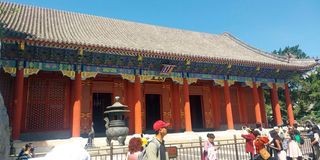
Tourists photographed on May 30, 2026 outside the Hall of Benevolence and Longevity that is within the Summer Palace in Beijing, China.

Photo credit: Elvis Ondieki | Nation Media Group

Your tour guide is likely to advise you against photographing a certain rock in a historic world heritage site in north-western Beijing, China. They will say that it may bring poverty or misfortune to your household.

Our guide told us: “Do not take a picture of that stone… It has bad luck.”
But curiosity could not allow this writer to leave without at least photographing the plaque in front of the stone. The plaque labels it the Azure Lingzhi Rock.

“This colossal stone, known for its azure hue and moist texture resembling a lingzhi mushroom, was discovered by the Ming Dynasty official Mi Wanzhong in Beijing’s Fangshan district. While being transported to Mi Shao’s garden, financial constraints forced its abandonment in the wilderness. Later, Emperor Qianlong of the Qing Dynasty allocated substantial funds to relocate it to its current location, naming it ‘Azure Lingzhi Rock.’ It is recognised as the largest ornamental rock in Chinese gardens,” it adds.

Upon further research, you realise that the rock’s reputation is mired in superstition. One online source says it is typical for tour guides to advise against photographing it because some locals call it “baijia”, a derogatory term for a person whose extravagant spending brings ruin to their family.

“Superstitious Chinese fear being robbed of all their luck or attracting bad luck if they photograph the stone,” says the Beijing Municipal Bureau of Culture and Tourism on its website.

Some have photographed it nonetheless, as proven by the shots of the rock available online. Did financial ruin follow them? The jury is out.

The rock is inside the Summer Palace, a former emperor’s second home. Buildings in the palace have been preserved and turned into a tourism site. Think of it as State House, with the main building and all the other structures in it, being vacated and then being turned into a tourist attraction.

The lingzhi rock sums up a number of things you will encounter in Beijing as a tourist: tales of past emperors and their dynasties, old buildings preserved for posterity, and crowds of people in most of the places you visit in the capital.

To experience all that as a Kenyan, you first need to enter China. Getting a visa requires you to prove that you have at least Sh500,000 in your bank account (confirmed by a notary public), an invitation from a travel agency in China, a confirmation of hotel booking, among other things.

Once you clear all the hurdles and are granted a visa, flying to Beijing from Nairobi will take at least 12 hours and will typically involve one layover. China is five hours ahead of Kenya, and so be ready to live half a day ahead of your folks in Kenya.

Should you land at the Beijing International Airport, be ready to use an automated entry system that will require you to scan your passport and key in some information about yourself. Luckily, if you are lost, help in the form of uniformed officers is never too far. However, your smartphone needs to have some charge as you will require photographing a QR code that the machine produces before you proceed any further.

English proficiency levels are not the highest among airport staff in China – and generally in many public places in the country – and so you may have to be creative in expressing yourself if there is no interpreter.

One way is by typing text on your phone that the other person can scan and translate then type a response. Prices will be punched into a calculator. Others will give you their phone to speak into it, then your English is converted into Chinese that they respond to and the feedback comes to you in text form. It is hiccups galore, if what this writer experienced is anything to go by.

Wi-Fi access in China’s airports is unlikely to work until you link a passport by photographing it on your phone then uploading it. Whereas you can simply dock onto the Wi-Fi at many airports, in China you will need to provide your identification document first.

When you finally get the connection, the Great Firewall will hit without any warning. You may wonder why WhatsApp isn’t loading new messages yet the Wi-Fi shows you are online. You may try to google something and realise that your browser has no way of bringing that all-too-familiar homepage.

 A table prepared for a banquet by the National Radio and Television Institute in China on May 31, 2026.

Photo credit: Elvis Ondieki | Nation Media Group

Then it will hit you that you have landed in a place where not all the online platforms are allowed. WeChat is allowed; WhatsApp isn’t. Baidu is permitted; Google is not. TikTok and its Chinese version, Douyin, are allowed; YouTube not so. Facebook doesn’t load; neither does X. Ditto Gmail.

To stay connected via the apps that Kenyans are accustomed to, you will need the technology that “lies” about where you really are. It is called a virtual private network (VPN) that is made possible through a number of apps — some free; others that need payment. Thanks to VPN technology, you can pretend to be browsing from another country. Only then can the path to most of Kenyans’ favourite apps be opened.

Our chat with the locals revealed that even when you use a VPN, the government really knows who is doing it. We were also informed that usage of VPN is generally allowed even among the Chinese, though it is banned among government officials.

On your way from the airport, you will come across either a subway system that operates with enviable efficiency or a road system that illustrates to you what Kenyan roads could be if every user were to use common sense. Roads have no slow bumps, and there are hardly any roundabouts at intersections. Everyone – including the not-too-few self-driving SUVs and unmanned delivery vehicles – obey the traffic lights to a tee.

In your room, you are likely to find a bin with a polythene lining next to the toilet bowl. Hardly is there a notice, but it is common practice in China not to flush toilet paper.

You drop it in the bin and workers will collect them the first thing every morning. Online sources say the practice traces back to the early sewerage systems in China that had narrow pipes and which suffered the risk of clogging if paper waste was deposited in them.

The TV set in your room will almost always be set to CCTV, the national broadcaster, and you will have to make do with the fact that no international cable networks will reach you. CCTV has multiple channels, including sports ones, and so you may find yourself engrossed in the Chinese basketball league as you struggle to understand what the commentators are saying.

The food you will be served is likely to feature starches different from what you are used to in Kenya. Rice will be plenty in any buffet.

In case you want to move around at night, sightseeing will feel different due to the fact that there is little fear of encountering a criminal in most parts of China. People use their phones with car windows pulled down and dangle about their gadgets with abandon.

Most locals believe it is futile to steal another person’s phone because if reported, it will be disabled.

Bike hiring companies leave their stocks everywhere and anywhere. Think of it like finding tens of bicycles placed next every major street without a single chain tethering one somewhere. You just need to pay via an app to unlock one and ride away.

To buy most things, you need to set up WeChat/ Weixin Pay and Alipay, as they are the most commonly accepted payment modes. Cash is accepted in some areas, but cashless payment is the default.

Back to the touring part, there are many attractions in Beijing and other parts of China. The most famous are perhaps the Great Wall and the Temple of Heaven.

For the Great Wall, prepare for it as if you are going to ascend the Kenyatta International Convention Centre using the stairs many times over. It is a steep climb to the uppermost stages of the wall that will leave you thirsty and heaving. Be ready to squeeze in narrow areas with hordes of people around you. The Chinese, 1.4 billion in total, have a saying carried from a Mao Zedong poem, saying that one is not a hero until they climb the Great Wall. And so, they use every opportunity to visit there in their chase for heroic status.

At the Great Wall, as you burn calories and sweat your way up, leave some mental bandwidth for amazement at how daring the constructors were to put up a structure so imposing at a time when there was no motorised transport.

Tourists passing by some of the ancient defensive weapons on a section of the Great Wall of China in this photo taken on May 23, 2026.

Photo credit: Elvis Ondieki | Nation Media Group

Having to scale tall mountains and work with rudimentary tools, many lost their lives in the process, and your guide may refer to the fact that the Great Wall is a massive graveyard. The History Channel reports that the structure, which stretches for over 21,000 kilometres and was built from the 1300s to the 1600s, witnessed mass casualties.

“It is said that as many as 400,000 people died during the wall’s construction. Many of these workers were buried within the wall itself,” the American outlet states.

Given its length, there are many points through which it can be accessed, though guides prefer ones that have been fortified to allow for large volumes of traffic and ease of ascension and descent.

Now to the Temple of Heaven, the place where world leaders like visiting. US President Donald Trump visited the site during his China visit in May. Former President Uhuru Kenyatta also went there in May 2017.

It is a temple of “heaven” because the Chinese, drawing from ancient wisdom, submit themselves to heaven. Not God. Not a god. Heaven.

“It was used to worship heaven and earth,” a plaque tells you, adding that it was used “exclusively for the ceremonies of praying for good harvests”.

It was originally called the Great Sacrificial Hall, but today it is called the Hall of Prayer for Good Harvests.

Twenty-four kilometres from the Temple of Heaven lies the Forbidden City, which was the seat of power for years. China’s rulers over a 500-year period resided in the Palace. It earned its name because entry was heavily restricted. Today, the 178-acre conglomerate of houses is uninhabited and has been converted into a tourist attraction, though the process of booking entry is complicated.

Thirty-four kilometres from the Temple of Heaven is where the Summer Palace lies; the palace that holds the “bad luck” rock. Think of the Summer Palace like a state lodge or a mini-State House on the outskirts of Nairobi, 34 kilometres from the State House.

The main building of the Summer Palace was first built in 1750 but was destroyed in 1860 by British and French forces. It was then rebuilt in 1886 and christened the “Hall of Benevolence and Longevity”.

“This hall served as the place where Empress Dowager Cixi and Emperor Guangxu managed state affairs, received congratulations, and met with foreign envoys during their residency in the Summer Palace,” says a plaque on the site.

Many other buildings dot the 717-acre Summer Palace lies, and three-quarters of the property is a scenic water body. Somewhere there, the “bad luck” rock rests, often snubbed by the visitors on the advice of guides.

The only drawback in visiting the Temple of Heaven and the rulers’ residences in Beijing is that you will not be allowed inside. You can only peep into them from a barrier placed to ensure the multitudes that visit do not get in and wear down the relics.

Away from the monuments of past rule in Beijing, there are numerous places worth visiting in China, not least the coastal areas as the country has a shoreline that stretches over 32,000 kilometres, a giant considering the fact that Kenya’s is only 536 kilometres long.

PAYE Tax Calculator

Note: The results are not exact but very close to the actual.