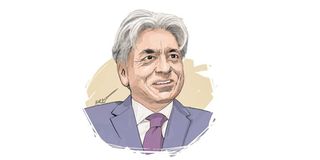
On Monday last week, Bharat Thakrar, the ousted chief executive of WPP Scangroup, made yet another attempt to reclaim influence over the company he founded more than four decades ago. The effort was always destined to fail.
At the annual general meeting of the Nairobi Securities Exchange-listed marketing services firm, Thakrar and a group of minority shareholders sought to remove the entire board and replace it with a slate of directors led by the company's founder.
But the numbers were never on their side. British advertising giant WPP Plc, which owns 56.26 percent of Scangroup, voted against every proposal put forward by Thakrar and his allies.
The result was predictable. The resolutions collapsed, leaving Thakrar where he has been since 2021: a minority shareholder watching from the sidelines as others steer the company he built.
"I built this company. I've watched its value fall 62 percent in four years. Today its minority shareholders vote to hold the board to account, a vote we cannot win but will not stay silent," Thakrar wrote on X shortly before the meeting.
Few stories illustrate the paradox of entrepreneurship better than Thakrar's.
The father of two founded Scanad Marketing Ltd in 1982 and painstakingly grew it into one of East Africa's most influential advertising agencies. At a time when many of the region's leading agencies were foreign-owned and expatriate-led, Scanad became a home-grown success story, winning some of the largest corporate accounts in Kenya and beyond.
But building a great company often requires founders to invite others into the tent. And once others arrive, ownership begins to change. In that sense, Thakrar's journey bears a resemblance to that of the late Steve Jobs, who co-founded Apple in 1976.
Like Thakrar, Jobs built a company that outgrew its founder. In 1985, after disagreements with management and the board, Jobs was pushed out of Apple, the company he had helped create. He would eventually return and lead one of the most remarkable corporate turnarounds in history.
Thakrar's story appears headed in a different direction.
His dream was never to run a small owner-managed business. It was to build an institution.
That ambition led him to seek global partners and eventually align Scanad with WPP Plc, one of the world's largest advertising and communications groups.
The partnership brought international expertise, multinational clients and access to capital. The company later restructured, became WPP Scangroup and listed on the Nairobi Securities Exchange in 2006. Thakrar remained chief executive, but increasingly as an employee of a company whose ownership was shifting away from him.
In retrospect, it was probably the correct decision.
Thakrar himself has acknowledged that he lacked the traditional academic credentials many corporate leaders possess. He never obtained an undergraduate degree, holding instead a Diploma in Advertising and Marketing from the Communications and Marketing Foundation in the United Kingdom.
Yet he compensated this academic deficiency with relentless ambition.
"I started with a one-man agency. One day I said I wanted to be big," he once recalled.
To become big, however, founders must often surrender a degree of control. They exchange ownership for growth. The trade-off is unavoidable.
The moment a business takes on outside investors, lists on a stock exchange or invites a multinational partner, it ceases to be a personal possession. It becomes accountable to shareholders, employees, creditors, regulators and customers.
That is the price of scale.
For years, Thakrar was the public face of Scangroup. He took the company public in an initial public offering that raised Sh94 million and was oversubscribed more than six times. His stake was at one point valued more than Sh1 billion.
Over time, however, he sold shares while WPP steadily increased its holdings through acquisitions and the integration of subsidiaries. Today, Thakrar owns 10.48 percent of the company while WPP Plc controls more than half.
The balance of power is no longer in doubt.
His fall from the corner office came abruptly. In February 2021, he was suspended alongside chief financial officer Satyabrata Das over allegations of gross misconduct. Both executives later resigned. A subsequent investigation found no incriminating evidence against the pair, but neither returned to the company.
Since then, Thakrar has become one of the company's most vocal critic.
He argues that shareholder value has been destroyed and points to years of declining performance. His concerns are not entirely without merit.
WPP Scangroup reported a net loss of Sh713.6 million in 2025 compared with profits as high as Sh867.3 million in 2013.
But the world that produced Scangroup's success has changed dramatically.
Advertising agencies globally are grappling with disruption from artificial intelligence, social media platforms, data analytics firms and content creators who increasingly bypass traditional agencies. Marketing budgets are migrating online, while multinational clients are consolidating accounts and demanding integrated digital solutions.
Competition has also intensified.
The company has faced pressure from global rivals, including French communications conglomerate Publicis Groupe, which has aggressively expanded across Africa. Major accounts have become harder to retain, while telecommunications firms, banks and consumer goods companies increasingly diversify their agency relationships.
The battle is therefore not merely about management. It is also about an industry undergoing structural change.
Those who know Thakrar describe him as intensely competitive, ambitious and relentlessly optimistic.
A profile by Jackson Biko painted a picture of a reflective businessman whose office featured a Feng Shui aquarium with eight goldfish and one black fish, meant to keep him centred amid the pressures of running a corporate giant.
He often spoke of success in almost athletic terms.
"There are no runners-up in FIFA World Cup football," he once remarked. "Nobody remembers the runners-up."
The philosophy helped build Scanad.
It also made him a prominent member of Nairobi's corporate elite. For years, he was associated with the so-called "Boys Club," a loose circle of influential executives and public figures that included former Safaricom chief executive Bob Collymore, Stanbic Holdings chief executive Joshua Oigara and veteran broadcaster Jeff Koinange.
The group symbolised a generation of corporate leaders who helped define Kenya's modern business culture.
Today, much of Thakrar's campaign has shifted to social media.
On X, he frequently shares some of the memorable advertising campaigns that emerged during Scangroup's golden years, including iconic Safaricom advertisements. The posts serve as a reminder of the creative legacy he believes helped build some of Kenya's most powerful brands.
They are also, perhaps, an attempt to shape history.
Whether Thakrar ever regains meaningful influence over Scangroup is doubtful. The mathematics of ownership are simply too overwhelming. WPP Plc's controlling stake gives it the power to determine the company's direction, board composition and leadership.
Yet his story remains instructive.
The founder may create the institution. But once a company grows large enough, it begins to belong to a wider community of stakeholders.
Thakrar succeeded in building one of East Africa's largest advertising companies. In doing so, he also surrendered the ability to control its destiny.
That may be the ultimate irony of entrepreneurial success: the bigger the company becomes, the less it belongs to the person who started it.