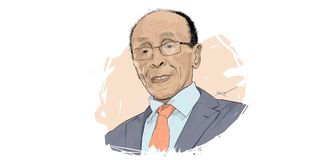
Titus Muya: The dreamer who built Family Bank

Family Bank founder Titus Kiondo Muya.

Photo credit: Joseph Barasa | Nation Media Group

On Tuesday, Family Bank shares will start trading on the Nairobi Securities Exchange (NSE), allowing shareholders, including its founder Titus Kiondo Muya, to sell part of their stakes to interested investors.

It is a watershed moment for Mr Muya, popularly known as TK, as he proudly watches a bank he founded more than 42 years ago grow from a modest idea to a listed firm.
Muya and his associates, including members of his family, hold a combined 35.6 percent stake in Family Bank, well above the 25 percent ownership cap enforced by the Central Bank of Kenya (CBK).

While the Capital Markets Authority (CMA) requires top shareholders in companies listing by introduction—where no new capital is raised, and there is no initial public offering—to retain their shares for at least two years, Mr Muya and his associates have been exempted from the rule partly to enable the lender to comply with the CBK's ownership limit.

This means Mr Muya, now in his 80s, and his family could be looking at a windfall running into billions of shillings should they reduce their stake by the required 10.6 percentage points.

Yet for Mr Muya, who stepped down as chief executive in 2006 and relinquished the chairmanship on July 1, 2007, when Family Finance Building Society converted into a commercial bank, his greatest satisfaction is likely to come, not from the potential windfall but from watching the institution edge closer to fulfilling his high-school dream of building a financial institution with branches beyond Kenya.

Today, Family Bank boasts assets of Sh168.5 billion and a network of 95 branches, making it one of Kenya's largest lenders and the sixth-largest by branch network.

In a public lecture at the University of Nairobi three years ago, Mr Muya traced the origins of Family Bank to 1961, when he was in Form Two, and not 1984 when he registered Family Finance Building Society.

Back then, it was just an abstract idea that crossed his mind after reading a business article in an international magazine: "Most of the big institutions you see today were started by individuals," Mr Muya recalled the article saying.

"They all start small, and in their own countries of origin, thereafter they open branches across the world to become international organisations."

The article went on to note that the same principle applied to the world's largest banks. The young Muya would eventually forget about the article after completing his O-Level examinations in 1963 and entering the workforce. Through the 1960s, 1970s and early 1980s, he worked diligently, hoping to rise through the ranks.

However, promotions never seemed to come. Instead, he watched as graduates he had mentored rose above him. Whenever he asked why he had been overlooked, he was told that his lack of a university degree stood in his way. He was incensed.

Over time, however, the anger gave way to reflection. Returning to school was unrealistic. He had four children, a wife and mounting family responsibilities. Entrepreneurship appeared to be the only path left. His difficult childhood had already taught him resilience.

His father was killed by British soldiers during the Mau Mau emergency in 1953 and, like the family of Dedan Kimathi, they never learnt where he was buried. His mother was tortured so severely that she eventually became a permanent resident of Mathari Mental Hospital, Mr Muya recalled.

The adversity would later fuel his determination. As he contemplated his future, the article he had read in 1961 came flooding back.
Armed with little more than an idea and an unshakable belief in himself, Muya set out to build a bank. He had neither the money, the university education, nor the experience required to establish and run a financial institution.

"The desire to start a bank was so strong at that point, and it did not even matter that I did not have the money or the knowledge of how to start it. I convinced myself that once I started a bank, somehow, money would be available," he recalled.

In 1977, he registered a company known as Family Finance & Credit Limited. For the next three years, he did little more than, in his own words, "build castles in the air" about the bank he wanted to establish.

In January 1980, he submitted an application to the Treasury seeking a banking licence under the name Family Finance & Credit Limited. The officials were unimpressed.

He lacked capital, a university degree and banking experience. They repeatedly questioned his qualifications and even asked who his political godfather was: "All I had was an idea. I also had a belief in myself."

For four years, the application remained stalled. Yet Mr Muya refused to give up. Every Thursday, he would walk to the Treasury Building to inquire about the status of his application.

Eventually, Treasury officials told him he could not be granted a banking licence. Instead, they suggested that he starts a building society. The experience mirrors that of Equity Group founder Peter Munga, who also started with a building society after facing barriers to establishing a bank.

Initially, Mr Muya was offended. In his mind, banks were institutions reserved for the wealthy and politically connected. A building society felt like a downgrade. The following weekend, he shared his frustrations with friends.

One of them advised him to take the opportunity: "You never know, you might end up doing with the building society what you wanted to do with the bank," Mr Muya recalled his friend saying. The advice changed everything. Within two weeks, on October 1, 1984, he registered Family Finance Building Society. The building society label, however, existed only for regulatory purposes.

Once he received the licence, he walked around town proudly telling anyone who cared to listen that he had started a bank.

"I did not talk about a building society. I said bank, because that is what I believed in."

He appointed himself chief executive and became the institution's first employee. On November 1, 1984, Family Finance opened a temporary office on the second floor of Standard Building along Kenyatta Avenue. A year later, it opened branches in Kiambu, Githunguri and Nairobi. In 1986, it expanded further with a branch in Gatundu.

The institution initially focused on serving ordinary Kenyans, particularly tea, coffee and dairy farmers. Loans were designed around farmers' cash flows, with repayments deducted directly from proceeds earned from tea, coffee and milk deliveries. The model proved highly effective. As more farmers joined, profits followed.

A breakthrough came when Kenya Tea Development Association handed them a cheque of Sh149 million as bonus payment for its members. The bank had never handled such money. According to Mr Muya, he secretly convinced cashiers of some banks to take leave and work for him. Some of them accepted, helping the institution to survive a critical phase of its growth. Expansion followed.

Branches spread throughout the Mt Kenya region before extending to other parts of the country. The 1990s brought fresh challenges.

Interest rates surged, non-performing loans increased, and many indigenous financial institutions collapsed. Political uncertainty compounded the problems, creating widespread panic among depositors.

Yet Family Finance survived. Its resilience strengthened customer confidence and reinforced its position in the market. By the early 2000s, management began pursuing a more ambitious goal—converting the building society into a fully fledged commercial bank.

The process was lengthy and involved significant regulatory and operational hurdles. But by 2005, Family Finance had expanded to more than 30 branches and was ready to make the transition. On July 1, 2007, the building society converted into Family Bank.

Today, his focus is on succession and preserving the legacy of the institution he spent decades building.

Looking back, Mr Muya's message to young entrepreneurs remains simple: "Take courage and follow your dream and actualise it."


PAYE Tax Calculator

Note: The results are not exact but very close to the actual.