Charles Kanjama: The reluctant public man

Newly elected Law Society of Kenya President Charles Kanjama is interviewed at his Nairobi office in the I&M Bank Building on February 24, 2026.

Photo credit: Bonface Bogita | Nation Media Group

Anyone can interview Charles Kanjama, the newly elected President of the Law Society of Kenya. His sentences arrive fully formed, tied with a bow. You won't need to garnish the journey of his content or lend it depth. All you have to do is show up with a recorder. Better if it is raining lightly outside, as it did during this interview, and Kanjama will do the rest of the storytelling.

The first thing you notice is how he speaks. He speaks in big, unhurried chunks. Not the nervous chunkiness of a man who has overprepared, but the steady heft of someone who has spent a long time thinking about who he is and what he is doing here. A sentence from him can carry the weight of a paragraph. A paragraph can feel like a chapter. You sit across from him and realise, after about 10 minutes, that you are not really interviewing him. You are just present while he thinks out loud.
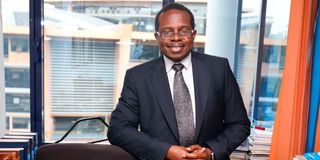
His story starts at Mater Hospital, where he was born, and in South B, where he was raised, because Kanjama is a Nairobi boy. From there it moves through State House Primary, through Strathmore, through a two-year detour into computer programming that he never planned and a law degree he always did. Through a firm he built with a classmate. Through committee rooms and lost elections and won ones. Through a philosophy borrowed from the Japanese – Kaizen, continuous improvement – that turns out to be less a philosophy and more a compulsion. Leave every place better than you found it. Every person. Every institution. Even yourself.

He has been doing this quietly for 22 years. Now the profession has handed him its loudest platform.

People are curious about this Opus Dei thing…

I prefer to speak as little as possible about religious matters. I don't want to be labelled or viewed on the basis of things that are personal to me and not part of my public persona.

People are interested in me because I've become President-elect of the Law Society of Kenya. I run a law firm, which I've run for many years. That's my public persona, the part I'm comfortable with. It's like someone who doesn't want to talk too much about their family, their spouse or children, because they prefer to keep that separate from their public life.

I feel that sometimes curiosity isn't about understanding the person; it's about highlighting how they're different. I don't want to emphasise the difference, so I'll speak about what I'm comfortable speaking about. And if I become vague at any point, don't worry.

But now you are a public figure, people will be curious about you beyond this office...

Yes, and you're entitled, as a journalist, to ask what you think is relevant. I just want to be clear in advance that I don't want an article focused on that topic.

You remember when the former Governor of the Central Bank [Patrick Njoroge] went for his interview and was asked about his personal life? It became a whole story – the Governor is Opus Dei, what it means, and so on. I don't want that.

I've built a 22-year career as an advocate without anyone reducing me to "Kanjama Opus Dei" or "Kanjama Catholic." I am Catholic, yes. But I prefer to describe myself simply as a Christian professional. That's the identity I'm comfortable with. Of course people are entitled to know some personal details, and I'll share a few. But I don't want to create a fascination around what some might consider different or unusual. That isn't who I am.

You make a compelling argument and I respect that. How can we understand you better?

You can ask me about my history, my profession, my inspirations and my values…

And all these stem from somewhere, from childhood. What can you tell me about your childhood?

I'm Nairobi born and bred. Born at Mater Hospital — you can't get more Nairobi than that. [Grin] We lived in Buruburu for the first four years of my life, then moved to South B, and that's where I spent most of my formative years.

My dad was an accountant at the University of Nairobi. My mum was a banker at Barclays — now Absa — and spent her entire career there before taking early retirement at 50.

We grew up middle class, a family of boys. I'm the fourth born. When I was almost 10, my parents had a fifth child, also a boy. He passed away at 17, so we remained four boys again, with me as the youngest.

Newly elected Law Society of Kenya President Charles Kanjama is interviewed at his Nairobi office in the I&M Bank Building on February 24, 2026.

Photo credit: Bonface Bogita | Nation Media Group

Because my dad worked near State House Road, he took us to State House Primary. We commuted every day in our car — a red Datsun 120Y. My parents in front, we squeezed in the back. I spent eight years there. I was usually top of the class — and on a bad term, number two. My dad never missed a parents' day. Not one. At the time I didn't fully appreciate it, but his presence had a huge impact on me.

I scored 614 out of 750 marks, was second in the school, and ended up at Strathmore on scholarship. Four years there. It had a profound impact on my life.

How so?

Sports was built into the timetable, which I loved. Academically, the school ran on a quarter system. The emphasis wasn't on rank but on which quarter you were in, and the goal was always to improve.

Strathmore also places a strong emphasis on spiritual formation. There was a chaplaincy, Catholic priests from an organisation within the Church called Opus Dei. That's where I began interacting with them.

The school also places great importance on mentorship, and that culture stayed with me. I later became an administrator of the Strathmore Educational Trust, the body that oversees Strathmore School, Strathmore College and GTC.

Is that where your faith got embedded?

My parents were very strong in their faith. We went to church every Sunday. At one point my mother was treasurer of the parish council, and my parents even became family life counsellors. So, faith was natural in our home. It wasn’t dramatic or exceptional — it was simply part of life, like having dinner together.

High school, though, is a period of awakening. As a teenager, you question everything. You start asking: Why do I go to this church? Why do I have to go at all? The things you once took for granted suddenly require your own decision. When you’re young, your parents decide for you. You absorb what they give you. As a teenager, you must either accept it for yourself or reject it. That’s where rebellion can come in.

I went through that questioning in an environment that offered strong formation, both academically and religiously. It helped me make my own decisions - intellectually and morally - rather than simply relying on how I had been brought up.

Why did you choose law?

At the time, the assumption was that bright students chose medicine. But I had asthma as a child. Night attacks, hospital visits — often to Mater — needles, injections. My early experience of hospitals was about pain and fear. That stayed with me. I ruled out medicine.

I considered architecture, then engineering. Then around Form Three, I began thinking more seriously about humanities. I liked reading. I enjoyed speaking. And law seemed to require both — reading and argument. That appealed to me. [Chuckles] I wasn't inspired by a particular lawyer. I simply had the idea of lawyers as people who argue cases in court.

After high school there was a two-year backlog before university. I joined Strathmore College and studied Management of Information Systems, earned a Higher Diploma, then worked for a year as a computer programmer. Some colleagues thought I should pursue computer science, but my decision was firm. Programming was useful, but temporary.

I then joined the University of Nairobi, studied law, and also qualified as a CPA. After pupilage, I worked for about two and a half years. After that, together with my partner Andrew Muma, we started our firm - Muma & Kanjama Advocates - which is now 20 years old.

Andrew Muma! I can’t forget that name. We were classmates in primary school - sharp fellow, always topping the class. My God. I haven’t seen or heard of him in 34 years!

You know Muma? He is next door. I will take you to him after this; he will be happy to see you again. We met at the University of Nairobi as classmates. Later, during pupilage, we found ourselves at the same law firm and worked together for about two years before starting this firm.

One of the values I developed early on was the desire to improve the world - which sounds grand, but for me it’s simple: Leave every place better than you found it. That’s the principle. Wherever I am, I ask, can this be improved? I’ve always had that proactive instinct to positively impact my environment. Not just places, but people. That’s how you improve the world in practical terms: one step at a time.

When I entered the legal profession, I noticed areas that weren’t working efficiently. Naturally, I wanted to improve them - first in my own firm, then in the wider practice environment. Leadership became one of the avenues for that. Sometimes you seek it; sometimes others see your interest and push you forward. So, to answer your question, that is my underlying motivation.

I want to leave people and places better than I found them, including myself. I want to be better than I was yesterday, last week, last year. It’s a commitment to continuous improvement. The Japanese have a word for that: Kaizen.

It seems you have always been set on a path of excellence, what have you struggled with?

I’ve struggled many times. The struggles are often hidden; people see the success. It’s like an iceberg - you see the 10 percent above the water, not the 90 percent below.

One example is personal. I became good in school almost instinctively. I concentrated intensely in class and didn’t revise extensively afterward. By the time I left the classroom, I already understood the material. When exams came, I only needed to review, not learn it afresh. There’s a perception that if you perform well, you must be reading all the time. That wasn’t the case for me. I relied on my ability to grasp concepts quickly.

Newly elected Law Society of Kenya President Charles Kanjama is interviewed at his Nairobi office in the I&M Bank Building on February 24, 2026.

Photo credit: Bonface Bogita | Nation Media Group

The challenge comes in the workplace. Being good in school doesn’t automatically translate into success in life. You enter the real world and realise it depends on how hard you work. It requires a shift in mindset, intentionality, discipline, sustained effort. That adjustment can be difficult.

Another struggle has been integrity. Early on, I made a conscious decision to align my behavior with my values. No one does so perfectly, we all fall short, but the intention is to remain consistent.

In professional life, however, you encounter systems that require compromise - corruption, facilitation payments, and similar practices. Choosing to say no, insisting on clean work, comes at a cost. You may lose opportunities. But it also strengthens your resolve to improve the environment, to create space where ethical professionals can thrive.

You guys don't really get married…

Which guys?

Opus Dei.

You are back to that question again.

Yes. We have to talk about family, I’m afraid. Are you married?

What I came to understand (of the Opus Dei) is that the majority of members, perhaps 70 to 80 percent, are married men and women. A smaller proportion, maybe around 20 percent, are single and practice apostolic celibacy within the Catholic tradition.

In that sense, it’s similar to the broader Church, where some people dedicate their lives to God in celibacy while the majority are married. In Opus Dei, the celibate members are the minority; most are married.

Great but that doesn't answer my question…

[Grins] I'm not married. I'm single. [Small pause] Single, but committed. That's all I can say on that topic. [Laughter]

You are turning 49, what’s your biggest question as you head towards 50?

At this stage of life, it's natural to think about impact and legacy. In your 20s and early 30s, you're full of ideals. By your mid-30s and 40s, you begin asking whether you're on the right trajectory.

Sometimes there's tension when reality doesn't match the dreams you had. Over time, you grow more comfortable in your skin, but the question remains: What legacy will I leave?

Viktor Frankl, in Man's Search for Meaning, says meaning comes from three things – pursuing a goal bigger than yourself, connection with others, and understanding suffering. Because as you pursue goals and relationships, there is disappointment. There is failure. You must learn to integrate suffering. That integration of purpose, connection and suffering — that is part of the journey toward meaning.

We have six minutes to wrap up and I’m curious, what's the one thing you'd undo in your life?

Before I answer, let me share a philosophy I try to live by. Entrust the past to the mercy of God. Don't become anxious about it or indulge in regret. Thank God for what has happened — the good, the bad and the ugly.

God is not responsible for the bad and the ugly, but He has helped you through them. Entrust the future to His providence. It will take care of itself, so long as you take care of the present — and entrust the present to His love.

So, in terms of what I would have done differently — I carry few regrets. As Catholics, we believe in repenting and seeking God's pardon through confession. We confess, receive forgiveness, and move on. The struggle continues, but you don't remain trapped in it.

Because of that, there isn't one major thing I truly regret. If there is anything I would change, it would be to commit fewer of the sins I've had to confess — even the small ones.

Follow ourWhatsApp channel for the latest business and markets updates.

PAYE Tax Calculator

Note: The results are not exact but very close to the actual.