Hussein Hausa did not set out to become a Pilates advocate. At 16, he was practising taekwondo. Over time, he moved into strength training, studying anatomy and biomechanics to better understand how the body works.
Now 41, with 15 years in the fitness industry, he is helping to shift perceptions around Pilates, particularly among men.
Hussein discovered Mat Pilates and practised it for about five years. Although Pilates has for years been seen as female-dominated, Hussein has worked to change that, introducing male clients to the practice and showing how it builds strength, flexibility and control.
When men attend their first Pilates class, Hussein says the most important thing they can bring is an open mind. “Come with an open mind,” he says. “It is always good not to have expectations.” He believes mindset is often the biggest barrier. “When your mind locks and says ‘I can’t,’ then it becomes hard to continue,” he explains.
Preparing for a first class is simple. Hussein says beginners only need comfortable sportswear, such as flexible training pants. One important item, however, is grip socks.
“Grip socks are very important,” he says, noting they prevent slipping on the equipment or floor and reduce the risk of injury. Beyond that, beginners simply need to listen and follow instructions.
Results, however, vary. Each body adapts differently depending on strength, flexibility and consistency. “Adaptation is key,” Hussein says. Some people adjust quickly, while others take more time. He also notes that precision matters. The better a person understands the instructions and performs the exercises correctly, the better their results will be.
For noticeable progress, he recommends at least three sessions a week. Within three to six months, most people begin to see changes, often starting with better balance and a stronger core. They also develop a deeper understanding of how their bodies move, improvements that can significantly enhance everyday activities and overall health.
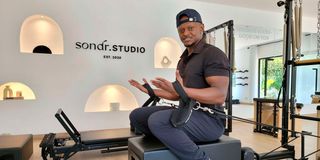
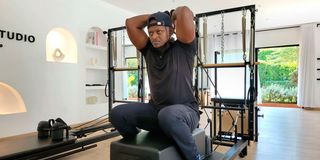
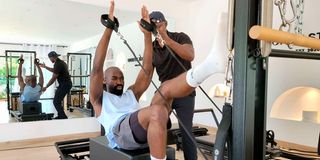
Hussein Hausa, 41, a Pilates trainer and instructor, demonstrates how the practice helps build strength, flexibility and better body movement.
Photo credit: Pool
Desk damage
For men who spend long hours sitting, Pilates can be particularly effective. Extended sitting weakens key muscle groups. Glutes and hamstrings become inactive, shoulders round forward, and the back overstretches. “Your biomechanics slowly become distorted,” Hussein says.
Pilates works to reverse this. Exercises such as bridging workout activate multiple muscle groups at once – glutes, hamstrings and lower back – improving stability and restoring movement. “You can see three different muscle groups being activated in one movement,” he explains.
By strengthening these areas, the exercise improves stability and encourages healthy blood flow. Sitting for long hours can reduce circulation and make muscles feel numb or inactive. Pilates helps reactivate those muscles. “We reactivate them by engaging them fully and specifically,” he says.
Strength shift
One of the biggest misconceptions is that Pilates cannot build strength. Hussein disagrees. “Yes, Pilates can help men build strength even without heavy weights,” he says.
Instead of lifting heavy loads, Pilates develops muscular endurance through controlled, repeated movements. Instructors often add exercises gradually, a method known as layering. As the body continues working through these layers, the muscles grow stronger and more resilient. Over time, this strengthens both large muscles and smaller stabilising ones often ignored in traditional training.
That is why shaking during exercises is common. “When you start shaking, it does not mean you are weak,” he explains. “It simply means smaller supporting muscles are beginning to assist.”
Pilates is as much mental as physical. It requires focus and concentration, especially when holding positions for extended periods. Hussein often reminds his clients to stay connected to their muscles. “Keep holding, keep feeling the muscle, connect with it,” he encourages.
This mind-body connection also supports mental well-being. As the body works, the brain releases chemicals such as dopamine, helping to regulate stress and improve mood.
Pilates benefits extend across sports. By improving joint mobility and alignment, it enhances performance in activities ranging from running to weightlifting. “When your joints move well and stay healthy, your performance in any sport improves,” Hussein says.
Because the exercises can be adjusted, Pilates suits everyone – from professional athletes to beginners.
Rather than waiting for physical problems, Hussein encourages early adoption. “You should never wait for signs,” he says. However, he notes that symptoms such as back pain, morning fatigue and joint stiffness often push people to seek help.
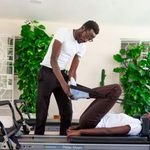
Pilates instructor Hussein Hausa assists a trainee during a session on the reformer machine at Sondr Studio along Kyuna Road in Nairobi.
Photo credit: Pool
Real results
For one of Hussein’s clients, Pilates was a turning point. After a decade of heavy weightlifting, injuries began to take a toll.
“I’ve always lifted weights,” he says. “But at some point, I started getting a lot of injuries because I wasn’t using proper form.”
The issue, he realised, was imbalance. Smaller stabilising muscles had been neglected, forcing larger muscles to overcompensate.
Pilates helped correct that.
“I basically relaxed on lifting weights so I could fix these smaller muscles,” he says. “Pilates targets muscles that a lot of weightlifters don’t even think about.”
Breaking stigma
He also highlights the stigma around certain exercises.
“Take the glute bridge, for example. Some people think it’s a very feminine exercise, but it’s actually great for both men and women,” he says.
For him, the goal was simple: it went beyond injury recovery to better movement and comfort.
“I wanted a better quality of life – to sit better, sleep better, just move better overall.”
There were unexpected benefits, too. “This one is underrated, but we should talk about it,” he says with a laugh. “It actually helped my sexual health,” he adds. “Pilates targets muscles around the hips, and you need good blood flow in that area. I didn’t start Pilates for that reason, but honestly, it improved that part of my life.”
Today, he combines Pilates with gym work, lifting lighter weights with greater control. “I’ve lowered the weight to about 60 percent of my max,” he says. “The idea is to feel the muscles working. Pilates helped me build that mind-to-muscle connection.”
He prefers morning sessions and currently attends once a week, although he would go more often if convenience allowed.
Reflecting on the results, he cites fewer injuries, improved posture and better body awareness. “A lot of it comes down to injury prevention, better movement, and just feeling stronger in the right places,” he says.