Time flies with great content! Renew in to keep enjoying all our premium content.
Prime
Why homes for the elderly are needed despite our culture
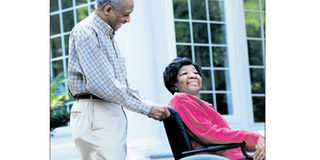
A man pushes an elderly woman in a wheelchair. Kenyans and Africans in general have very limited experience in dealing with the large numbers of old people, some of who have lived in urban areas all their lives. Photo/File
My British husband has suggested that we take my father to a home of the aged rather than staying with him in our house.
While my father is 79 and needs constant care (he is diabetic), I find that I might be accused of neglecting him. Also, I do not know how to tell my father why he cannot continue staying with us in Nairobi and why he should go to a home for the aged.
------------------------------------------
You raise a very topical question, which must be addressed sooner or later by all Kenyans.
Historically, there are a number of taboo subjects that “good Africans” do not discuss. One of them is the care of the elderly, the others being, the writing of wills, cremation, and in general all matters relating to death.
As a matter of habit and custom, many Africans prefer to wait until death has taken place to start planning. Even when it is obvious that a parent is on his last days on earth, the offspring continue to behave as though he will live forever and woe unto the one who implies that death might take place any time soon.
A few years ago, a highly educated and respected lawyer spoke to me about his 96-year-old grandmother who was in intensive care. He wanted to know what I thought best for the old woman.
In moment of misguided enthusiasm on my part, and without letting him finish his thoughts about his grandmother, I suggested it would be best to get the doctors switch off the machines and let go of the old woman, who after all had led a life of distinction, and whose children and grandchildren were making, or had made an indelible mark on Kenyan social, political and economic scene.
After I let him finish the question, it was then clear that it was not about switching off the machine. He wanted to know, which centres, anywhere in the world could receive his grandmother with a view to prolonging her life.
The family had decided to pull together in honour of the great woman and were prepared to go to whatever expense to keep her alive. After all, they argued, they were all that they were because of her. Same facts, different conclusions!
They wanted her to live longer, the doctors wanted a practical, pragmatic and scientific approach, which was to treat death as part of life, and accept it when they felt they could offer no more. Respectfully, the family disagreed.
This experience led me to reconsider my view on the whole question of the end of life debate. Prior to that, it was very clear in my mind that when medical evidence led to the conclusion that the elderly was in a permanent vegetative state, then only one route was left! Do not prolong life and suffering and certainly do not resuscitate!
This experience led me to believe that this matter was not black and white as it appeared from a doctor’s perspective.
The totality of the experience of the patient, her offspring, culture and spiritual background all played a part in whatever conclusion the family accepted. In the end, she died 10 days after my discussion with her grandson. To this day, the family remains convinced that in ignoring medical advice, it had done the best thing for the old woman!
You are presumably Kenyan, and hence reference to your British husband, who wishes to have your father placed in an old peoples’ home. In your predicament you join many other Kenyans who have your type of problem. There are several issues you raise.
The first is the clear case of a conflict of cultures. It is possible that your husband’s parents already live in an old people’s home in the UK, and that taking them there 10 years ago was as a matter of course and that neither your husband, his siblings and parents, gave the matter a second thought.
If you try to “throw your father” into an old people’s home, you will find the whole village, not just your siblings coming to condemn you! Your father is also likely to refuse to go!
Kenyans are not ready for old people’s home, just yet anyway.
Planning
Does that mean the days are not coming? Not at all, I believe that the time has come for those in their sixties and seventies to seriously start planning for their old age.
The baby boom generation is now coming face to face with old age. Kenyans and Africans in general have very limited experience in dealing with the large numbers of old people, some of who have lived in urban areas all their lives.
That life expectancy is steadily rising to that of Japan, USA and other countries, is not in doubt. More and more men and women will reach eighties and nineties. Old peoples’ homes are coming whether we like it or not.
Is the current arrangement where the elderly live with their children tenable? Given the toll on family life that persons with dementia for example place on their children, the time for this debate is now, not later.
As to your specific question of your father, husband and others, I would suggest you call a family meeting and seek to develop a consensus, in the knowledge that the situation will not be easy to resolve.
Unlock a world of exclusive content today!Unlock a world of exclusive content today!