Raymond Otieno: The man who ran 6,000km and now chases impossible distances

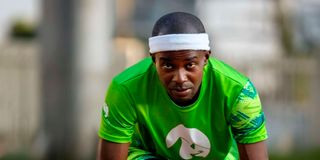
Raymond Otieno, an ultra-marathon runner, during a training session at Nyayo Stadium in Nairobi in March 2026.

You would expect Raymond Otieno to cite the Bible as the source of his motivation. After all, he makes a living selling Bibles and motivational books.

But the 38-year-old draws his drive from somewhere far less predictable.

“I don’t know how else to explain it. It’s that feel-good factor after those brutal runs, the endorphins. Not that I take bhang, but from seeing how happy and excited people get after smoking, that’s the same feeling I get,” he chuckles.

It is a revealing comparison for a man whose life revolves around endurance. In 2024, Otieno ran a staggering 6,000 kilometres – enough to carry him from Nairobi to South Africa.

“Last year I fell short, I did 5,600 kilometres, where it would not have been for the marathons I was preparing for, I should have clocked more,” he adds.

Endurance edge

This Saturday, Otieno, a recreational ultra-runner, will line up for an even more punishing test: a race known as One Man Standing.

“On this challenge, you run 6.7 kilometres every one hour until the last man is standing, who is declared a winner. So if you are fast enough, you can do the 6.7km in less than an hour and use the remaining minutes to recharge because at every hour you need to start a new run.”

The format is deceptively simple. The reality is anything but.

During peak training blocks, Otieno covers between 150 and 200 kilometres a week, roughly 20 kilometres a day, every day, rain or shine. In 2024, his 6,000km total meant averaging more than 16 kilometres daily without a single rest day.

Fuel, at that level, becomes ritual. Carbohydrates and protein form the base, with chapati a constant companion. During runs, he keeps things simple.

“I treat it like a normal day. If I am running from Nairobi to Naivasha, which is 91km, I will do my breakfast as usual, then lunch at whichever stop that finds me and then I just keep going because, as you might know, sometimes an ultra-run may take days.”

To some, such extremes would suggest a body on the brink. Otieno sees it differently.

“I think being able to push your body to the limit just explains how healthy you are. It means your organs are operating at optimum. The most important thing is how you recover,” he says. “I mean I eat everything. I eat chapatis during races, sometimes I do fizzy drinks like Coca-Cola that keep you alert, yet I remain very lean and super fit,” he stresses.

His recovery routine is disciplined, almost non-negotiable.

“Recovery is the most important thing. You sleep right, in my case, I do a minimum of eight hours. Eating right is also key, especially protein and complex carbs… I tend to compromise and do the chapatis and sodas during the runs because you need carbs that your body can easily digest.”

Occasionally, he turns to physiotherapy. Other times, the solution is simpler.

“Sometimes, it’s as simple as soaking my legs in cold water after a long run or a bucket of ice cubes. You recover right, and your body learns to handle the distance.”

Ultra-marathon runner Raymond Otieno is redefining endurance one kilometre at a time.

Photo credit: Pool

Road calling

Otieno’s path to ultra-running was anything but direct.

He grew up in Nairobi’s Eastlands, where football, not distance running, dominated. From the age of 12, he played on dusty pitches, running only to chase a ball, never for its own sake.

That changed when he stumbled across videos of ultramarathon legend David Goggins.

“I was really motivated. He is a retired Navy SEAL and calls himself the toughest man alive. He completed Navy training, one of the hardest physical training programmes in the world, three times. Even at 51, he is still going,” he says.

What began modestly, a half marathon here, a 21km stretch there, soon escalated.

The turning point came in 2024 at the Mountain to Mountain race, an 80km ultramarathon across high-altitude terrain under punishing heat. He finished in just over eight hours.

“When I completed that one, I knew I was ready. Now I can do ultra,” he says, laughing.

These days, Otieno seeks out races that border on the absurd. Backyard ultras like One Man Standing test not just endurance, but psychology, runners complete 6.7km loops every hour until only one remains.

“The last runner standing earns the right to represent their country at the ultra-run world championships.”

But his journey is no longer just personal.

Otieno is part of a growing running collective organising town-to-town ultra-challenges, a community built on pushing limits and pulling others along. Using GPS technology, they map routes between towns, turning Kenya’s open roads into proving grounds. Their ambition is bold: to link seven towns in a single, continuous ultra-run.

“It’s not just about running, but about stretching limits and pulling others along in the process. The more you run, the better you become.”

For a man who sells motivation for a living, Otieno seems to have found his own version,  just not in the pages he trades.

Follow our WhatsApp channel for the latest business and markets updates.

PAYE Tax Calculator

Note: The results are not exact but very close to the actual.