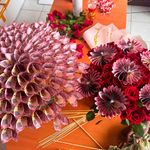
People spend a lot of money on flowers that die within days. What if I told you that the fresh bouquet you received over the weekend, could last for an entire month? How is that possible?
According to Michael Wangai, who runs Flower Zone in Nairobi, the longevity of your bouquet begins the moment you select it at the florist.

"Customers usually tell us that fully opened flowers are the best. But that is not the case," says Michael. "If you want flowers that will last longer, you have to go for those that are slightly open. A bud will gradually open over time, and you'll enjoy watching it bloom over the next few days or weeks."
Cynthia Kitur, who runs Sekani Flower Shop, sees another common mistake that happens before the flowers even reach a vase. "People receive flowers, get excited, and take photos to show them off. By the time they put them in water, hours have passed," she explains. By the time the stems finally touch water, the damage has already been done, and the flowers' lifespan has been significantly shortened.
Fragility vs endurance.
Walk into any flower shop, and you'll see roses everywhere—red for love and pink for admiration. But here's something that might surprise you: roses are the most high-maintenance and shortest-lived flowers you can buy.
"Roses have weak petals, and they wither faster," Michael explains. The softness that makes them pleasant to touch also makes them fragile. Add to that the fact that what we get locally is often not top quality.
Cynthia reveals that "export-grade flowers go to Europe and other countries, while what remains is sold locally."
If you want flowers that last, Michael says, "Chrysanthemums can last up to a month, or at least three weeks with proper care."
Lilies, carnations, and spathodeas have a similar lifespan. While they might not have the romantic reputation of roses, they offer something roses can't: endurance.
Michael Wangai, founder and CEO of Flower Zone, places a bouquet of flowers in water to prolong their freshness at his shop in Nairobi’s Central Business District on February 7, 2026.
Photo credit: Wilfred Nyangaresi | Nation Media Group
"Mix it up! Get a few roses for romance, but base your arrangement on longer-lasting flowers, such as chrysanthemums. That way, you get both symbolism and longevity," says Michael.
He is categorical about one thing: "Changing the water daily, particularly for roses, is perhaps the most important factor in flower longevity." Yet, most people skip this step, thinking they can just top up the vase every few days without any consequences.
It's important to change the water daily because bacteria start forming in the vase water almost immediately, feeding on bits of organic matter from the stems and any leaves that fall in. This bacterial soup clogs up the stems' vascular systems—the flowers' "straws"—so even if your vase is full, your flowers are dying of thirst because they can't absorb the contaminated water.
Cut the stems diagonally
Every time you change the water, make a fresh cut on each stem using clean scissors or shears. "Cut at an angle, a centimetre or so," Michael advises. The diagonal cut increases the surface area for water absorption.
Strip off any leaves below the waterline
"Any foliage that sits below the waterline will rot and contaminate the water," Michael warns. This is crucial because leaves underwater start rotting quickly.
Add jik and sugar to the water. This is one of Cynthia's favourite tricks. If you have flower food packets, use those. But if you don't, add just a capful or less of jik to a standard vase of water. Jik kills the bacteria in the water," she explains.
Then, add a bit of sugar. "It's for osmosis," she adds.
Finally, spray the flowers with water since external moisture helps too by supplementing what comes up through the stems. Keep them cool
"Even when flowers are being transported from farms in Nakuru to Nairobi, the temperature in the trucks is regulated. High temperatures make flowers wither faster," she explains.
If you've bought flowers in advance, refrigerate them overnight. When displaying them, keep them away from direct sunlight and heat sources. "Direct sunlight means a higher temperature, which accelerates wilting," Cynthia notes. That sunny windowsill that seems like the perfect spot to show off your bouquet is actually killing your flowers faster.
What about mixed bouquets?
Many bouquets mix different flowers, such as roses for romance, lilies for elegance, and chrysanthemums for fullness. However, these flowers have different needs, raising an interesting question about how to care for them.
"Use two vases," Michael suggests, "if you're serious about maximum longevity." "Keep roses separate from tropical flowers like chrysanthemums and lilies." This way, when the roses start to decline faster, they won't drag down the longer-lasting varieties.
Cynthia offers a different perspective that feels more realistic to most of us. "When flowers are put together, it's purely for aesthetic value. It's not a problem to have flowers with different needs together in one place. It will still work for all of them," she says.
Unlock a world of exclusive content today!Unlock a world of exclusive content today!