Most people are drawn to a planter based on its colour, shape, and whether it looks right in the space they have in mind.
Magdalyne Kataa, a pot and plant seller based in Ruiru, says that such instinct is fine, but it is only half of the decision-making process and often the less important half.
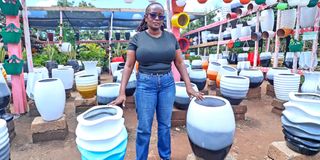
“The other half has nothing to do with aesthetics. It's about root space, drainage, the material used, and whether the pot is suitable for the conditions in which the plant will actually live in,” she says.
"Get these wrong, and you'll end up with a struggling plant in a beautiful pot."
Samuel Kungu, a pot seller based in Karen, agrees. He explains that a hanging pot that looks great on a Nairobi apartment balcony would be unsuitable for a large garden, while a wide ceramic bowl that is perfect for a slow-growing succulent would not be suitable for a fast-growing palm.
“The moment you try to find one universal answer, you are already asking the wrong question,” says Samuel.
So, what should you consider when picking a planter? Size is the most important factor for plant health. Magdalyne explains that roots need enough room to expand as the plant grows.
“If you put a plant in a very small pot, it will prevent it from growing,” she says.
The plant stalls not because there is anything wrong with the soil or the light, but because the root system has nowhere left to go. And if a plant is placed in a pot that is too large for it, the excess, wet soil will cause rotting.
Clay planters on display at Meg Pots and Plants outlet along the Ruiru Eastern Bypass on May 2, 2026.
Photo credit: Wilfred Nyangaresi | Nation Media Group
Magdalyne's rule of thumb is to match the depth and width of the pot to the plant's growth pattern, rather than its current size.
“Deep containers suit plants with long taproots, such as trees and tomatoes, or anything growing aggressively downward. Shallow, wider containers suit plants that spread horizontally, such as herbs, succulents, and ground-cover varieties,” she says.
The material your planter is made of shapes the growing conditions inside it, often in ways that are invisible until something goes wrong.
“Plastic is lightweight, affordable, and retains moisture well, making it a practical choice for plants that need consistent watering, as well as for anyone who moves their pots around frequently,” Samuel says.
Clay and terracotta are porous, meaning water evaporates through the walls as well as the soil surface. This is ideal for plants that prefer to dry out between waterings, such as succulents, cacti, and most Mediterranean herbs. However, for moisture-loving plants, Samuel says it means watering far more frequently than planned.
“Ceramic is well-suited to indoor plants in stable environments, but it is heavy and often expensive, and the glaze reduces breathability compared to unglazed clay. Its weight also makes it impractical for balconies or situations where it might need to be moved,” says Samuel.
Sandcastle-style bucket planters on display at Meg Pots and Plants outlet along the Ruiru Eastern Bypass on May 2, 2026.
Photo credit: Wilfred Nyangaresi | Nation Media Group
As for metal planters, they have a clean, modern look but can be problematic in an overly hot environment.
“Metal conducts temperature efficiently, so a metal pot in direct afternoon sunlight will heat the soil to a temperature that can damage the roots. If you want to use a metal pot, keep it in the shade or use it indoors,” advises Magdalyne.
Wood insulates roots well against temperature swings and brings natural warmth to a garden or balcony.
“The vulnerability is moisture—untreated wood rots, particularly in high-rainfall conditions. Treated or lined wooden planters can last a long time, but they do require maintenance,” she adds.
Fibreglass is a relatively new product on the Kenyan market.
“Unlike clay, it gives you a lot of flexibility,” says Magdalyne.
“For anyone who wants both functionality and design freedom, fibreglass currently occupies the strongest position of any available material.”
Drainage
Your planter must drain.
"A pot without drainage holes creates a reservoir of stagnant water at the base of the soil that roots cannot escape. The roots sit in stagnant water, so oxygen cannot reach them, and they begin to rot."
Magdalyne advises checking for drainage holes before buying.
For indoor plants, place each draining pot on a saucer and empty it regularly.
Match your planter to your space
Magdalyne notes that balcony-hanging pots have become one of her fastest-selling products. Troughs, long rectangular planters that hold two or three plants side by side, let you add variety without placing pots everywhere.
In a suburban home with a garden, think big, says Samuel.
“Large statement pots anchor outdoor spaces and allow for plants that cannot live in small containers, such as trees, tall grasses, and dense shrubs,” he explains.
Samuel Kung’u Wanjohi, a salesperson at Samscapes Solutions, poses for a photo at the outlet along Ngong Road in Nairobi, on May 2, 2026.
Photo credit: Wilfred Nyangaresi | Nation Media Group
Magdalyne often recommends lemon cypress in tall fiberglass pots for walkways and driveways.
However, a common mistake is overcrowding, which affects all living situations. A wall of pots overcrowded into a corner may look lush in photographs, but it struggles in reality.
“Plants compete for light and air. Fewer pots, placed where conditions genuinely suit the plants inside them, will always outperform a crowded collection,” says Magdalyne.
If you want a green space that doesn't require a lot of maintenance, it's better to have fewer large pots with slow-growing, drought-tolerant varieties than many small pots that demand regular attention.
“Some clients will tell you, ‘I rarely stay at home, so I need something that requires minimal care,'" says Magdalyne. Matching the plant and pot to this reality is as important as any other factor.