Pilau is one of the most-cherished dishes in Kenya. From weddings to funerals, the aromatic, spice-laden rice is a staple feature, so much so that for many, a celebration hardly feels complete without it. This popularity, however, has given rise to many interpretations, raising the simple question: what actually makes pilau, pilau?
Qamili Dave, a professional chef and content creator in Mombasa, says pilau is not pilau if it lacks meat (preferably chicken), potatoes, and five main spices: cardamom, cinnamon, clove, black pepper and cumin, the core ingredients in her recipe, which she inherited from her mother.
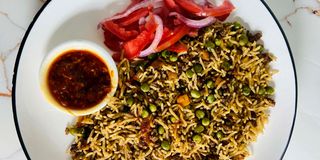
“I usually start with making a flavourful broth because that’s what gives the pilau its main taste,” she says. “So I caramelise the onions, add in the spices, then the chicken goes in to cook first. When it's ready, I add the potatoes and finally the rice comes in last. You can tell that it’s ready when the rice is properly cooked and all the water has evaporated.”
But while some people swear on using whole spices, chef Qamili grinds hers just so she doesn’t have to pick the pieces out of her food later.
Having travelled across East Africa through food, she has also encountered different versions of the one-pot rice dish across cultures.
“Pilau is a global dish but every culture has its own version,” she says. “One of the more interesting versions I’ve seen includes a dried black lime, which adds a really nice but very strong tangy flavour.”
Seby Onyango, founder of Jikoni Yangu.
Photo credit: Pool
But while she avoids defining the dish in one singular way, she is firm on one point. “Tomatoes have no business in pilau,” she says simply.
For her, the ideal serving is on a communal sinia, with a side of kachumbari and plain natural yoghurt.
Well salted pilau
Muthoni Kirunyu is a self-taught chef and founder of Kirunyu’s Kitchen. Growing up, her grandmother would make pilau regularly.
“She would make it all the time, but I didn’t learn my pilau recipe from her,” Muthoni says. “She was a big fan of curry powder and she used it in most of her dishes, including pilau. But while I like curry, if you add it to pilau, you no longer have pilau.”
For her, a proper pilau needs cumin. She lightly sautées the seeds in a pan together with the other spices before grinding them. Then she caramelises her onions to a deep brown colour.
“Most Swahili pilau is lighter in colour because the onions are not browned fully, but I like to let mine brown completely,” she says. “This is not to mean let the onions burn, you just want a golden brown hue before adding the beef and spices and letting them deepen the colour and flavour even further.”
And while others prefer adding meat directly to the pot, Muthoni often recommends boiling it first.
This, she says, serves two purposes: it ensures the meat is tender and provides a rich stock that can be used to cook the rice.
Once the spices are well infused into the meat, she adds the rice and stock, then seasons the mixture.
“I love a pilau that is well salted,” she says. “I usually advise tasting after adding the stock. The goal is to have it tasting almost as salty as the ocean, but not beyond that.”
Muthoni Kirunyu, founder of Kirunyu’s Kitchen.
Photo credit: Pool
For the stock-to-rice ratio, Muthoni sticks to two cups of liquid for every cup of rice, though she notes this depends on the type of rice used.
As for what to avoid, she agrees that tomatoes and tomato paste lean more toward jollof rice than pilau, but she also cautions against adding soy sauce.
A meat enthusiast, she also avoids limiting the amount of meat in the dish. For her, the ideal ratio is 1:1, that is, one kilogramme of meat for every kilogramme of rice.
“The authentic Swahili pilau also has potatoes, but despite my central roots, I do not enjoy the taste of potatoes in my pilau,” she says. “I prefer to keep them in stews or bake them as a separate dish.”
In addition to kachumbari and yogurt, she also serves her pilau with a banana on the side.
Pilau Indian style
Dia Raithatha, popularly known as 'Indianting', says authentic pilau should not be overly dry.
“We add more water than usual, so it’s saucier and slightly more tender than the traditional Swahili pilau,” she says.
Her Tanzanian-Indian mother blends both Indian and Swahili techniques, resulting in what Dia, a food vlogger and digital marketer, describes as her favourite meal.
“I find it very wholesome and comforting and I especially like that it’s just one dish that’s both simple and filling at the same time. I prefer it over curry or even biryani.”
The spice profile too, is different.
“We use minimal spices,” she says. “The masalas are in small quantities, but the main flavour profile comes from black pepper and whole green chillies.”
Another non-negotiable in their kitchen is bone-in chicken.
Mombasa-based Chef Qamili Dave.
Photo credit: Pool
“We use chicken for pilau more often than we do mutton, but it always has to be on the bone,” she says. “This makes the meat more tender and much more flavourful than boneless cuts.”
For her, a bad pilau is one where the meat is tough, the spices overwhelm rather than comfort, and the dish feels disjointed in terms of texture and flavour.
Dia likes to pair her pilau with strained Mala (sour milk) that’s been seasoned with cumin and a pinch of salt, alongside a kachumbari that leans less towards tomatoes and more toward onions, lemon and chillies.
Pilau experimentation
Seby Onyango, founder of Jikoni Yangu, makes a pilau that defies all the rules. Not that she doesn’t know them - she does. But for her, cooking is an art. It is about experimentation.
“I know the typical Swahili recipe and it smells good and tastes even better,” she says. “But if it's your recipe, you can always make it your own and see how it turns out. If it tastes good, then that’s what matters.”
For the perfect pilau, her non-negotiables are cardamom, cumin, the right rice and the right heat.
“All you need is to grind your spices well, have the right kind of rice - which you shouldn’t rub too hard while washing or stir too much while cooking, measure your ingredients well, and maintain your heat between medium and low.”
Her heartiest version leans boldly away from tradition. It includes peas, chopped carrots, curry powder, dark soy sauce, more frying oil than usual, and minced instead of cubed beef. Sometimes, she even adds in some tomato paste.
“I’m certain there are people who will say that this is not pilau,” she says. “But it tastes just as good as the regular pilau, only that this one has a bit more flavour. And who is to say what is right or wrong?”
Sharing one of her cooking hacks, she emphasises keeping the lid on throughout the cooking process, to trap in the aroma.
She serves her pilau with pilipili ya kukaanga, kachumbari, chicken stew and a drink of choice.
“Even after I’ve finished cooking, before I do anything else, I fluff the rice slightly then cover it with foil and let it sit for about 15 minutes,” she says. “This just makes it more flavourful.”