Time flies with great content! Renew in to keep enjoying all our premium content.
Prime
How Ethiopian cuisine is winning Kenyan foodies
Guests enjoy a traditional Ethiopian meal at the “Infinite Plate,” hosted by the Embassy of the Federal Democratic Republic of Ethiopia on March 28, 2026.
Photo credit: Wilfred Nyangaresi | Nation Media Group
If you’ve ever sat around a table with friends, picking nyama choma straight from a shared wooden tray, then you already understand the heart of Ethiopian cuisine.
The difference is that here, everything—the meat, lentils, greens—is laid out on a single large platter, spread over soft injera. There are no plates, no cutlery. You eat with your hands, tearing off pieces of the spongy flatbread and scooping up rich stews.
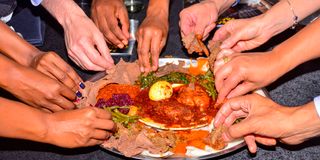
It is not just a way of eating. It is a way of being together.
The embassy of the Federal Democratic Republic of Ethiopia hosted an immersive cultural and culinary experience at Trademark Suites Enaki. It started with live cooking, then followed large siniya that were set at tables to be eaten the Swahili way.
Although some hesitated and reached out for side plates, others just adjusted, helping themselves to injera and scooping up the doro wat and tibs.
Food as identity and heritage
Bethlehem Bayu, the Second Secretary for Public Diplomacy at the Ethiopian Embassy, says the presented master recipes were meant to reflect the structure of a traditional Ethiopian banquet.
Bethlehem Bayu, Second Secretary for Public Diplomacy at the Ethiopian Embassy, speaks during an interview at the “Infinite Plate” event hosted by the Embassy of the Federal Democratic Republic of Ethiopia on March 28, 2026.
Photo credit: Wilfred Nyangaresi | Nation Media Group
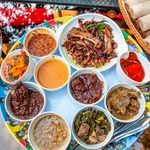
“We presented five Ethiopian dishes, the doro wat, tibs, shiro wot, misir wot and gomen. We also had the Birz, which is a traditional Ethiopian non-alcoholic honey beverage and of course, injera,” she says.
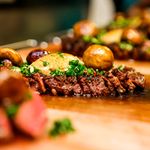
Each of these dishes shows a different part of Ethiopian cuisine. Tibs, for example, is an Ethiopian tendered steak cubes which feels familiar to the Kenyan diners.
“Doro wat is a national dish. We present it whenever we have a very special occasion. It takes hours and hours of caramelised onions and chicken as well, that’s our signature dish for Ethiopians,” Bethlehem says.
“Injera is almost the base for every Ethiopian cuisine. It’s our utensil, our basic dish. It carries a lot of memories as well. We eat communally. We share plates, which leaves us with no choice but to eat together,” she adds.
The Ethiopian style of dining is built on togetherness, which forsakes individual plating. One of their most defining practice is gursha, where one person feeds the other by hand. This is often done between close family members and friends, but it also extends to guests as a sign of hospitality.
“Gursha is the ultimate expression of love and respect for one another.”
Bethlehem also acknowledges that this way of eating has been misunderstood.
“Many foreigners struggle with the idea of eating with their hands. There are concerns about hygiene, but for us, it reflects our connection to the food and to each other.”
Moving between it all were glasses of birz, which is a traditional fermented Ethiopian honey drink. It is light and slightly sweet.
Recipes passed through memory
Ethiopian culinary traditions are largely passed down through experience rather than formal instruction.
Most of the time the women in the household are in charge of preserving those cuisines, the ingredients and the cooking process. “But Ethiopian women are starting to document their way of cooking and many learn from that,” Bethlehem says.
“Ethiopian dish is more than food. It is about experience, togetherness, and unity. It is not about just sharing meal, it's sharing emotions, burdens,” she adds.
Ethiopian coffee is served at the “Infinite Plate,” hosted by the Embassy of the Federal Democratic Republic of Ethiopia on March 28, 2026.
Photo credit: Wilfred Nyangaresi | Nation Media Group
For newcomers, she recommends starting with something familiar.
“Tibs is a good entry point for Kenyans,” she says. “Though I was surprised that many here already enjoy doro wat, which is one of our spiciest dishes.”
Culinary diplomacy
Ambassador Demeke Atnafu, the Deputy Head of Mission of Ethiopian Embassy in Kenya, says the event is part of a broader effort to connect people and countries through culture.
“This is culinary diplomacy,” he says. “It uses food and shared experiences to build cross-cultural understanding.”
He explains that food creates a space where people can engage naturally, without the formality that comes with official meetings.
“It contributes a lot in building and nurturing connections and the relationship between governments as well as the peoples of the two countries. It is also part of the cultural exchange programme.”
Ambassador Demeke Atnafu Ambulo, the Deputy Head of Mission at the Ethiopian Embassy, during an interview at the “Infinite Plate,” hosted by the Embassy of the Federal Democratic Republic of Ethiopia, on March 28, 2026.
Photo credit: Wilfred Nyangaresi | Nation Media Group
The ambassador adds that such exchanges are important because they deepen understanding beyond the surface-level interactions.
“When the two people come to know each other’s culture, it would be a good base and foundation to further enhance both political, economic, and other aspects of the relationship. We aim to promote Ethiopian cultural heritage and also the positive image of Ethiopia through food.”
At the same time, it has practical benefits. It promotes tourism between the two countries.
The ambassador says that by introducing people to Ethiopian food, culture and traditions, it creates interest and curiosity that can extend beyond the event itself.
A growing market
For Eva Mwangi, Head of Sales and Marketing at Tribe Collection, events like this reflect a broader shift in how people engage with food.
Eva Mwangi, Head of Sales and Marketing at Tribe Collection, during an interview at the “Infinite Plate” event hosted by the Embassy of the Federal Democratic Republic of Ethiopia on March 28, 2026.
Photo credit: Wilfred Nyangaresi | Nation Media Group
“There is growing curiosity,” she says. “We host an international cuisine every month. People want more than just a meal—they want to see how it’s made, to understand it.”
Authenticity, she adds, is key.
“Maintaining the integrity of the cuisine is important. It helps avoid losing its meaning when introducing it to new audiences.”
Kenyan diners, she notes, are becoming increasingly open, though familiarity still shapes preference.
“Elements closer to Kenyan culture—like the lighter injera—are adopted more quickly than the darker, more fermented versions. But people are open. They want the experience.”
That openness is creating new opportunities for the hospitality industry.
“If there’s diplomacy needed in the world,” she says, “food is what softens the conversation.”
More than a meal
For Yvonne Makena, who once lived in Addis Ababa, Ethiopian cuisine is deeply personal.
Singer-songwriter Yvonne Makena during an interview at the “Infinite Plate,” hosted by the Embassy of the Federal Democratic Republic of Ethiopia on March 28, 2026.
Photo credit: Wilfred Nyangaresi | Nation Media Group
“The food is fantastic. It is tied to everything they are…the sense of family and community,” she says.
Replicating that authenticity in Nairobi, however, can be difficult. Beyond taste, she highlights its health benefits.
“Injera is fermented, so it’s good for the gut. And the food is rich, not just in flavour, but in the time and care that goes into it.”
Ethiopian cuisine is known for its slow cooking techniques and flavours. Many dishes take hours to prepare, especially stews like doro wat, which relies on slowly caramelised onions and a blend of spices.
Spices are central to the cuisine, the blends like berbere (a mix of chilli, garlic, ginger and other spices) and mitmita give their dishes depth and heat. Additionally, legumes like lentils, chickpeas and split peas are used to create rich stews like misir wot and shiro wot, that makes the cuisine naturally diverse and suitable for vegetarian diets.
The vegetarian dishes are also partly influenced by religious practices, especially the fasting traditions in the Ethiopian Orthodox Church, where many people avoid animal products on certain days.
Makena, a self-confessed enthusiast, has her favourites.
“I eat Ethiopian food almost every day. I always have injera in the house,” she says. “I love tibs firfir and doro wat.”
Traditional Ethiopian bread prepared for serving at the “Infinite Plate” event hosted by the Embassy of the Federal Democratic Republic of Ethiopia on March 28, 2026.
Photo credit: Wilfred Nyangaresi | Nation Media Group
At the event, an elderly Ethiopian woman prepared coffee the traditional way—roasting, grinding and brewing it in a clay pot known as a jebena. She poured it into small cups with quiet precision, turning the act into a ceremony.
Nearby, a woven basket of bread rested quietly, like an extension of the meal.
In Ethiopian culture, coffee is more than a drink—it is a ritual. The ceremony, performed in multiple rounds, is one of the most important social traditions, bringing people together in conversation and reflection.
And that, perhaps, is the essence of it all.
Ethiopian cuisine is not just about what is on the table. It is about who gathers around it—and what is shared between them.