Why more Muslim women are embracing butter yellow and burgundy hijabs

Anzal Sheikh, founder of Soubh; and Anisa Ibrahim Haithar, a law student and aspiring content creator. Hijab-wearing women are now going for bold prints and bright colours.

Photo credit: Pool

Growing up, Zahira Khalaaf wore hijabs with muted colour tones. She thought these colours signaled maturity while brighter hijabs were attention-seeking. But today, that thinking is changing.

“Now it’s all about preference,” the 25-year-old says. “We’ve evolved from just three options [blacks, browns and whites] to so many colours like butter yellow and burgundy.”
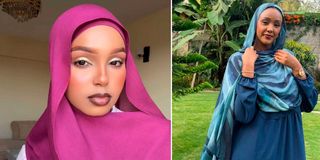
Hijab-wearing women are now going for bold prints and bright colours.

“These options have always been there; they’ve only now become more accepted because of social media trends and constant exposure,” Zahira adds.

A resident of Mombasa, Zahira says she gravitates toward colours that complement her skin tone.

“I’m currently leaning toward baby pink, burnt orange, and jungle green because they make my skin pop,” she says. “If my outfit is simple, then I pair it with a hijab that has florals, patterns, or accents. When I’m happy, I choose brighter colours like yellow, and then when I want something more earthy or adventurous, I go for the greens and browns.”

The choice of hijab for younger women, she says, comes down to confidence. “It’s the same as a woman choosing to wear bold red lipstick,” she says. “A bold hijab on a woman shows she wants to stand out, but also that she belongs.”

For Anisa Ibrahim Haithar, a law student and aspiring content creator, she appreciates how bold prints and brighter hijab colours allow her to stand out. “I always feel more expressive and more confident when I have them on.”

But this has been a gradual shift. It wasn’t always the case.

“I never used to experiment with colour until I went hijab shopping with my friends and they asked me why I didn’t wear bright colours often,” she says. “I initially picked what felt safe.”

Even so, wearing bolder hijabs comes with judgment.

“People are very supportive, but there are also moments of judgment. Sometimes you hear comments like, ‘Why hide your beauty behind a hijab?’ and that can be frustrating because it completely misses the point.”

Remove hijab

She talks of some posts on social media showing women choosing to remove the hijab.

“This shift shows that Muslim women are thinking deeply about their faith and making choices, even when those choices look different to the majority. It also reminds us that everyone’s journey is not the same. Some women are growing into the hijab, some are redefining how they wear it, and others are stepping away from it, each of them shaped by their own realities,” says Anisa.

Anisa Ibrahim Haithar, a law student and aspiring content creator, says the hijab is both a spiritual commitment and a form of personal expression.

Photo credit: Pool

31 colours

As more women embrace individuality in their hijabs, vendors say the change is showing up in the market.

Anzal Sheikh, founder of Soubh, has been selling hijabs and their matching undercaps for three years now. She has had to evolve with changing demand.

“I started with the usual neutral colours, but now I stock 31 colours, and I add more every few months,” she says.

“My clients especially love the printed hijabs, but colours like butter yellow, light blue, mint green, lilac, dark purple and pastels are increasingly popular as well.”

According to Anzal, while she might skip out on stocking neutral colours every now and then, demand for prints has grown so much that sales happen almost daily, or every two days. Bright colours are also catching up with sales at least three times a week.

“Not everyone has shifted, but people are definitely no longer scared of colour. I get customers who used to wear only black or brown now asking me what colour suits them best. ”

Social media trends, she believes, have been the biggest catalyst of this changing tide, with women in their 20s leading the charge. Her hijabs retail at Sh1,600 for plain styles and Sh1,800 for the printed ones.

 Anzal Sheikh, founder of Soubh, says demand for bold and printed hijabs has grown, driven largely by younger consumers and social media trends.

Photo credit: Pool

Office wear

At Zuri Modest Wear, however, the picture is slightly more nuanced. Founder Aurelia Shabaya Hafsa says that while bold prints and colours are gaining popularity, neutral tones still dominate everyday wear, especially among working women.

“Many of my clients go for black, grey, and brown,” she says, noting that these colours remain popular for office settings because they are easy to style and require little thought. “They’re safe, you don’t have to overthink.”

Still, she acknowledges the clear shift among younger customers.

“For university students and younger ladies, though, they like the coloured and printed ones,” she says, pointing to an increase in demand among those in their late teens and early 20s.

“I used to sell about 20 percent of the bold hijabs stock back in 2019, but now it can go up to 80 percent,” she says.

PAYE Tax Calculator

Note: The results are not exact but very close to the actual.