Rich Kenyans are increasingly buying rocky, bushy and vast jungles in the middle of nowhere. The large landholdings in remote areas, some spanning over 2,000 acres and located in private conservancies, have become investment hotspots as the wealthy seek privacy, space, and to benefit from the carbon credits market.
Naivasha, Gilgil, Samburu and Nanyuki are emerging as favourite spots for these individuals.
“There is this whole concept of land banking. Some investors use land banking as a strategy to benefit from value appreciation, based on a future forecast of development in a given area, which triggers land appreciation. Remember, land requires very little maintenance, yet it acts as a hedge against inflation,” explains Johnson Denge, a former Real Estate Services Advisory Manager at HF Group.
When Kenya’s ultra-wealthy invest money in remote areas or wildernesses, Mr Denge says it is rarely a gamble. He adds that these investments are always calculated, heavily backed by data and refined by wealth advisors, who rely on long-view forecasts that a majority of Kenyans have no access to.
“High-net-worth investors operate with a different compass. They have access to what I like to call policy direction. In some cases, you will find some of them are actually involved in the formulation of those very policies. So, it is easier for them to tell where the development is going to go in the next few years, and so they move early to position themselves where the next wave is most likely to break,” he adds.
The expert disagrees with the analogy that one of the key factors driving this interest in off-grid land is that the traditional wealthy enclaves are now crowded, forcing them to discover other areas where they can diversify their portfolios.
“I don’t necessarily think that is the case. Land has always appreciated when you compare it to equities and other forms of investments, especially right now. Look at the market where the government is borrowing heavily, they [the wealthy] still have gotten more value in bonds and other government securities,” Mr Ndenge says.
The drivers could be infrastructure-led or mineral deposits, but not limited to these.
“It could also be that there are rare minerals that exist in such areas, and they have a strategy where, in the future, they are likely to be exporting. There is also a growing market, due to climate change around carbon trading, and some of these conservancies have become a good front for these kinds of businesses,” Mr Ndenge.
Carbon credit markets
Quality carbon vintages are now seen as a luxury good similar to watches. The latest Knight Frank Wealth Report notes that forward-looking investors and businesses are looking for land for carbon sequestration projects.
“There have been some big deals,” it said.
Carbon sequestration projects turn forests, rangelands and soil into financial assets by measuring the carbon they absorb and converting that storage into credits that companies can buy to offset emissions elsewhere.
“They take years to produce, but the result is high-quality, limited edition pieces that command a premium [price] – and may have a waiting list,” Rich Stockdale, founder of Oxygen Conservation, which aims to “store carbon, provide space for nature, and deliver positive environmental and social impacts” was quoted in the wealth report.
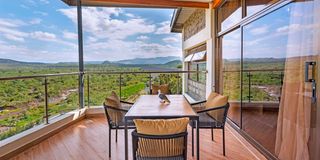
One such property is Kambi Moran (Sleeping Warrior Camp), being developed by a Kenyan businessman.
Located at the slopes of Sleeping Warrior Hills, deep within Soysambu Conservancy, cabins rise from the wilderness, facing Lake Elementaita and Ugali Hills.
In the mornings, buffalo graze in the distance. Zebras roam throughout the day. At night, the laughter of hyenas echoes through the darkness.
There is constant noise from helicopters taking off and landing over the camp, and more often, top-of-the-range cars in the parking area.
Three years ago, when the investor acquired the more than 2,000-acre land, he built a tented camp, a silkworm factory and a carbon credits centre.
“A lot is going on here. For example, we raise silkworms, where part of its bi-products is used in the production of cosmetics such as shampoo, conditioner, lotion, and soap. The plan is to produce more for retail and export,” Steve Ododah, the general manager overseeing operations and the ongoing construction of the camp, tells the BDLife.
“With the race to net zero intensifying, vintage carbon could be a game-changer both for those producing credits and those investing in them,” noted Flora Harley of Knight Frank on the evolving market.
Holiday destination
Although the construction of the camp is still ongoing and has not officially opened to the public, it has started attracting wealthy holidaymakers.
“We are yet to fully commercialise the property. There is still a lot of construction going on to develop the place from a bushy, rocky jungle. So you won’t find us on any online booking site, but once in a while we get enquiries and host guests, especially affluent individuals and corporates. Those enquiries, I would say, are by word of mouth,” Steve says of the camp which recently housed Safari Rally fans who paid between Sh60,000 and Sh75,000 per night.
They have also hosted weddings, with couples paying Sh1 million for the grounds.
“When we host weddings, we curate bespoke experiences like an open bar, which you don’t get in most hospitality facilities,” he adds.
These privately-owned wilderness lodges also doubles as small-scale farms.
“We raise our own goats and cows. We have about 140 goats, and we’re in the process of importing rare breeds from South Africa, the Boer, Savanna and Kalahari Red, known for their quality meat. We also rear our own chickens and even grow our own herbs on the farm,” says Steve.