Time flies with great content! Renew in to keep enjoying all our premium content.
Prime
The Kenyan who swims with sharks for a living
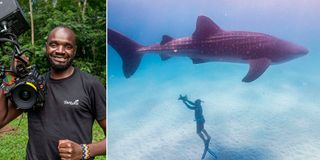
Anthony Ochieng, Kenyan conservation photographer (left) and a whale shark photographed off Mafia Island, Tanzania, featuring National Geographic Explorer Mogamat Shamier Magmoet from South Africa.
Anthony Ochieng, 37, has charted a rather unusual career path and found his true calling in a highly demanding workspace. The career conservation photographer has made a living out of underwater photography for the last decade.
Even though it was not part of his grand plans, the first time Mr Ochieng swam with a shark in the Indian Ocean was a career-defining moment.
“I descended into the waters near Mafia Island off the coast of Tanzania fully kitted and with a mind racing with both excitement and fear. You know sharks, people always talk about sharks,” he says. “They are often painted in the wrong way that makes everyone afraid.”
For Mr Ochieng, that moment confirmed that he had found his calling. It not only increased his passion for conservation, it also redirected his career to a new path.
Today his work days are defined by deep dives into oceans around the world, swimming alongside marine predators and fragile coral ecosystems while photographing them to tell stories about conservation.
The workplace hazards
His job comes with its many dangers like encountering an unfriendly sea creature, strong waves that could present a catastrophic ending of an expedition and many more. Mr Ochieng, however, feels at home under water.
“It’s usually a very peaceful place,” he says. “I’m in my element when I’m underwater.”
A decade-long experience and safety protocols like having a dive buddy, a designated partner who accompanies him for safety underwater, are some of the things that helped him manage the fear.
He also shares that, all careers pose potential professional hazards and underwater photography is no different.
Beyond the eminent danger, Mr Ochieng has practiced among very few Africans. “I can only count less than 10. And this being a small industry, I can authoritatively say that we are not more than 10.”
This made Mr Ochieng work more-harder than it is typical to prove his skills and earn a seat on the high table of underwater photography. “I wouldn’t call it racism, maybe it is the industry not being used to seeing black people like me and therefore it demands more from us. That means more scrutiny. It eventually works in your favour because you learn to be perfect in your shots, timely in delivery to hit all those indices.”
A journey of a thousand strokes
The path that led Mr Ochieng to swimming with sharks began about two decades ago and far away from the ocean. It started with a fascination for nature and wildlife. Mr Ochieng eventually pursued that interest academically, when he enrolled at Moi University to study wildlife management.
At the time, he imagined a straightforward career path, perhaps working for a conservation organisation or the Kenya Wildlife Service. “I just wanted to support wildlife conservation,” he says.
After graduating, he spent nearly eight years working within the field of wildlife ecology and natural resource management. The work gave him an understanding of ecosystems, animal behaviour and conservation challenges across Africa. But all the while he felt that something was missing.
“I realised that knowledge alone was not enough. People needed to see these stories, to connect with nature in a visual way.” This is how photography became the bridge to merge the two.
“Photography and wildlife can never be separated, especially in my area of conservation,” he says. “Photography has simply added value to my wildlife degree and allowed me to build the career I have today.”
Early projects
His early projects focused largely on wildlife and environmental stories across Africa. One of his first major assignments was documenting chimpanzees at Ngamba Island Sanctuary in Uganda.
“That project really made me proud of myself. It allowed me to create a portfolio that showed people I was serious about conservation photography.” Another story came closer to home.
Mr Ochieng documented fishermen in his village near Lake Victoria who were using solar-powered lamps to catch omena fish at night. “I never thought the story would be published,” he says. “But it ended up being exhibited in Egypt, Benin and Uganda.”
The recognition opened doors to more assignments across Africa, including projects in Ghana, Cameroon, Benin, Tanzania and South Africa. Still, he remained aware that he was entering a profession with very few Africans. Rather than discouraging him, the scarcity became motivation.
“I felt it was an opportunity,” he says. “It was a chance to show that Africans can tell our own conservation stories.”
Despite his success photographing wildlife on land, Mr Ochieng was drawn to the ocean. “The marine ecosystem was always something I wanted to work in,” he says.
Eventually he makes the leap into underwater photography—a decision that required patience, training and significant investment. “It took almost two years just to conceptualise the move,” he says.
Underwater photography
Unlike traditional photography, underwater photography demands specialised equipment and diving skills. Cameras must be placed inside waterproof housings, and photographers must learn to operate them while managing buoyancy underwater.
“You have to understand how to control your body underwater, so you don’t damage coral reefs,” he explains. “You also need to understand marine life behaviour.”
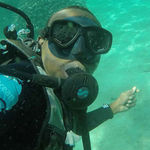
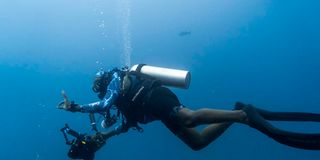
Anthony Ochieng Onyango pictured during a dive in the Maldives, 2025.
Photo credit: Pool
Training is essential. “You go through training and examinations to get certified. Once you have that certification, you can dive almost anywhere in the world,” he says.
The high cost
Becoming an underwater photographer is expensive.“You can start with about Sh500,000 for entry-level equipment,” Mr Ochieng says.
Professional gear, however costs far more. A high-quality camera alone can cost around Sh500,000, and the waterproof housing required to protect it underwater can cost nearly the same.
“The housing can even be more expensive than the camera itself,” he adds.
Additional equipment such as dome ports, strobes, lights and diving gear adds to the bill. “And then there is the training,” he says. “Short courses in underwater photography can cost between Sh100,000 and Sh400,000.”
His most memorable shark encounter happened in the Maldives, where he swam alongside several species during a diving expedition.
“Swimming around sharks in the Maldives was a highlight for me. It was an incredible moment.”
Would he encourage young Kenyans to take on underwater photography as a career?
“Yes. Don’t look at how uncommon this is in Kenya or even Africa. I have done it for a decade now,” he says.
Travel expenses also form a major part of the job. You have to go where the marine life is. That means travelling to different oceans and ecosystems.
Sometimes this will include air ticket, processing travel documents, shipping gear at extra cost etc. He advises that one does not need to acquire everything at ago.
“My equipment has been acquired incrementally. I view it as an investment, reinvesting each time I return from the sea. Over time, I have built a collection of tools and gear, not by doing it all at once, but by adding to it bit by bit.”
For Mr Onyango, the investment was worth it. “My business is to share conservation stories to inspire people to conserve nature. Photography and film are the tools I use to do that and to achieve good results, I had to have the skills and the tools.
High adrenaline ecosystem
Few experiences match the adrenaline of encountering a shark underwater. Yet Mr Onyango insists that these encounters are often misunderstood.
“People think sharks are always dangerous,” he says. “But most of the time they are calm and curious.”
The experience reinforced his belief that photography can change perceptions about marine predators. “When people see these images, they realise sharks are not just monsters. They are beautiful animals that play an important role in ocean ecosystems.”
Beyond the thrill of underwater encounters lies a more serious mission. The oceans are changing rapidly due to climate change, pollution and overfishing. He has witnessed those changes firsthand.
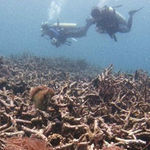
“I remember seeing coral reefs in Kisite Mpunguti years ago that were vibrant and colourful. Today many of them are bleached white because of rising water temperatures. Coral bleaching occurs when warmer ocean waters stress corals, causing them to lose the symbiotic algae that give them colour and nutrients. These are things that must be documented.”
Current work
His current work includes documenting the plight of hammerhead sharks in West Africa, where fisheries are increasingly targeting shark species. “My project now focuses on documenting hammerhead sharks in Ghana’s fisheries,” he explains. “It’s about understanding the impact of shark fishing.”
His goal is to create images that spark conversation and action. “Photography has the power to show people what is happening in our oceans,” he says.
His mission goes beyond his personal photography. He also runs a conservation initiative that uses visual storytelling to inspire young people to care about the environment. The organisation teaches photography and provides educational programmes about biodiversity.
“Our goal is to inspire children into conservation. Many young people have never visited national parks or seen marine ecosystems.”
The initiative also gives students access to wildlife areas, helping them connect with nature firsthand. “For many Kenyans, wildlife feels like something distant,” he adds. “Photography allows us to bring that world closer.”
The power of purpose
Looking back at his career, Mr Ochieng believes purpose has been the driving force behind his journey.
“This journey started when I was around 27, it hasn’t been easy, but it has been worth it.”
Understanding why he wanted to pursue conservation photography helped him navigate uncertainty and financial challenges.
“You have to understand your purpose, your why. When you know why you are doing something, you can push through the difficult moments.”
Mr Ochieng’s work continues to take him across oceans and ecosystems, documenting wildlife both above and below the water. Asked if he would encourage other young Kenyans to take on underwater photography as a career, he answers affirmatively.
“Don’t focus on how uncommon this is in Kenya or even Africa. I have been doing it for a decade, so anyone can do it if they understand their ‘why’ and invest what is needed along the way.”
Follow ourWhatsApp channel for the latest business and markets updates.
Unlock a world of exclusive content today!Unlock a world of exclusive content today!