Time flies with great content! Renew in to keep enjoying all our premium content.
Prime
Kenyan surgeon returns home, finds untapped market in shoulder and knee treatment
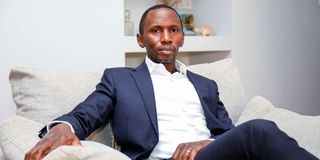
Consultant Orthopedic Surgeon and Sports Medicine Specialist Dr. Mordicai Atinga during an interview at his home in Loresho, Nairobi, on February 21, 2026.
After decades of studying and working abroad, Dr Mordicai Atinga made a bold, “no-plan-B decision” to return to Kenya. He returned at a time when many of his peers were chasing jobs overseas, a decision he says he has never regretted.
“I did it without a plan B. Some guys hedge. They tell their employer, ‘hold this job for me for a year while I see what’s happening back home. If I fail, I’ll come back.' If you do that, I think you’re almost guaranteed to go back, because that first year is brutal. You have culture shock. You realise that coming home for a holiday is a completely different thing from coming home to build a business. You have to navigate a different setup, and if you have an easy exit strategy, you’ll take it the moment things get tough,” he tells BDLife.
The consultant orthopaedic surgeon and sports medicine specialist had spent decades mastering the shoulder and the knee.
He knew he wanted to be an orthopedic surgeon as early as age 10. His father was an orthopedic surgeon, which meant he had access to books and resources about the field long before he set foot in medical school.
“I grew up in a house full of medical books. As a sporty child, I was always getting into scrapes. I remember leafing through a book my dad had titled Sports Injuries. By the age of 11 or 12, I had diagnosed three of my own injuries just by matching my symptoms to the diagrams in that book. I knew right then I wanted to be an orthopaedic surgeon, but specifically for sports,” says Dr Atinga, now in his late 40s.
Knowing exactly what he wanted to become made the requirements of a general medical degree feel like a long detour. “To be honest, I didn’t love the whole breadth of medicine. I knew where I wanted to go. So, during medical school, when I was doing an attachment in something like psychiatry or internal medicine, I did the work, but my heart wasn’t in it. But the moment I got into an orthopaedic ward? That was home.”
Many Kenyans struggle to settle abroad, but he says his time at the University of Nairobi’s medical school, though hectic, helped shape the tenacity he would later rely on while studying abroad at the University of Sheffield in the UK.
“It was the 1990s, a time of frequent strikes at the University of Nairobi and a 'nebulous' academic calendar. The university would be closed for months, and then suddenly they’d say, 'the gap is ready, come now.' But even in that chaos, I realised I was among some incredibly sharp guys. The volume of work was staggering. I call that my 'high-altitude training.' When I finally landed in the UK, I hit the ground running hard. I had already seen the crazy volume, so I wasn’t intimidated.”
He deliberately chose to upskill in arthroscopic (keyhole) surgery and joint replacement. “I made sure every research project, every presentation, and every elective I ever did was orthopaedic-related. It created a consistent pattern. When I went for interviews, the panel would look at my CV and see a straight line. I wasn’t a guy trying to find himself; I was a guy who knew exactly what he was there to do.”
His urge to become a hyper-specialist in just the shoulder and knee came from his early days at Strathmore School, where he observed teammates suffer life-changing injuries which he believes could either have been remedied or prevented with the right knowledge and experience.
“In my journey, you realise orthopaedics is a huge field,” he says. “I decided to narrow my interest down to shoulders and knees; these are common body parts that sportspeople injure a lot. I think that’s the direction the world is going. You want a guy who focuses on one or two things so that when you have a problem that is exactly what he does every single day. If someone comes to me with a hip problem, I’m honest with them. I say, ‘Look, I understand hips, but I spend my life in shoulders and knees. I’m going to send you to a very good hip guy.' I’d rather be an apex thinker in my specific area than be mediocre across the board. The volume of knowledge today is too high to be a specialist in everything.”
Return to Kenya
In 2018, after nearly two decades of living and working in the UK, Australia, and New Zealand, Dr Atinga decided it was time to come home. It was a one-way ticket with no consideration for returning to the diaspora had things not worked out.
Many diaspora professionals “hedge” their bets by keeping foreign bank accounts open, houses rented, and jobs on “pause” for a year, just in case the Kenyan dream fails to unfold as expected. He, however, took a different route.
He admits that he felt a sense of imposter syndrome during the early months in Kenya. “I used to tell people, ‘Just call me Mordi' (short for Mordicai). I didn’t want the big doctor title to define me because I wasn’t sure yet if I would succeed here. I thought, if it all falls apart, at least I’m just Mordi.”
The gamble, however, paid off. Dr Atinga found a massive, underserved gap in the Kenyan market: the injured athlete. “We lose an unquantifiable amount of talent in this country to injuries. I see it all the time. A child in high school is a brilliant basketball player or a promising striker. They tear their ACL [a knee tear]. In a developed health system, that’s a six-to-nine-month recovery with surgery and physiotherapy. In Kenya, most of those children just give up the sport, limp for a few years, and a potential world-class career ends before it begins.”
He points out that most team doctors in many local clubs often just know how to wrap a bandage. “Let’s be honest, our sports teams often cannot afford to have a specialist around. But the cost of not having one is higher. A knee injury in your 20s that isn’t fixed leads to an inactive 30s, an obese 40s, and a diabetic 50s. We aren’t just fixing joints; we are preserving the future health of these people.”
He compares the Kenyan situation to New Zealand, where he also practised. “New Zealand has a population smaller than Nairobi, yet they have more orthopaedic surgeons than all of Kenya. And every single one of them is busy. That tells you the level of need we have here that is currently going unmet.”
Dr Atinga adds that the numbers are disproportionately distributed. “A majority of us who practice are stationed in Nairobi, with a few others in major cities. There are not many of our services in remote places in the country.”
He talks of the difference of working abroad and in Kenya and challenges with running a profit-making and patient payments.
“In the NHS [National Health Service used in the UK], if someone had a problem, I didn’t have to ask about their insurance. I just fixed the problem. Here, it’s a zero-sum game. If I suggest a treatment that doesn’t work, I’ve messed up the patient because the insurance won’t pay for a second attempt, or they’ll call it a pre-existing condition. It forces you to be more aggressive and to choose the one solution with the highest success rate immediately, rather than the most conservative one.”
He also worries that Africa is drifting toward an Americanised, “raking-in-millions” model of medicine. “For me, it’s not about the money; it’s about the quality.”
Studying medicine taught him the language of precision. “What you are taught in medical school is exactness. There is no room for error because you are dealing with human life. This language allows you to communicate with a colleague halfway across the world, and they know exactly which millimeter of tissue you’re talking about. And I pressure myself to stay up to date. Last year, I took time off just to go to South Africa and hang out with other shoulder and knee surgeons. You have to make sure you aren’t being left behind. I want to know that the service I give a patient in Nairobi is the exact same quality they would get in London or New York.”