When Jane Nduta left Kenya for Portugal on a Master of Science in Clinical Nutrition scholarship, she expected to build a career in hospital wards and patient care.
But a decade later, she has found success in Europe’s technology sector. She tells BDLife her journey is proof that the hardest work abroad is not just about landing a scholarship, but reinventing yourself in a foreign job market.
She left Kenya on a fully funded Erasmus Mundus Scholarship. “I learned about this scholarship in a small talk on the sidelines of a dinner at Kenyatta University. Someone just told me to take a chance. I thought scholarships were not for me.”
As if to affirm her doubts, she didn’t get in during her first year of trying. “I told my referee that I knew I wouldn’t get it. They encouraged me to keep trying, and in my second attempt, I got it.”
While in Kenya, Jane had tried all the tricks in the book to be successful. She did a BSc in Nutrition and Dietetics alongside CPA up to level 4, an MBA, and even ventured into writing.
“I was a Jacqueline of all trades. My nutrition degree did not offer many promising opportunities in Kenya at the time, unfortunately. Pursuing this scholarship was a gamble that would eventually pay off,” she says.
Jane, now in her 30s, works in a tech firm. She debated whether to come back after graduating in a market that felt increasingly foreign yet familiar.
“My base was in Portugal, a city called Porto, but the programme was managed by Portugal and the Czech Republic; I also did a bit of the Netherlands and Spain. At the end of my studies, I had quite an experience in Europe.”
Upon settling in Portugal, she quickly realised that while the scholarship may have taken her to Europe, it was the lived experience that would shape her.
“When I landed in Porto, it became apparent to me that the financial security the scholarship offered me did not eliminate the emotional and cultural adjustments that come with relocation,” she notes.
The Erasmus Mundus Scholarship covered her tuition, insurance, and living expenses, offering a stipend of 1,000 euros (Sh150,000) and an overall total of between 33,000–34,000 euros (Sh4.9 to Sh5 million) to for the full study period. Even such a comfortable safety net could not prepare her for the shock of everyday life in a foreign environment.
Facing the shocks
“The first barrier was language,” says Jane. “The course was in English, but outside the university, everything was Portuguese. Suddenly, you realise how much of life happens outside classrooms.
Even simple interactions like buying groceries, asking for directions, or opening a bank account—they call for a great deal of patience and humility. A language barrier can truly hinder doing even the most basic things.”
She also discovered something that, for the longest time, she thought wasn’t a problem: the realisation that her English, perfectly normal at home, sounded unfamiliar abroad. “People kept asking me to repeat myself.”
Coming from Nairobi’s urgency, she initially struggled with what felt like a slow rhythm in Portugal.
“In Kenya, you are always moving. You feel as if you stop, life will overtake you,” she says. “In Portugal, people take time to enjoy life; they will sit and watch sunsets, have meals slowly over conversation, and take slow evening walks. It felt strange at first, but eventually, it taught me balance.”
She began questioning what success truly meant to her. Was it about titles and income, or about impact and mobility? These questions lingered long after her studies ended.
When her Master’s programme neared its end, a new reality began to set in: that of a professional life in Portugal. She realised that while she was now highly educated, the clinical nutrition field in Portugal was heavily guarded by language requirements and local certifications.
Her Portuguese was not yet at a level where she would trust herself in a hospital setting, and the thought of returning to the “hustle” in Nairobi was equally daunting.
Moment of realisation
Jane remembers her time in Kahawa Wendani, Nairobi, the long commutes to internships at Thika Level 5 Hospital, a job in Mater Hospital and the realisation that the clinical path in Kenya often meant stagnant pay or being posted to hardship areas.
“That is when I made the decision to stay and leverage my experience in Europe to explore opportunities. If it didn’t work, I would go back home and try something else. I am Kenyan, after all, and we have this unrelenting spirit of not giving up,” she says.
As she explored employment options, she realised that the European labour market rewarded versatility more than specialisation alone. “I started seeing that my project management skills could open doors that clinical work couldn’t at that time.”
In her pursuit of grounding and settlement, Jane was referred by a friend to a US-based cruise company. She got the job offer, but it came with a catch.
“The company would hire me, but would not facilitate my residency permit. They gave me a six-month grace period to transition from my student visa to a professional work permit by myself.”
Character development
She describes the eight months that followed as a period of extreme “character development” that tested her resolve to stay.
She was essentially working a full-time job while doubling as her own immigration lawyer. She spent sleepless nights going through a frenzy of paperwork, coordinating with the Portuguese immigration authorities and various offices back in Kenya to get her documents legalised, translated, and certified.
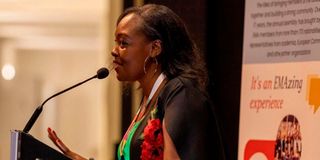
Jane Nduta Wambura, founder of Inspire Abroad, at the Global Gateway High-Level Event on Education in Brussels, Belgium, July 2024.
Photo credit: Pool
“I took up the challenge; those months of navigating bureaucracy alone taught me more about resilience than any textbook ever could.”
It was during this stressful transition that she realised her MBA from Kenyatta University was actually her most valuable asset. It allowed her to look past clinical roles and move into the technology sector, taking on responsibilities in project management, tech support, business analysis, integration, and implementation within big tech firms and other start-ups in Portugal.
Carving a niche
Through this well-calculated transition, Jane eventually carved out a niche in helping global tech firms and start-ups adapt their software for African markets.
Her first job in Portugal exposed her to global corporate structures and multicultural teams—environments she says were both intimidating and equally transformative.
“You find yourself in meetings with people from five different countries, each thinking differently,” she says. “It forces you to communicate clearly and think beyond your own assumptions.” Instead of seeing herself solely as a nutritionist or project manager, she began to see herself as a connector—someone able to interpret African markets for European companies and vice versa.
Black professional in Europe
Jane admits that being visibly different in many corporate spaces came with its own pressure.
“Sometimes you are the only Black person in the room. It means you carry an almost resident responsibility to prove yourself. You learn to prepare more, to speak clearly, and to stand behind your ideas. It may not always be fair, but it teaches you strength.” Jane is now a dual Kenyan-Portuguese citizen who can debate in Portuguese as fluently as she can in English or Swahili.
After living and working in Portugal and EU countries for a decade, she saw another opportunity, offering consultancy services to Africans looking for scholarships abroad.
“I help young people identify and take scholarship opportunities, as well as offer relocation advice. But that solidified about two years ago when I founded Inspire Abroad,” she says, adding that she charges between Sh10,000 and Sh15,000.
Hardest part of moving
What would she say is the hardest part of moving abroad? “I always tell people that the immigration interviews are the easy part. It is the internal interview you have with yourself every morning when things get tough that is the hardest part.”
For anyone considering Portugal, she says, "As a student, it is easy to survive with between 1000-1500 euros (Sh150,000 to Sh225,000), especially in smaller cities. Bigger cities like Lisbon, Porto and Faro are more expensive.
A shared room in bigger cities would cost anything between 700-1,200 euros (Sh105,000 to Sh180,000) while a one-bedroom house is upwards of 1,200 euros.”
Jane adds that finding housing in Portugal can be tough for students who want to transition to a working life. “Landlords demand to see a work contract and can ask for a deposit for up to a year if you don’t have a guarantor.”
The minimum wage in Portugal, Jane adds, is 1,000 euros ((Sh150,000). “This is for people who work in restaurants, call centres and so on. Startups and international companies pay a much higher wage. I encourage people to move via the tech visa scheme. But again, depending on your lifestyle, you could work two or three jobs or work with a tech company that pays you three to 10 times the minimum wage.”