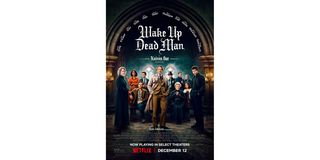
Watching Glass Onion, the second entry in the Knives Out trilogy, I couldn’t shake the feeling that I was watching a Bond movie. It had that distinct Bond touch, the Bond villain lair, the vehicles, the structure of a villain with a world-ending plot.
It was big, over the top, and glossy. But Wake Up Dead Man? This feels like Rian Johnson decided to pivot entirely. If Glass Onion was Bond, this is pure Sherlock Holmes. It strips away the tech and the spectacle to return to the roots of the classic mystery genre.
But let’s not get ahead of ourselves. Let’s assume you’ve never heard of, let alone watched, a Knives Out movie. Maybe you just forgot they existed. Here is a quick refresher before we dissect Wake Up Dead Man, the latest chapter in the series.
Rian Johnson’s franchise is essentially a modern, stylish love letter to the whodunit, anchored by the eccentric Southern private investigator Benoit Blanc, played by Daniel Craig.
Johnson is the writer, director, and producer of these films, creating a sandbox where each movie has a different cast every time.
The first film, Knives Out (2019), was a hit, earning over $300 million and proving that audiences still crave good mystery movies. Its success led to two sequels. The second, Glass Onion (2022), was much glossier and more accessible to the general audience.
Fun fact: every title in this franchise is pulled from a rock song—Radiohead’s Knives Out, The Beatles’ Glass Onion, and now U2’s Wake Up Dead Man.
Wake Up Dead Man
Wake Up Dead Man is a standalone sequel, meaning you don’t need a flow chart of the previous movies to understand it.
Daniel Craig reprises his role as Benoit Blanc, and following the trend of the first two, he is surrounded by a stacked ensemble cast including Josh O'Connor, Glenn Close, Josh Brolin, Mila Kunis, Jeremy Renner, Kerry Washington, Andrew Scott, Jeffrey Wright, and Thomas Haden Church.
The plot centres on a rural parish in upstate New York, a parish with dark secrets and a dark past, led by the charismatic and domineering Monsignor Jefferson Wicks (Brolin), who has to deal with the newcomer, Father Jud Duplenticy (O'Connor), and a congregation he has wrapped around his finger. Without spoiling it and because this is a murder mystery, someone dies, and Benoit Blanc has to solve an impossible case.
Back to the roots
As I mentioned, my immediate thought watching this was “Sherlock Holmes,” and a huge part of that comes down to the visual language. The production design here is a massive departure from the sun-soaked, sterile luxury of Glass Onion.
The costume design and hair, starting with Blanc’s slightly longer, more European cut, have a stylish, deliberate feel. The colour palette is significantly more muted.
Even the priests, who you might expect to look visually flat in black vestments, are shot with a strong sense of style. The world feels Gothic and dark, anchored by the church, which sits at the centre of the mystery like a brooding character in itself.
From a filmmaker’s perspective, the movie looks incredible. The composition is married perfectly with the use of light and colour.
There is a particular scene in a forest that immediately comes to mind that is visually stunning. The church interiors are framed to capture the intensity of the dialogue, with some moments featuring Josh Brolin where the camera placement makes him feel larger than life, almost suffocating the frame. It’s an unusually somber film compared to its predecessors, and that moodiness works in its favor.
An impossible mystery
This movie presents what feels like an impossible-to-solve mystery. They mention it in the dialogue, and sure enough, this had one of the most unpredictable outcomes I’ve seen in years. It is a proper mystery.
You might have a vague idea about who did it, but the mechanics of the “how” are almost impossible to figure out until the film presents it to you.
However, the structure is going to be the most divisive element for fans. If you loved the template of the first Knives Out, you might appreciate this, but it’s twisted on its head. Specifically, you don’t really see Benoit Blanc for the first 30 to 40 minutes.
But this is where Rian Johnson’s confidence as a director stands out. Not a lot of films can pull off sidelining their franchise star for the first act, but here, it pays off. Each act gets better as the story progresses. By the time the murder happens, I realised how the setup of those first 35 minutes, minus Blanc, was crucial. It was laying the thematic groundwork.
When Blanc finally begins to sift through the evidence, the movie does that thing where it presents you with everything you missed. It shows you scenes you’ve already watched but from a slightly different angle, revealing clues that were right in front of your face. It keeps you on your toes, making you feel smart for keeping up but humble for missing the obvious.
Thematic depth and direction
Thematically, this has to be the richest film Rian Johnson has made in this franchise. The first film deconstructed family and class, the second tackled influencers and new money. Wake Up Dead Man tackles faith and religion.
Johnson mixes these themes not only in the character motivation and foundation but also visually, using lighting and blocking. The lighting in the church scenes is dynamic, using shadows to suggest guilt and divinity in equal measure.
There are small moments, like one involving a phone call between O'Connor and Craig, that perfectly encapsulate the film’s depth. O'Connor’s shift during the call captures the essence of the core theme of this movie. It shifts the perspective entirely. By the final 20 minutes, you realize that Benoit Blanc may or may not have changed.
As a character, there is a clear moment at the end when you see his arc—how he has been affected by the moral weight of what he’s uncovered.
Seeing that growth in Blanc, a character who usually remains a constant while the world changes around him, was satisfying. It makes me eager for the next mystery, not just for the puzzle.
Performances
If Ana de Armas was the heart of the first film, Josh O'Connor is the centre of it all. He is effectively the lead, and I will go as far as to say he delivers the best performance in the entire franchise.
His arc is the clearest we’ve seen in this series. He conveys so much internal conflict through silence and micro-expressions. As he navigates this mystery alongside Blanc, his character arc is actually more profound than the mystery itself.
If there is a grievance to be had, it’s that O'Connor, Glenn Close, Josh Brolin, and Craig are so good that they overshadow everyone else. The rest of the cast is talented, but they don’t get the same room to breathe.
Glenn Close has some incredible, sharp moments as the church secretary Martha, and Josh Brolin is surprisingly funny as the intense Monsignor. But when you go down the list—Mila Kunis, Jeremy Renner, Andrew Scott, Kerry Washington, and Jeffrey Wright—they feel a bit more like puzzle pieces than fully fleshed-out humans.
In Glass Onion, the disruptors are rich in personality and presence, so we knew almost everything about them. Here, the setting is a secretive religious congregation. By design, these people are closed off. They don’t want to share their lives.
While that makes sense for the story, because it does make the characters much more mysterious, we don’t get as much time to understand their interpersonal dynamics. I just wish we had a little more time with them, but I understand that their secrecy is part of the film’s texture.
Conclusion
Wake Up Dead Man, like the first Knives Out film, is necessarily a little slower in the beginning and a little darker than its predecessors. It demands more patience in that first act, and because of that, it won’t be for everyone at first—but sticking with it is far more rewarding than you expect.
Rian Johnson has crafted a film that feels lived-in and mature but, most importantly, a film that goes back to classic mystery like a Sherlock Holmes story.