Kenya’s wealthy art collectors are searching for paintings created and acquired during the 1980s, 1990s and early 2000s. Reason? Not solely to hang them on their walls but as an alternative investment.
Art, the latest Knight Frank Wealth & Investment Trends Report shows, is now the most-sought-after collectible asset by Kenya’s high-net-worth individuals, followed by watches and classic cars.
The surge in demand has driven prices sharply higher. Paintings that once sold for between Sh7,000 and Sh10,000 now fetch Sh800,000, Sh900,000, and in some cases over Sh1 million at art auctions, says veteran artist and curator Michael Soi. He explains that the appetite largely centres on paintings and modest-sized sculptures, unlike the monumental artworks.
“It basically just revolves around paintings and sculptures, but we’re not talking about huge sculptures, just something manageable. It fits anywhere, no space issues,” he tells BDLife.
The appreciation in value has now transformed art from a house accessory into an attractive asset for affluent Kenyans with excess liquidity.
“Art has started enticing local Kenyans who’ve got what I’d call excess liquidity into looking at it as a source of investment,” Mr Soi says.
“It is a form of investment where I will pay like $150,000 (Sh19.4 million) today, sit on the piece [artwork] for a few years and then put it in auction. Chances of doubling or tripling what you had invested are very high.”
That growing appetite is now reflected in the latest Knight Frank Wealth & Investment Trends 2026 report, which ranks art as the leading “investment of passion” among Kenya’s wealthy, ahead of luxury watches, classic cars, jewellery and wine.
“This year, 75 percent of respondents indicated that their clients are interested in acquiring art , up from 72 percent in 2025, reinforcing its position as the preferred passion asset within wealthy portfolios,” the report states.
However, the report shows most wealthy Kenyans are still reserved, allocating less than 10 percent of their investment portfolios to luxury assets. Real estate, equities and fixed income remain the main ways Kenya’s rich investors are building and protect wealth, with a small share put into collectibles, which give them personal enjoyment and the chance of long‑term gains.
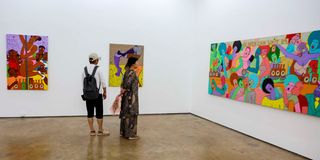
Micheal Soi pictured on January 20, 2026 during Heaven Can Wait Two exhibition at Circle art gallery in Nairobi.
Photo credit: Billy Ogada | Nation Media Group
More art, many galleries
Mark Dunford, Knight Frank CEO, says that the performance of art as the top preferred passion asset has been reflected in both the market dynamics and the changing consumer preferences.
“There’s a lot more art in this market. Kenya’s expanding creative scene and internationally recognised artists have made collecting attractive,” he says.
He points to the rising global profile of artists such as Michael Armitage as one of the factors putting Kenyan art on the international stage. Wangechi Mutu’s work has been exhibited across major cities from London and Moscow to Paris. Agnes Waruguru, whose art featured at the 60th International Art Exhibition La Biennale di Venezia in Italy, is also helping to boost Kenya’s presence in the global art scene.
Secondary market
For the artists, however, the soaring art prices present a paradox. While collectors celebrate rising valuations, many artists see little of the wealth generated after their original works leave the studio.
“Unfortunately, for the artists, we don’t seem to be in that equation because of the simple fact that it is always the secondary market that ends up benefiting from it and not the artist,” Mr Soi says.
He illustrates the point with one of his own artworks. “I have once sold my piece to someone who actually bought it for like 1,000 euros (Sh147,410) and then flipped it in an auction in Paris for 37,000 euros (Sh5.5 million). The thing is we are not the beneficiaries. It is the secondary market that seems to benefit,” the artist says.
He adds that in many cases, artworks are resold privately without the artist’s knowledge. “Most of the art will actually be auctioned in secret without your knowledge.”
The disconnect between artists and the secondary market is one of the defining characteristics of the global art trade, where collectors, dealers and auction houses often capture the greatest financial gains as an artwork changes hands over time.
Even so, Mr Soi believes the international success of Kenyan artists has raised the profile of the country’s creative industry and contributed to the stronger demand for local works.
Pensive Gaze Oil on canvas art work by Boniface Maina pictured on May 27, 2026 at Circle Art Gallery in Nairobi.
Photo credit: Billy Ogada | Nation Media Group
Last year, this growing appetite for art as an investment was in full force when collectors in Nairobi spent about Sh30 million competing for some of East Africa’s rarest artworks. The highlight was “Baobab Under the Red Moon’, a 1968 painting by the late Tanzanian artist Francis Msangi, which became the most sought-after piece after selling for Sh3.5 million.
The Kenyan artist with the most sought-after item was Justus Kyalo, whose 2021 painting fetched Sh1 million after three minutes of bidding. Beatrice Wanjiku’s art was also bought for Sh938,200.
However, Mr Soi cautions against equating auction prices with artistic worth. “People need to understand that auctions or prices at auctions do not directly tell people how much you sell your work for.”
Instead, he encourages collectors to engage more deeply with artists, galleries and exhibitions. “I would urge people to be a little bit more active. Art auctions will never give a complete scope about the artist. It is imperative for people to take their time and travel. Don’t believe everything you read on the internet.”
Younger collectors
When it comes to the positive attributes, one development Mr Soi finds encouraging is the emergence of younger Kenyan collectors.
Traditionally, art collecting was associated with older, established business people and expatriates. Today, he says, a growing number of younger Kenyans are entering the market, many of whom have investment motives.
“I seem to be having a local kind of market for my work, where I am selling work to very young Kenyans, which is very weird.”
Unlike the earlier generations, these buyers view paintings and limited-edition prints as assets that are capable of appreciating over time.
“The young Kenyans are buying it for investment. Most of the investment is on paintings and prints,” Mr Soi says.
Many of these collectors have studied abroad, returned from the diaspora or have been exposed to art through international education systems.
He also credits international schools with helping cultivate appreciation for art among younger generations.
A Personal Playlist Oil on canvas art work by Boniface Maina pictured on May 27, 2026 at Circle Art Gallery in Nairobi.
Photo credit: Billy Ogada | Nation Media Group
“Access to good quality education, systems that teach art, teach the importance of art. The international schools are doing that on a very large scale, which is very commendable.”
He adds that visibility has also become just as important as talent in attracting collectors.
“It is more like the role of the artist himself to make sure that your work is visible. Create your own… make noise about your art, tell people, have exhibitions, give talks. This is how people become visible, especially on social media, platforms like Instagram.”