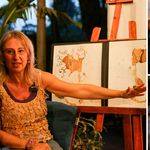
Linda Chao did not begin her professional life in the arts. Art found her unexpectedly when she encountered the visual art ecosystem.
After studying tourism and psychology, she pivoted into curatorial studies, exhibitions and artist management, drawn by a desire to understand not just art, but artists. Early roles at Ardhi Gallery, where she worked as an editorial and events curator and artist manager, sharpened her focus on emerging talent.
It was there that she identified a persistent gap: gifted artists with little structural support.
“A majority lacked financial literacy, mental health support and management skills,” she says. “It is one thing to be talented, but if we sell your work and two weeks later you’re broke, then we haven’t helped you.”
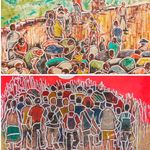
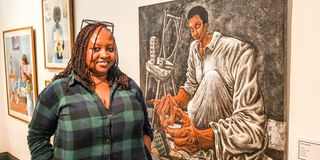
Whispers of Resilience IV, an acrylic on canvas painting by Oluwatobiloba Fasalejo, featured in Cultural Tapestries: Threads of Pan-African Identity, curated by Linda Chao at The National Museum, January 25, 2026.
Photo credit: Billy Ogada | Nation Media Group
That realisation shaped her curatorial philosophy. For Linda, artistic development must go hand in hand with entrepreneurship and personal sustainability.
Artists, she argues, must see themselves not only as creators but as entrepreneurs, supported by business professionals and mental health practitioners when necessary.
In 2023, she co-founded Sena Art Gallery, conceived as more than a commercial space. “Sena,” meaning light, was envisioned as a platform to mentor and position emerging artists for long-term visibility.
The early days were difficult. Proposals went unanswered. In its first year, the gallery secured only one exhibition slot. But rather than retreat, Linda recalibrated.
Her strategy was unconventional: take art out of intimidating white-cube galleries and into accessible, everyday spaces. She approached restaurants and social venues across the city, sometimes offering to pay for space, and began running concurrent exhibitions to maximise exposure for her artists.
Art enthusiasts view paintings at Cultural Tapestries: Threads of Pan-African Identity exhibition at The National Museum, January 25, 2026.
Photo credit: Billy Ogada | Nation Media Group
That approach continues to define Sena’s footprint. As one exhibition runs at the National Museum of Kenya, another may unfold at the Hyatt Regency, deliberately bridging institutional and commercial audiences.
“We must place artists’ work in as many spaces as possible,” she says. “That’s how reputations are built.”
For Linda, visibility is currency. While sales matter, she insists exhibitions generate cultural capital that can shape an artist’s trajectory. A show at a national institution strengthens a portfolio, builds credibility and expands networks.
Her recent exhibition, Cultural Tapestries, at the National Museum of Kenya, brought together emerging artists from Kenya, Uganda, Tanzania, Rwanda, Burundi, the DRC and Nigeria. Rather than promote a singular “African story,” the show foregrounded multiplicity.
Cleopatra’s Spirit, an acrylic on canvas painting by Romeo Niyigena, featured in Cultural Tapestries: Threads of Pan-African Identity, curated by Linda Chao at The National Museum, January 25, 2026.
Photo credit: Billy Ogada | Nation Media Group
Linda is candid about the realities of the art economy. Curation can be financially viable, she says, but income streams are often layered; grants, consulting, project management, exhibition fees and commissions. It requires entrepreneurial discipline as much as creative insight.
Kenya’s commercial art scene, she observes, can be elitist and fiercely protective of established structures. Yet her response has been to widen the circle rather than compete within it.
“I want to be known as the unconventional curator,” she says. “Gallery spaces can be intimidating. I want art to be for everyone, because art is universal.”
Her long-term vision is to build a dynamic cultural hub integrating visual and performance art.
“Curation is both creative practice and cultural entrepreneurship,” she notes.
Mwanankabandi, an acrylic on canvas painting by Romeo Niyigena, featured in Cultural Tapestries: Threads of Pan-African Identity, curated by Linda Chao at The National Museum, January 25, 2026.
Photo credit: Billy Ogada | Nation Media Group
She challenges the notion that intellectual rigour alone defines a strong curator. Research and art historical knowledge are essential, she agrees, but insufficient.
“A good curator must have intuition and curiosity, and commit to continuous learning,” she says. “Equally important are relationships — with artists, collectors and institutions.”
Curators, she adds, are interpreters. They translate artists’ ideas across audiences and platforms, requiring strong research, writing and communication skills. With that role comes ethical responsibility.
“Artists often speak from lived experience or community narratives. As cultural custodians, we must represent those narratives transparently and respectfully.”
If there is a thread running through her practice, it is resilience.
Her long-term vision is to build a dynamic cultural hub integrating visual and performance art — a space that reflects the accessibility she advocates.
Until then, she continues to carve out platforms wherever she can find them, steadily amplifying emerging voices and redefining what visibility looks like in Kenya’s art landscape.