Time flies with great content! Renew in to keep enjoying all our premium content.
Prime
Art from the earth: Khabula Lango confronts Congo’s cobalt wars and global silence
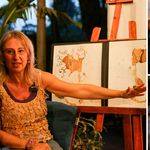
Khabula Lango (left) with Wachimbaji 1 (acrylic and sand on canvas) and Elikya (acrylic and sand on canvas) by Khabula Lango (bottom right) at the Matieres Voyageuses exhibition, Alliance Française, February 9, 2026.
From childhood, Khabula Lango was always drawing. He had no formal training in art, but creativity came instinctively. Growing up in the mining town of Goma in the Democratic Republic of Congo, he used nature as his canvas and the earth itself as his medium. The stories that shaped his youth — minerals, conflict and survival — became the foundation of his artistic voice.
His current exhibition, Matières Voyageuses, showing at Alliance Française, centres on sustainability in art. By transforming recycled and abandoned materials into textured work, Lango constructs narratives of struggle, exploitation, and rebirth.
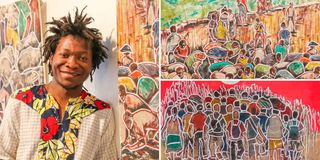
The exhibition traces the life paths of mines, minerals, wars and communities in Congo, interrogating the human and environmental cost of extraction.
Lango’s journey into full-time art began after high school. Goma, where he grew up, did not have an arts school, but Lango and his artist friends formed a group where they would review each other’s works and encourage one another to create art.
Later, visiting art professors from Kinshasa held exchange programmes in the town, and they would teach the young artists from Goma about Congo’s art history and techniques.
Mifuko ya Cobalt 2 (acrylic and sand on canvas) by Khabula Khabula Lango, displayed at the Matieres Voyageuses exhibition, Alliance Française, February 9, 2026.
Photo credit: Billy Ogada | Nation Media Group
They invited the students to their studios to continue painting. This, Lango admits, was the inspiration they needed to venture into full-time art.
What makes Lango’s work unique is not just his unusual technique of doodling silhouettes over fully painted figures in white acrylics, creating a patterned distortion, it is the medium he uses to make his subjects: Sand. Growing up in a town where minerals dictate destiny enabled him to see sand as more than construction material.
“The war over minerals in Goma started before I was born. When I began my artistic journey, I wondered why the war was not ending. I discovered that the war went all the way back to the days of King Leopold of Belgium. He used violence and forced labour on people to extract rubber and ivory for his own personal gain,” he says.
Waves of conflict
Uranium mined in Congo later contributed to global warfare. Today, cobalt, a critical component in lithium batteries powers smartphones and electric vehicles, fueling a new wave of conflict.
“For me, cobalt mining and the wars around artisanal mines represent a recurring cycle,” he explains. “I use my work to raise awareness and call for an end to it.”
His use of sand is deliberate.
“It is a natural resource from the ground, just like the minerals at the centre of these wars. It reflects the message I want to pass across on misuse and exploitation.”
His style, which he classifies as figurative expressionism, employs an impasto style technique made popular by Van Gogh. He uses a palette knife to split sand and create structured figures. It is a style that evokes deep feelings using bold outlines. The shapes and figures create shadows that define shades and structures within his paintings.
Art enthusiasts admire works at the Matieres Voyageuses exhibition, Alliance Française, February 9, 2026.
Photo credit: Billy Ogada | Nation Media Group
For Lango, the minerals, though a good thing, have become a curse for the Congo because they have attracted leeches who do not care about the communities living next to the mines, but only want to enrich themselves. All while damaging the environment and shattering societies through wars.
At the centre of the exhibition is an installation that looks like a ramshackle trampoline turned upside down. This contraption is bound by wood and masking tape with freckles of sand on top. It depicts the mines in Goma, the wood supporting beams meant to prevent the mines from collapsing.
The sand represents the minerals or natural resources that are the bane of Goma’s wars, and the masking tape is the deafening silence of the world enjoying their smartphones and electric cars at the expense of devastated villages and landscapes in Goma.
Mafikri 2 oil (acrylic and sand on canvas) by Khabula Khabula Lango, displayed at the Matieres Voyageuses exhibition, Alliance Française, February 9, 2026.
Photo credit: Billy Ogada | Nation Media Group
“Eighty percent of the cobalt in the world comes from mines in Congo. People are silent about the reality of the gadgets they are using and the source of materials used for making them. These questions should be discussed in universities. Mining has caused climate change. The wars have displaced thousands. I understand that people cannot live without these minerals but there is a more ethical way of extracting them. People are using electric vehicles in Kenya and America while Congo, which produces the raw materials, is slowly being turned into a desert. How is this fair?
“The war in Congo has little to do with the local citizens but more to do with organisations with vested interests,” he says.
His sand-infused portraits pay homage to cobalt miners and the quality of life they live, which he describes as squalid.
“The companies that hire them do not build schools for them or their children. Instead, they bring them alcohol and drugs, enslaving them to an already unjust system. Chemicals are poured into the soil and the mines, which adversely affect the quality of life these miners live and the environments in which they live. They lack clean water, they are always sickly, they cannot grow their own food because their environment has been poisoned and degraded…in short, the money they get from mining does not add value to their lives.”