Michael Soi lifts veil on Nairobi's pain-numbing parties

Micheal Soi at the ‘Heaven Can Wait’ Two exhibition at Circle Art Gallery in Nairobi on January 20, 2026. 

Photo credit: Billy Ogada | Nation Media Group

Heaven Can Wait feels like a prodigal son returning home, not with regrets but with the goodies. It marks his return in solo exhibition after more than six years.

It is quintessentially what you would expect from Michael Soi albeit with an upgrade, the colour scale and transitions are impeccably clear, and the catchphrases on the works are downright witty. Heaven Can Wait is colourful, salacious, provocative, evocative and a perfect reflection of a society leaning on its numb side of life. It masks as a hubris for hedonists but in reality, it is the veneer of a society numb on the inside.
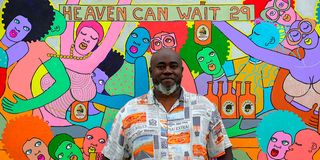

Heaven Can Wait centre around celebration, it highlights the urbane uppity end of the high life, the night life and a society living on the end of a tippled existence. In it one experiences a typical weekend in Nairobi, the stag and bachelorette parties, the after-work shindigs. It paints the picture of a city suckling life from the long end of a brown bottle. This is however the tip of the pinnacle; the real issue lies beneath hubbub.

“What people classify as partying is an attempt to numb the brain from what Kenyans are going through, and these include socio-political issues, harsh economic times, and civil unrest. Since there is very little they can do, most choose to go and bury themselves in the life of the party, it is both a happy and sad scenario,” Michael Soi says.

Soi wanted to curate a body of work flexible enough for his audience to look at and make their own conclusion.

The particulars of the pieces are presented in such a way as to have a different messaging for different members of the audience. It is a tactful masking of pain and agony with things that make it oblivious of the suffering that people go through every day. Masterfully, the paint sugarcoats the misery.

‘One Tam, 2025’ acrylic on canvas by Michael Soi.


Photo credit: Billy Ogada | Nation Media Group

Traditionally, Soi’s style has been known to provoke by touching on issues political, economic or even sexual and in Heaven Can Wait, he does not veer off this lane. Controversy is an aspect of his life which he seems to embrace with verve.

“Call me whatever you want but also look at me as a documenting artist. I am not doing this because I want to change society to a better place, no, that is not my goal, my role is to document moments for posterity so that 40, 50 years from today, somebody can get a book and get a picture of what Nairobi looked like. I document things that Kenyans don’t want documented. We love what we love, we do what we do but let us not talk about it openly is what we keep saying.”

The stance gets him into problems at times, but Soi remains unfazed because he says his goal, once he cleared art school, was always to be as different as possible from everyone else and to tell stories that nobody was telling and for this to happen, he had to develop a very thick skin.

He describes his current exhibition as a slight departure from his usual work which is very political. It is an overlook at a society that complains of harsh economic realities but still manages to pack up reveling joints which he sums up as people are trying to temporarily forget their problems. The appearance of having money is farcical.

Soi does not ascribe to being a moralist but rather defines himself as a cartographer of happenings, he highlights the pulse of happenings, most of which stem from his experiences tracking people's lives, men especially.

“There was a point around 2016/2017, I spent a lot of time around strip clubs in Nairobi. One thing that people miss the point about this body of works is that it doesn’t revolve around the women, it is the men whom I follow because I want you to know where your man, husband, brother, son is when they are missing from the house. Since 2015, these places have grown to the extent of even moving into residential areas, go to Umoja, Pipeline, strip clubs have been completely decentralised and I felt like this was a story that needed telling.”

‘Heaven Can Wait 33, 2025’ acrylic on canvas by Michael Soi.


Photo credit: Billy Ogada | Nation Media Group

His female figures have an uncanny resemblance to each other, and he says this is by design. He has never been able to find another muse from the time he ditched his cat and pig figures which were the custom of his political satire work.

Soi remains unbothered about government interference with his work by way of perceived threat or otherwise, mostly because he says they are clueless about what is happening in the visual art scene.

“We have been lucky because for a very long time, the government has never looked at art as something that can be used to voice dissent. We have managed to get away with many things because there is very little interest in art here, a lot of critiques of my work also comes from a very ignorant point of view which doesn’t bother me much.”

The art scene has been experiencing tumults of its own with a large number of galleries closing up shop.

Globally, art festivals and Biennales are seeing a downside in numbers and positive reviews and closer home, the art scene has not had enough infrastructure poured into it especially by the government. Soi believes that the solution is pretty simple, “we need to rely on the local market”.

“The whole dependency on the West as the market for Kenyan art should end, we have to target local audiences because that is where the money is at. I am telling you this because it is happening to me. I am probably the most collected artist in Nairobi in terms of the number of my works that people have in their houses. Social media can be a good tool if used properly, 70 percent of my clients come from Instagram.”

Occasionally, he burns his artwork on social media.

“I struggle with space; my studio is not very big and so instead of having a sale of my work I destroy it. This is because if you buy my work at say Sh387,840($3,000) then later on you hear that I sold the same for Sh12,928 ($100), you would feel cheated. When you sell at discounted prices, you lose your credibility. Whatever remains from my shows comes back to my studio and stays for a year then I destroy it. I don’t show my work twice,” he says.

Despite having a large volume of works, Soi’s last exhibition was six years ago. The break happened because he didn’t feel ready. He ascribes to the notion that if his work doesn’t make him happy, then he has no business showing it.

How does he feel about his current exhibition? “It makes me very happy,” he says with smile.

The exhibition at the Circle Art Gallery runs until February 25, 2026.

PAYE Tax Calculator

Note: The results are not exact but very close to the actual.