How Gakunju Kaigwa turned fallen trees into a lifelong sculpting career

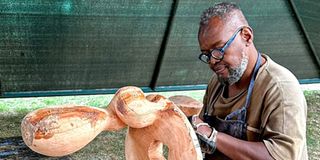
Veteran sculptor Gakunju Kaigwa at work in his Nairobi studio in May 2026.

Photo credit: Pool

Of all the visual art forms exhibited in Nairobi, sculpture remains perhaps the hardest to encounter. In a city where gallery walls are dominated by oil and acrylic paintings, three-dimensional works are comparatively rare. That is what makes veteran sculptor Gakunju Kaigwa’s latest exhibition, Ancestral Grain, at Rooftop Gallery in Village Market feel like a welcome departure from the familiar.

“If you get a room with 10 visual artists, you would be lucky to have two sculptors. There seems to be a perception out there that sculpting is difficult, but I tell painters to make an effort before complaining. Some of the best sculptors you will ever come across, like Cyrus Kabiru, Denis Muraguri and Kepha Mosoti, are painter friends who I convinced to try sculpting, and they never looked back”, he says.

Kaigwa’s journey into art began with drawing while in primary school. However, it was while he was in high school at Lenana School that his love for the arts solidified, largely because of the importance placed on the subject at the school.

At university, where he specialised in art, he was introduced to painting, graphics, ceramics and sculpture, which broadened his knowledge. Upon graduation, he continued painting for three years before fully getting into sculpting.

“While painting was my major, sculpturing did things for me that painting was not. It was effortless and more expressive for me. When I was a painter, I would use a lot of outside stimulus, like pictures, to come up with my compositions, but with sculpting, I just imagine and create. Paintings would take me a month to complete, whereas it takes me a week to complete a carving”, he says.

Before he fully ventured into art, Kaigwa worked with the Voice of Kenya for two years as a graphic designer before quitting to focus on art full-time.

“I had my first solo exhibition in October 1982 at the French Cultural Centre. Later on, I joined Gallery Watatu, which was the biggest art gallery in Nairobi at the time. I was one of the youngest in that generation with people like Jack Wanjau, Ancent Soi, Joel Oswago, and Timothy Brooke. Many of the artists I was with at the beginning of my journey are sadly no longer with us”, he says.

Eburru 2, a sculptural work by Gakunju Kaigwa, on display at Rooftop Gallery in Nairobi.

Photo credit: Pool

A turning point came in 1988 when he received a scholarship to study in Carrara, Italy, a city globally renowned for its marble quarries and sculptural heritage. For a young Kenyan sculptor, the experience was transformative.

“I was 32 years old and suddenly immersed in an environment where art was a fully-fledged profession. Italy should be a mandatory pilgrimage for anyone pursuing the creative arts because there is inspiration everywhere. As a stone sculptor, standing before Michelangelo’s David takes your breath away. It also shows you what is possible.”

On returning, he diversified his practice from exclusively working with stone to working with metal and wood because he had found stone limiting. He would later on get another scholarship to Dundee in Scotland, where he pursued a Master’s programme in the arts before undertaking a residency programme in Trenton, New Jersey, in the US for four years, where he specialised in sculpting with metal. Learning for Kaigwa is a relentless experience.

Turning 68 on May 22, 2026, Kaigwa attributes his longevity in the craft to his passion for the arts and the support from the people in his corner, including the people who commission him for his works.

Some of the famous places his works lie include the fountain at Starehe Girls Centre and School, and a sculpture of a girl reading a book on a bench at the International School of Kenya.

“You do it because you love it; it is what makes you stay around for that long. I always tell people that I don’t work when I step into my studio, I play. You need to have your inner child with you at all times because you are exploring having fun and playing. This is what keeps me young. I don’t know what will happen at any time when I step into my studio, except for the excitement of the next piece. I haven’t made my best piece yet.

I also have a very supportive family, my wife and my children, who are both creatives, and have been fundamental. My mum, who is 95 and lives with me, is a big part of who I am. It is very difficult to do art around people who don’t see what you are doing because it is easy to get discouraged,” he says.

Kaigwa made his first wood carving in 1999 when he came back from Italy. He had never worked with wood before. His decision to flirt with wood was driven by his desire to make not only art that would decorate places, but functional art.

“I wanted to create pieces that were not only beautiful but functional,” he says. “I was interested in furniture that could be used as a table, chair or stool while still being appreciated as fine art.”

This exploration led him into a longstanding debate within artistic circles: where exactly does fine art end and craft begin? His inspiration came from the humble three-legged stool once found in many Kenyan homes.

"Those stools gradually disappeared, and I wanted to bring them back. They inspired some of my earliest wooden works before I expanded into other forms. Some collectors buy my pieces and refuse to sit on them because they see them purely as artworks."

For Kaigwa, wood possesses qualities that other materials cannot replicate.

“Wood has a warmth missing in other materials. There is a spirit within it that draws people probably because it was once a living thing. I source my wood from trees which have been brought down through no fault of their own. My works gives these trees a new life, and remembers that they once lived, he says.

Olengurone, a sculptural work by Gakunju Kaigwa, on display at Rooftop Gallery in Nairobi.

Photo credit: Pool

For carving, he picks wood depending on the type of grain that they have and the ability to withstand his hands and tools and take shape without breaking and being resistant to attack by insects.

There are four that I mainly use: eucalyptus, jacaranda, cypress and, more recently, mango wood, which I absolutely love because it is a medium-hard wood. If you get the right piece, it has amazing colours and grain patterns. Podo is also a very beautiful wood, but it is a bit harder to find, so I haven’t worked with it much. However, I am always looking for it.

Ancestral Grain pays homage to the ancient nature of the wood art craft. It gives fallen trees a second life, one that honors their long memory and the unseen energy they still hold.

In Ancestral Grain, Kaigwa poses as the muse that listens to what the wood remembers. Each curve, hollow, and surface is a still conversation between artist and ancestor, his chairs, stools, and tables are carved with impeccable fluidity almost as if the wood itself is reminiscing movement.

Follow ourWhatsApp channel for the latest business and markets updates.

PAYE Tax Calculator

Note: The results are not exact but very close to the actual.