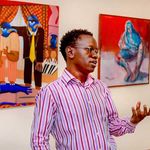
From the cohort of emerging artists last showcased at One Off Art Contemporary Gallery last year, it is Yusuf Mirumbe that the deities of art seem to have been kindest to.
From his journey at Alfajiri Street Kids Art where he learnt and taught painting with street children, there has hardly been a dim to his shine in as far as the progress and evolution of his craft is concerned.
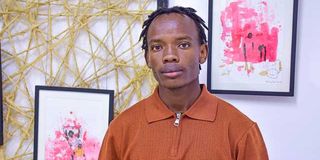
Now, a body of his works is being showcased at the PhotoGallery on Chicago Avenue in Minneapolis in a solo show dubbed Mothers of Mathare which explores his traditional style of figure painting that plays form and posture while maintaining a classical renaissance look on his female subjects
Closer home, at the Nobody Owns Me Gallery in Kibera, he takes a more socio-political role with his works largely depicting the violence experienced in the Rwandese Genocide in a show together with Benjamin Ogada that is dubbed Things That Make Us.
The two shows held concurrently in different continents are as different as light and day because in one, he paints piles of ashes but in another, gold takes a centerstage, figuratively speaking.
For Yusuf, the rise of his journey into international acclaim stems from a practice which feels like a habit but sometimes, even for a gifted artist, lady luck takes a chance and changes their lives.
“Last year, a lot of people collected my works which has made my practice feel like it is worth it. Amongst these is one Cherie Kihato, the founder and owner of Savannah Space, a furniture selling entity based in Nairobi. She saw my work on Instagram and messaged me after which we worked on a commission. During this time, she was doing a series on furnishing her Nairobi apartment. She has a large online audience and she shared my work with her followers and asked them to support me. They flooded my inbox and before I knew it, I had sold every single painting in my studio within two months”, he says.
Many would get interested in Yusuf’s career and for the first time in his life, the budding artist had a problem that he had never anticipated, he had more commissions than he could handle.
“After Cherie did the video, I didn’t have any work in my studio. I was totally sold out. In a way, I feel like she discovered me then brought me to light, to her audience and from then on, most people were able to see my work from there. It is s not a journey I ever imagined. Prior to this, I had never imagined myself as a professional artist let alone even getting any limelight, he says.
Unlike many other artists, Yusuf’s interaction with art came about as a means of distracting himself.
An alumnus of Lenana School under Equity Bank’s Wings to Fly Programme, he considered himself as an extremely sharp student with the ambitions of even going to Harvard after high school.
“A bad thing happened; I got a B+. For me, that was a complete failure. I had envisioned a future where books had to make sense because books were the only way out for me. Everyone around me celebrated my results but I was extremely disappointed and felt that my life had ended”.
Corrections ink, acrylic and oil on watercolor paper artwork by Yusuf Mirumbe pictured on July 12, 2026 at Nobody Owns Me gallery in Kibera.
Photo credit: Billy Ogada | Nation Media Group
Coming from a poor background, he had been hopeful of getting another scholarship which would see him through the next phase of education but this was never forthcoming. It is how he started to sketch to pass time. He started studying realism from YouTube videos starting off with graphite.
One day while listening to Radio Jambo, he heard of an organisation called Afajiri Street Art, which was using art to rehabilitate and empower street children. He wanted in and called to volunteer. He became a part of them and before long, they would help him to get to campus as well as teach him how to paint.
“With them, I got to showcase my work in exhibitions and I remember my first one which was held at the National Museum in Nairobi where I sold two paintings, I had never been happier. One thing that the director of Alfajiri taught me was, that whatever an artist felt in their heart, should end up on the canvas whether it is pain or sorrow,” he says.
In most of his paintings especially in his show in Minneapolis, Yusuf’s work largely centres on female figures as his muse, an act he says is deliberate.
“Mostly, I paint a lot of women and mother figures because to me, they are they are the ones who rescued me. Growing up, I mostly had my grandmother and so I see them as angels. I see women as strong figures, I see them as a symbol of beauty and hope,” he says.
Traditionally, Yusuf is a painter of beautiful things but his latest body of works at the gallery in Kibera seems to veer from norm. It feels a little tampered down from the human figures done in oil on canvas which are his signature style.
The work however is deliberate with regards to what inspires him especially when it comes to doing social commentaries using art work. Last year, he would do a series of water colours on paper, largely miniscule sketches of people with backdrops of red which he christened as the Congo series, an ode to the skirmishes in Goma in Congo. The 10 pieces he made from the series were all sold out.
“I saw black people fleeing from black people and it looked so bad. Most of the people who were fleeing were women and children. I really pitied them and it touched me, there was nothing I could do about it, I could not go there and stop the rebels, I could not make noise about it but I think I can make people aware that what is happening in Congo, is here at home because their lives were equally as important as those in Gaza and Ukraine, he says.
What we carry ink, acrylic and oil on watercolor paper artwork by Yusuf Mirumbe pictured on July 12, 2026 at Nobody Owns Me gallery in Kibera.
Photo credit: Billy Ogada | Nation Media Group
In Kibra, his show depicts the blood and gore of the Rwandan Genocide. His subjects reflect the anguish and the injustice of war and the helplessness of civilians caught in the crosshairs of the blades of human animosity. He captures moments of the genocide drawn from a personal study into the murky world of wars ranging from Sudan, Goma, to Rwanda.
When Yusuf is not painting beautiful women, he is likely buried in the annals of bloodshed and war.