Everyone holds a definitive opinion on Kenya’s creative industry, particularly our music. Critics often claim the scene is stagnant despite a relentless stream of hits.
Optimists argue we are entering a digital golden age fuelled by streaming, and the State frequently frames it as an “employment opportunity".
What we can all agree on is that Kenya’s music culture has had a vibrant past. That’s what the Recording Industry of Kenya (RIKE), led by National Coordinator Angela Mwandanda and Chairman Eric Musyoka, supported by the British Council and International Federation of the Phonographic Industry, set out to capture in Sonic Nation, a documentary released in April 2026.
The idea behind Sonic Nation is undeniably noble. As a culture, we are notoriously poor at documenting our history. So, before I go all out on this production, I respect and appreciate what they were trying to do. And it's also important to note that what they are working on is "work in progress".
A primer for the uninitiated
If you are a student writing a paper on the Kenyan music scene, this documentary will come in handy. It packs a good amount of information into its runtime. providing a functional overview of the culture's genesis and its contemporary standing.
A decade from now, this will be a foundational resource for the generation born in the 2010s seeking to understand their musical roots.
The guest list is impressive. The production managed to secure interviews with influential figures across various eras. Seeing pioneers like John Katana Harrison and Japheth Kasanga alongside legendary broadcaster Fred Obachi Machoka provides a necessary link to the past.
The inclusion of modern industry players like Tedd Josiah, DJ Pinye, Muthoni Bwika, and Shaffie Weru helps round out the narrative of the urban sound.
Visually, the segments featuring younger artists are technically polished. These clips are colourful, glossy, and clearly benefited from a decent budget and careful location scouting. For a younger audience used to the fast-paced nature of the internet, the 46‑minute runtime and upbeat editing style might be a plus.
The sound and music mix is fantastic. For people who have a knack for Kenyan music, millennials especially will love the music selection. Nostalgic? Yes, but the choice and style of layering and integration with the talking heads is thoughtful.
The musical layering is atmospheric and precisely timed, enhancing the experience without ever becoming intrusive.
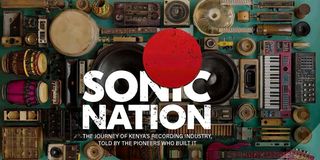
The splash screen, title card from a design percpective is very cool.
The structural identity crisis
My primary critique lies in the film's classification. Sonic Nation lacks the structural gravity essential to the documentary genre. It frequently feels like a high-production YouTube video, one that refuses to let the audience pause or synthesise the information. By favouring a frantic, music-video aesthetic, the film sacrifices the traditional three-act arc with no calibrated emotional highs or lows.
The film attempts to cover everything from the colonial era to the modern day, but it lacks a coherent roadmap. It tries to use timelines, but the talking heads frequently get derailed.
Someone will start talking about the 80s, then suddenly shift to the 90s or start discussing matatus, and the edit just follows them there without any redirection. The result is a disorienting experience that relies heavily on the viewer’s prior knowledge to fill the gaps.
Simple visual cues, such as era-specific "chapters" on screen, could have anchored the narrative. Instead, the production feels "assembled" rather than directed.
A more inspired approach might have compartmentalised the industry through technological shifts: the vinyl era, the cassette era, the CD era, and the streaming age. While these transitions are mentioned, they are unfortunately tangled into an uneven blend of opinions.
Technical laziness and the AI factor
For a project about history, the lack of a vast amount of archival footage is baffling. Given the wealth of footage showcased during national holidays, the heavy reliance on AI-generated clips feels like a lacklustre substitute for authentic documentation. AI should be a tool of necessity, not a shortcut.
If the script discusses a defunct yet influential recording studio, the b roll should take us to its physical location on River Road, where it used to stand, to establish a sense of place before introducing synthetic visuals. River Road is still there, with people still recording up to now. Basically, there is a lot of telling without showing.
This lack of authenticity extends to jarring geographical errors. At one point, the narrator describes River Road while the b roll displays Moi Avenue.
When producer Clemmo discusses the origins of Calif Records, we hear Genge music, yet the screen shows a glossy, modern video unrelated to the Calif aesthetic.
Why not use archival footage of Jua Kali or scenes that capture the grit and realism of that era? These mismatches suggest a production pandering to Gen Z sensibilities rather than staying true to historical accuracy.
I was also bothered by the idea that they were talking about the DJ who played Kenyan music in matatus, and I kept wondering why not talk to them.
The narration also lacks personality. It sounds like a tourism ad, safe, clean, corporate. But what bothered me most was that the phrasing is full of AI grammar, with an overuse of negative -postive antithesis. Even in structure, it feels like the script was pulled from Wikipedia and polished by a bot, devoid of human intuition.
While the voice‑over was clean, it leaned on a corporate ad tone. I have no issue with the voice actor, but I kept thinking of Nick Odhiambo, whose authentically Kenyan voice has a personality that would make the documentary sound and feel Kenyan.
A Nairobi‑centric view
On a personal note, as a millennial who grew up with this music, the scope felt narrow. Yes, it’s a work in progress, and they promise a broad platform to capture more voices, but I am focusing on what we have, not what is promised.
It is titled Sonic Nation, but it feels more like Urban Nation. It focuses almost exclusively on secular urban producers and capital-city radio stations, largely ignoring the monumental contributions of Western Kenya, the Coast, and Eastern regions. Most glaringly, it overlooks the profound influence of religious music on Kenyan culture.
I was also disappointed by one major omission. For me, the gateways into Kenyan music were figures like Eve D’Souza and DJ Adrian. Eve’s Top 9 at 9 was my introduction to what was new in the industry, and Adrian was a massive part of why I fell in love with the urban scene. Their absence felt like a significant oversight that deeper research might have rectified.
But above this production doesn't offer (though it has the potential to) anything more than you can't find on YouTube, specifically, Cleaning The Airwaves (CTA).
Amateur polish
On a technical level, the branding of the production feels amateurish. While the splash screen looks fantastic, the choice of display fonts for the lower thirds and the general videography, which I would not even call it cinematography, feels rushed. It lacks the depth expected of a professional documentary.
Even more surprising was the total lack of a credit roll at the end. Not seeing the names of the people who worked on this is such a basic mistake.
There is also a segment regarding copyright and state institutions that is very important but it felt less like a cultural exploration and more like a sanitised corporate advertisement. It felt disingenuous, as if the documentary’s secondary purpose was to bolster the image of government bodies rather than critique or celebrate the actual plight of its theme.
Final thoughts
The ambition to document our musical history is commendable, and Sonic Nation serves as a functional educational supplement for those seeking a surface-level understanding. However, the execution is fundamentally flawed.
Condensing such a vast, diverse history into 46 minutes inevitably leads to an incoherent result. This story required more than 90-minutes to breathe.
The producers have indicated a forthcoming platform for full interviews, which may provide the depth missing here. My advice for future instalments is simple, consult or collaborate with seasoned documentary filmmakers, visionaries like Sam Soko or even mainstream fiction film directors like Victor Mbaya, who understand the art of storytelling.
We need our history documented with the personality, soul, grit, and precision that have been a part of it for all those decades. Sonic Nation is a noble step forward, but currently, it remains a "YouTube video" occupying the space where a definitive documentary should be.