Why IMF is still critical in Kenya’s economic plans

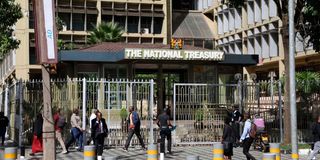
The National Treasury building in Nairobi on April 16, 2025.

Photo credit: Dennis Onsongo | Nation Media Group

Kenya’s push for a successor programme with the International Monetary Fund (IMF) is not necessarily a quest for just new funding from the multilateral lender.

The country’s move to remain within the guardrails of the fund is seen more as an assurance that the government will carry through with critical reforms including improving revenue collection and reducing borrowing.
According to analysts, investors both home and abroad see a successor IMF programme as crucial in ascertaining the credibility of fiscal, monetary and governance reforms.

Kenya turned to the IMF at the onset of the 2020 pandemic after years without a programme as it sourced for funding in the backdrop of Covid-19 induced challenges including the deterioration of domestic revenues against expected sizable debt maturities.

In May 2020, IMF approved the disbursement of Sh95.5 billion ($739 million) to be drawn under the Rapid Credit Facility (RCF)- a facility providing fast concessional financial assistance to low-income countries facing an urgent balance of payment needs.

“The Covid-19 pandemic has delivered a large economic shock to Kenya. The pandemic has impacted nearly all facets of the economy-particularly tourism, transport and trade- and led to urgent balance of payments and fiscal financing needs,” Tao Zhang, the then deputy managing director and acting chair said on May 6, 2020.

Nearly a year later on April 2, 2021, the executive board of the IMF approved a 38-month arrangements under the Extended Credit Facility (ECF) and the Extended Fund Facility (EFF) for Kenya for an amount first estimated at Sh302.3 billion ($2.34 billion), before subsequent increments to support the next phase of the government’s response to the pandemic and address urgent debt vulnerabilities.

As of October, last year, the IMF financial commitment stood at Sh466.5 billion ($3.61 billion) with about Sh403.1 billion ($3.12 billion) approved for disbursement.

In March however, the IMF pulled the plug on the ninth and final review of the multi-programme, freezing a disbursement estimated at Sh110 billion.

The freeze has not been detrimental to the fiscal picture as Kenya has had access to international capital markets in the past two years where it has undertaken buybacks of Eurobond notes that were due in June 2024 and May 2027 lessening pressure on upcoming maturities.

Moreover, the National Treasury has projected to run the budget up to June 2030 without factoring in new funding from the IMF, with the domestic credit markets expected to plug the bulk of the fiscal deficit.

Externally, Kenya sees a smaller requirement for commercial financing as it expects multiple disbursements from the World Bank's development policy operations (DPO).

But even without near term external maturities and with options to financing its deficit, experts reckon that a programme with the fund remains paramount.

A successor programme with the IMF could be funded or unfunded, implying that a new programme may not necessarily unlock new financing.

Moreover, the scope of new financing is limited by access rules which dictate how much each member of the IMF can draw resources from the fund. Kenya can only access a cumulative Sh604.7 billion ($4.68 billion) or six times of its $781.6 million quota, under normal access limits, which is expressed as 542.8 million special drawing rights (SDRs).

Outstanding loans by Kenya due to the IMF stood at Sh536.3 billion ($4.15 billion) as of June 30, implying that Kenya can only access a further Sh68.4 billion at present.

Vice President-Senior Credit Officer, Sovereign Risk at Moody’s Ratings David Rogovic notes that while access to new financing would be positive, a successor programme for Kenya from the IMF is more telling from its anchoring of crucial reforms to ensure macro-stability.

“It’s really the signalling, whether you have a funded programme or not. The IMF brings credibility and is an external anchor that if the government is committed to a programme with it, this will lead to improved fiscal outturns,” he said in an interview on Wednesday.

“The IMF can catalyse concessional financing, but it ultimately comes down to delivering the fiscal adjustment. The government needs to deliver on the fiscal to maintain positive investor sentiment and low market spreads.”

Previous IMF programmes have come with clear and tough quantitative performance conditions including a target on both revenue collection and the fiscal deficit, inflation and even the level of official usable reserves.

In terminating its previous programme with Kenya, the fund for instance referenced missed performance targets including underperformance in revenue mobilisation and lack of clear plans to improve the financial performance of ailing State-owned enterprises (SOEs).

Even with just a reform-only programme, the IMF relationship with Kenya is still seen as highly valuable, determining the country’s access to other financing including from bilateral and commercial sources.

Some analysts, however, think that it might be too early for a successor programme at a time when Kenya is under no immediate balance of payments pressures.

IC Group economist Churchill Ogutu reckons a new programme could make more sense after the 2027 General Election when Kenya will be moving closer to new external maturities.

“I think they (Kenyan authorities) can muddle through. Balance of payment risk is no longer a threat, with the building of forex reserves and improvement in external balance with the recent methodology tweak, and as such, the case of a programme should be around 2028 when gross financing needs are elevated, and when Kenya has rebuilt adequate room for a substantial normal access funding,” he said.

An IMF staff team jetted into the country on Thursday to initiate discussions on what is expected to be a successor programme.

“At the request of the Kenyan authorities, an IMF staff meeting will begin discussions in the coming days on a possible fund-supported programme,” IMF Mission Chief to Kenya Haimanot Teferra said.

PAYE Tax Calculator

Note: The results are not exact but very close to the actual.