Time flies with great content! Renew in to keep enjoying all our premium content.
Prime
Why Agoa extension deal signals tougher trade terms for Kenya
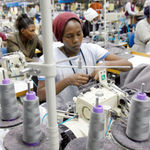
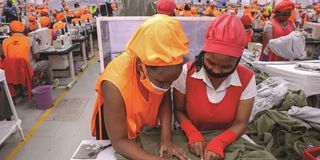
Kenyan workers prepare clothes for export at the New Wide Garment Export Processing Zone (EPZ) factory operating under the US African Growth and Opportunity Act (Agoa) in Kitengela, Kajiado County, Kenya on September 19, 2025.
Kenya is set to face renewed pressure to open its market wider to American goods, services, and investors after President Donald Trump late on Tuesday extended the African Growth and Opportunity Act (Agoa) through December 2026.
The re-authorisation of the preferential trade programme applied retroactively from September 30, 2025, meaning exporters will get back the tariff benefits they had lost since the pact lapsed.
The US House of Representatives last month passed a Bill seeking to renew Agoa for three years, but the Senate cut this back to a one-year extension. The House later concurred with the Senate amendment before the legislation was forwarded to President Trump for assent.
US Trade Representative Jamieson Greer, however, said the short-term renewal marks a shift toward a more demanding framework that prioritises greater reciprocity and expanded market access for American firms.
“Agoa for the 21st century must demand more from our trading partners and yield more market access for US businesses, farmers, and ranchers,” Mr Greer said in a statement after Mr Trump signed the legislation into law.
“We must also make sure that the programme enhances US-Africa trade and will work with Congress [US Parliament] over the next year to modernise the [Agoa] programme to align with President Trump’s America First Trade Policy” the official added.
Ambassador Greer, a Cabinet member who serves as Mr Trump’s principal adviser and negotiator on trade matters, argues that while Agoa has boosted African exports, it has not delivered enough reciprocal access for American companies.
The language points to a recalibration of trade relations that could see Washington press Nairobi to lower barriers facing US companies if it wants to retain preferential access to the American market beyond 2026.
The Trump administration is expected to push for lower Kenyan tariffs on US agricultural products, expanded access for American service providers, and fewer regulatory hurdles for US investors in sectors such as healthcare, financial services, energy, and digital services.
Washington has repeatedly raised concerns over Kenya’s sanitary, phytosanitary, and regulatory standards, which have denied American firms access to Kenya’s agriculture sector.
US trade officials have taken issue with Kenya’s Director of Veterinary Services over barriers that have made it difficult for American firms to export bovine embryos to Kenya, despite a deal struck with the US Department of Agriculture’s Animal and Plant Health Inspection Service in January 2020.
American exporters have also complained that selling meat, dairy, and poultry products into Kenya remains difficult due to what Washington describes as “complex, non-transparent and costly requirements.”
Corn exports have also been flagged as uncompetitive because Kenya imposes a lower total aflatoxin limit of 10 parts per billion and a stricter maximum moisture content of 13.5 percent—standards that US officials say are more restrictive than those applied domestically in the US.
“Kenya imposes standards that are overly restrictive for bovine semen imports, precluding actual market access for most US bovine semen,” the US Trade Representative’s Office said in its 2024 National Trade Estimate Report on Foreign Trade Barriers, adding that additional processing requirements make US corn exports “largely uncompetitive.”
Kenya has since 2000 exported goods, mainly textiles and macadamia nuts, to the US tax- and quota-free under Agoa, supporting tens of thousands of jobs in export processing zones, largely in Athi River and Thika.
However, following the lapse of Agoa last September, manufacturers say shipments to the US have been hit with full duties ranging from 15 to 42 percent—costs that industry players say are higher than earlier projections and have squeezed margins.
The Kenya Private Sector Alliance (Kepsa) and Kenya Association of Manufacturers (KAM), which had earlier proposed a three-year extension to Agoa, welcomed the extension, saying it will provide critical short-term relief and support business continuity to exporters.
KAM estimates that the US has recorded a cumulative trade surplus of $1.7 billion (about Sh219.3 billion) since Agoa took effect in 2000, with Kenya exporting goods worth $13.3 billion (about Sh1.72 trillion) while importing $11.6 billion (about Sh1.5 trillion).
KAM chief executive Tobias Alando said Agoa-backed investments in Kenya have about 68,000 people supporting nearly 700,000 dependents.
Mr Alando, however, warned that eligibility comes with obligations that require beneficiary countries to eliminate barriers to US trade and investment, and demonstrate progress toward market-based economies, good governance, and respect for the rule of law.
“To compound on the gains made through Agoa and provide a long-term and sustainable framework, we urge the governments of the United States of America and Kenya to conclude negotiations for the Kenya-US bilateral agreement,” he said.
KEPSA chief executive Carole Kariuki reiterated that Agoa has been “the single most effective US policy tool in Africa over the past 25 years”, with Agoa-linked industries supporting hundreds of thousands of livelihoods in Kenya.
KEPSA added that the deal also benefits American consumers, saving the US an estimated $200–250 million (about Sh25.80 billion-Sh32.25 billion) annually on products such as jeans and uniforms, while supporting jobs in logistics, retail, and distribution.
“The signing of this act provides the immediate certainty required to maintain investor confidence and protect existing jobs,” Ms Kariuki said. “KEPSA will embark immediately on the Kenya–USA trade deal negotiations in collaboration with the government, ensuring mutual economic transformation aligned with both Kenya and US trade policies.”
Both Washington and Nairobi have signaled plans to revive stalled efforts toward a comprehensive US–Kenya free trade agreement. President Trump’s administration first initiated negotiations with Kenya in February 2020, but the talks were shelved under President Joe Biden, who opted instead for a narrower US–Kenya Strategic Trade and Investment Partnership (STIP).
STIP negotiations began in July 2022 and ran through eight rounds by September 2024, but failed to deliver a deal before President Biden left office. State Department for Trade disclosures show the talks were only about 50 percent complete, missing a 2024 target.
Kenyan officials have sought to downplay fears that Nairobi could be targeted under Trump’s tougher trade stance. Cabinet Secretary for Investments, Trade and Industry Lee Kinyanjui has previously argued that Kenya does not run large trade surpluses with the US and, therefore, does not fit the profile of countries Washington is seeking to rein in.
“The US President has said that he is trying to correct situations of countries which were taking advantage of the US and had huge trade surpluses,” Mr Kinyanjui said in a past interview. “Kenya does not fit in that space.”
The current Trump administration has signalled its intention to restart comprehensive trade negotiations with Kenya, arguing that a full bilateral deal could serve as a template for other African countries seeking reciprocal arrangements beyond Agoa.
“I had my counterpart and Trade minister from Kenya last week, and we sat in my office, and we had a good talk,” Ambassador Greer told the US Congress Committee on Ways and Means in April 2025. “He [Mr Kinyanjui] understands our concerns, but he also understands the need to move forward… They want to have some kind of agreement.”