Wage bill, revenue arrears blur counties’ ambitions

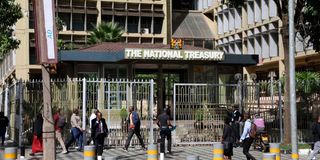
The National Treasury building in Nairobi on April 16, 2025.

Photo credit: Dennis Onsongo | Nation Media Group

Governors are at a crossroads, trying to juggle county finances to achieve much-needed development growth for residents while facing revenue woes, as the Treasury struggles to fund the devolved units in time.

Faced with burdens of a ballooning wage bill, weaknesses in the payroll system, and competing cash drain points, counties are finding it difficult to survive on just their own revenues.
Oversight bodies have revealed how a majority of the counties continue to pay salaries outside the approved payroll system, exposing them to risk of siphoning of public funds.

During the year ending June 2025, counties processed Sh12.88 billion in salaries manually, the Controller of Budget (CoB) reported, which was six percent of all the salaries paid by counties during the year.

The Parliamentary Budget Office (PBO) warns that the worrying trend puts billions of shillings of public funds at risk, even as counties struggle with the monster of exorcising ghost workers who have raided their payrolls and worsened their wage bill burden.

“Indeed, except for Baringo and Nyamira, all the other 45 counties had a component of their personnel emolument (PE) costs processed through the manual payroll,” the PBO observes.

Turkana led the pack, processing Sh1.4 billion in salaries manually, followed by Nyeri (Sh725.5 million), Kiambu (Sh713 million), and Wajir (Sh682 million).

Most counties claim to process salaries manually to pay casuals, Community Health Promoters (CHP), salaries for staff not on-boarded into the official payroll system, and top-up allowance for security personnel--a position which is prone to abuse.

“The use of manual payroll by counties poses various challenges, including potential abuse which may result in the loss of public funds through inflated wage bills,” the PBO notes. The office, which advises MPs on budget and economic issues, reckons that counties also need to undertake audits of their existing human resource data “to help identify and eliminate ghost workers.”

The National Treasury has indicated that it is currently integrating all public entities into a central payroll system that will eliminate ghost workers and address other payroll challenges, with counties expected to be fully onboard by June 2026.

Treasury Cabinet Secretary (CS) John Mbadi says sealing the loopholes within the public payroll system will help the government at least maintain its current wage bill level, ruling out any possibility of firing workers to achieve a lean, effective public service workforce as earlier promised.

“We can make our public sector more efficient and manage our payroll so that it can efficiently let us eliminate ghost workers in our payroll, and that is why we are integrating the payroll now. By the end of this year (2025), the entire national government executive will have been integrated, and all counties by June next year,” he said.

Efforts to address weaknesses within the counties’ wage bill are being made at a time when it has risen from Sh195 billion to Sh220 billion in just two years to June 2025, eating into nearly half (48 percent) of the counties’ revenues.

CoB Margaret Nyakang’o observes that counties are not following through on their commitments to lower their wage bills to the legally set 35 percent of revenues, most of them spending even more than half of what they get to pay salaries and allowances.

During the national wage bill conference in April 2024, counties were asked to refine strategies and action plans to achieve a wage bill-to-revenue ratio of 35 percent by the end of June 2024. During the first quarter of the current fiscal year, counties spent Sh43.7 billion on salaries and allowances.

University of Nairobi (UoN) Economics Professor, Samuel Nyandemo, observes that counties must put their house in order by addressing internal challenges draining their coffers, if they have to fund projects that benefit residents.

“All these problems from the huge wage bill and other expenses, ghost workers, and other leakages can be addressed if county administrations focus on addressing them. This will be the lasting solution rather than getting more cash that ends up in the drain,” Prof Nyandemo says.

The one area where counties have posted improvements in their financial management has, perhaps, been in generating their own revenues.

A trend of the counties’ Own Source Revenue (OSR) shows that the local revenues have jumped by about 2.5 times since the onset of devolution.

From a collection of Sh27.2 billion in the year to June 2015 to Sh67.3 billion in the past fiscal year, this shows that continued automation of revenue collection systems and expansion of the revenue streams are paying off.

The CoB, however, warns that some counties are still using manual revenue collection methods, which undermines their ability to hit their potential and exposes them to weak controls that are prone to leakages, underreporting, and fraud.

Other counties also still have unexploited potential, with the Commission on Revenue Allocation (CRA) estimating that counties could generate up to Sh250 billion annually, while some have not employed effective collection methods.

Between June and September this year, revenue arrears for counties grew from Sh124.9 billion to Sh156.2 billion, official documents show.

“The situation significantly impedes liquidity, making it challenging for the Counties to implement the financial year 2025/26 budget effectively,” Dr Nyakang’o observes.

Counties have also been fingered for possible wastage of resources through bursary kitties, where their funding of students in primary, secondary, and tertiary levels has been put into question.

In June 2025, the High Court barred county governments from allocating cash for bursaries pending a resolution on the matter, though the PBO reveals that some disregarded the court order and allocated Sh1 billion in the current fiscal year.

“Despite the ongoing challenges, county governments continue to allocate significant amounts to bursaries – a potential PFM (Public Finance Management) breach,” the office says.

Among counties that have allocated cash for bursaries during the year to June 2026 are Kwale Sh400 million, Kakamega (Sh240 million), Homa Bay (Sh215 million), Laikipia (Sh75 million), and Lamu (Sh70 million), though the CoB has stayed her ground, refusing to approve bursary requests by counties.

PAYE Tax Calculator

Note: The results are not exact but very close to the actual.