Treasury’s first 2025/26 mini-budget lifts spending by Sh263bn

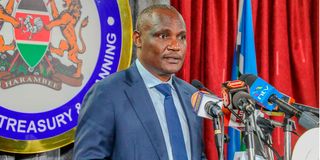
National Treasury and Economic Planning Cabinet Secretary John Mbadi.

Photo credit: File | Nation Media Group

The first supplementary budget for the present 2025/26 financial year is set to increase government spending by Sh262.9 billion amid rising pressure from underperforming revenue collections.

New estimates by the National Treasury project spending for the fiscal year to June 30, 2026, to hit Sh4.532 trillion, up from Sh4.269 trillion in the approved budget.
The increase is largely attributable to recurrent spending, which is set to rise by Sh204.6 billion to Sh3.338 trillion, while the development vote goes up by Sh58.3 billion to Sh707.3 billion. Kenya’s recurrent spending has remained persistently high, driven by wages, allowances, and operational costs across the government.

The increased spending requirements in the planned mini budget will raise the fiscal deficit – the difference between total spending requirements and available resources – from Sh901 billion to Sh1.14 trillion or six percent of GDP from 4.7 percent.

Expenditure performance through the first six months of the 2025/26 fiscal year shows the government surpassed its target for recurrent spending on increased receipts on operations, maintenance, and debt service, while disbursements to development and counties suffered as a consequence.

“The total expenditure and net lending for the period ending December 2025 amounted to Sh2.02 trillion, against a target of Sh2.09 trillion. The resultant below target expenditure of Sh72.6 billion is largely below target disbursement towards development expenditure and county governments,” the National Treasury indicated.

“Development expenditure was also below target by Sh33 billion, while transfer to counties recorded a shortfall of Sh50.4 billion, mainly due to delayed disbursements. The recurrent expenditure was above target by Sh10.9 billion, mainly due to higher than targeted expenditures in operations and maintenance, and domestic interest.”

The rising spending pressures are against an underperformance in revenue mobilisation, implying that the government will have to borrow more to plug the wider budget hole.

As at the end of December 2025, total revenue, including Appropriations in Aid (A-i-A), amounted to Sh1.5 trillion against a target of Sh1.637 trillion. A-i-A are revenues generated directly by government departments or agencies — such as service fees, charges, or donor funds — retained for operational costs rather than being deposited into the Consolidated Fund.

Revenue collection was below target by Sh136.1 billion, with the outcome being attributed to underperformance recorded in ordinary revenue or taxes of Sh115.3 billion and Sh20.8 billion in ministerial appropriations.

“The ordinary revenue collection was Sh1.236 trillion against a target of Sh1.351 trillion. All ordinary revenue categories except import duty recording below target performance during the period under review,” the National Treasury added.

The National Treasury is expected to lean on the domestic credit markets to plug the widened deficit, with the target for net domestic borrowing rising by Sh272.4 billion from Sh613.5 billion to Sh885.9 billion.

The exchequer has set down its target for net foreign financing by Sh32.6 billion from Sh287.4 billion to Sh254.8 billion, pointing to its lower expectation of finding adequate financing from abroad by June.

The return of supplementary budgets indicates the challenge of estimating expenditure requirements and projecting revenues across a financial year, even as Treasury Cabinet Secretary John Mbadi claims it is considering scrapping supplementary budgets from the national budget cycles.

“If you notice, I am one person who believes we should kill supplementary budgets. So, we are gradually moving there...previously we used to have supplementary budgets in December, November,” CS Mbadi said last week.

Kenya has traditionally issued two to three supplementary/mini budgets over a financial year.

The National Treasury has issued three supplementary budgets since Mr Mbadi took over office on August 8, 2024.

The Treasury was forced to table its first mini-budget early in the fiscal year 2024/25 after the rejection of the Finance Bill, 2024. The second mini-budget was, meanwhile, forced by the underwhelming performance of new tax measures legislated in December 2024.

The National Treasury on June 18, 2025, tabled its third supplementary budget for the 2024/25 fiscal year, less than a fortnight before the end of the financial cycle. The third supplementary budget proposed to increase the overall budget for the year to June 30, 2025, by Sh18.9 billion, with the big winners from the mini-budget being the State House, Teachers Service Commission, the State Department of Higher Education, Internal Security, and the National Intelligence Service.

Follow ourWhatsApp channel for the latest business and markets updates.

PAYE Tax Calculator

Note: The results are not exact but very close to the actual.