Households hit as State bursts domestic debt target by Sh591bn

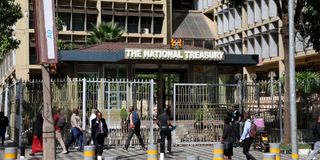
The National Treasury building in Nairobi on April 16, 2025.

Photo credit: Dennis Onsongo | Nation Media Group

The government exceeded its domestic borrowing target by more than three times in the year to June 2025, edging out households and businesses, which were starved of credit amid the prolonged high interest charges by commercial banks.

Data from the Treasury shows that net domestic borrowing closed the fiscal year 2024/25 at Sh854.5 billion, which was 3.24 times the initial target of Sh263.2 billion as the State stepped up uptake of credit in the local market to offset reduced external financing.
Contrastingly, private sector credit growth was negligible at only 2.2 percent in 12 months to June 2025, with the absolute cumulative flow to households and businesses being just Sh83.4 billion.

The heavy domestic borrowing by the government saw the State drown out the private sector in the uptake of credit, worsening an already soft economy that was characterised by falling real wages and economic disruptions from deadly street protests.

Commercial banks took advantage of the sustained appetite for borrowing by the State to push Sh376.2 billion into instruments such as treasury bills and infrastructure bonds as they avoided households and businesses, deemed as riskier in the face of high interest rates and rising credit defaults.

“By the end of June 2025, net domestic borrowing amounted to Sh854.5 billion,” the National Treasury said.

“The borrowing consisted of Sh474.6 billion from non-banking financial institutions, Sh376.2 billion from commercial banks, net repayment of Sh1 billion to non-residents, and a net repayment of Sh3.3 billion to the Central Bank.”

Domestic credit extended by the banking system grew by 18.6 percent in the year to June 2025 from 9.8 percent previously, indicating increased lending by banks to the government during the cycle.

Kenya’s public and publicly guaranteed debt from commercial banks subsequently soared from Sh2.44 trillion in June 2024 to Sh2.86 trillion in June 2025.

Total public debt in the year was Sh11.22 trillion at the end of June from Sh10 trillion previously, with domestic debt at Sh6.32 trillion.
The government leaned on domestic borrowing to cover shortfalls in net foreign financing, which undershot the target at Sh179.7 billion against an initial target of Sh333.8 billion.

Net foreign financing underperformed as Kenya missed out on key financing from the International Monetary Fund, which terminated a multi-year programme in March over unmet conditions and delayed disbursements from the World Bank Group.

The government moved up its domestic borrowing target across three supplementary budgets in the fiscal year to plug the hole created by not just the shortfall in foreign financing but also an underperformance in taxes.

Taxes collected by the Kenya Revenue Authority underperformed by Sh76 billion to total Sh2.42 trillion against a revised target of Sh2.49 trillion.

The fiscal deficit-- difference between government revenues and spending requirements-- widened in the period to an equivalent 5.8 percent of GDP from 5.6 percent previously, derailing the State’s quest for fiscal consolidation.

The government took advantage of declining interest rates to load up on more domestic debt after the Central Bank of Kenya (CBK) aggressively cut the benchmark rate to encourage lending to the private sector.

CBK eased monetary policy by cutting the Central Bank Rate (CBR) from 13 percent in August 2024 to 9.75 percent in June 2025.

The 91-day Treasury bill rate declined to 8.2 percent in June 2025 from 16 percent in June 2024, significantly cutting borrowing costs for the government.

Returns on the 364-day or one-year paper also fell to 9.8 percent from 16.7 percent over the same period, cutting the government’s debt service costs.

Cuts to the CBR are yet to have their desired impact as rates on commercial bank loans to households and businesses remain relatively high, with lenders failing to pass the benefit of lower domestic rates to customers.

The average lending rate decreased to 15.3 percent in June 2025 from 16.9 percent in June 2025, but the reduction was a far cry from the cumulative 3.25 percentage points trimmed on the CBR since August.

The National Treasury argues that the deceleration in credit growth to businesses and households was partly masked by the foreign exchange impact on hard currency loans.

“This slowed growth reflects improved demand in line with the declining lending interest rates, and dissipation of exchange rate devaluation effects on foreign currency-denominated loans following the appreciation of the shilling,” the exchequer said.

“Reduced credit growth was observed in finance and insurance, trade/imports, mining and quarrying, business services, and private households.”

CBK is now betting on a new credit pricing regime to bring down the cost of credit to the private sector and boost demand.

The new regime, which takes effect from next month, will see all shilling-denominated loans based on the average interbank lending rate as the base.

Commercial banks have a six-month transition period to bring all new and current loans to the new pricing regime, where rates are expected to be closely linked with the CBR.

PAYE Tax Calculator

Note: The results are not exact but very close to the actual.