State House spent more than double the money planned in the first quarter of the current financial year, underscoring a persistent strain of President William Ruto’s fiscal consolidation plan amid shortfall in revenue.
Fresh Treasury data shows that the State House spent Sh4.32 billion against a quarterly target of Sh1.92 billion for the three months to September 30, overshooting its recurrent budget by 125 percent.
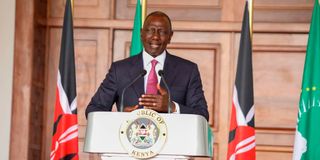
The State House’s deviation from its approved recurrent spending was the sharpest among all national government departments in the three-month period, despite the administration’s repeated commitments to tighten public finances and narrow the budget deficit, which is projected at Sh901 billion for the current year.
Analysis of the Treasury data raises questions over the control of recurrent expenditure across key security and governance offices.
Busting recurrent spending limits has the effect of forcing the exchequer to borrow more to balance the books, plunging the country deeper into the debt hole.
The Office of the Deputy President, Kithure Kindiki, also exceeded its ceiling, spending Sh1.11 billion against a target of Sh743 million, while the National Police Service, Internal Security and National Intelligence Service overshot their allocations by nearly Sh17 billion.
The expenditure pressures come at a time the National Treasury has pledged to improve efficiency in public spending in a bid to rein in the budget deficit and stabilise rising public debt.
“In the 2026/27 fiscal year, the government will continue implementing its fiscal consolidation plan aimed at reducing the fiscal deficit and containing growth in public debt. This will be done while safeguarding essential service delivery through enhanced domestic revenue mobilisation and prudent expenditure management,” National Treasury John Mbadi wrote in the 2025 Budget Review and Outlook Paper (BROP) in September.
“The government will continue to strengthen public financial management by improving expenditure efficiency through the implementation of end-to-end e-Government Procurement System, integrated human resource management systems, pension reforms, expanded use of public-private partnerships, and governance reforms in State corporations.”
However, the numbers in the first quarter suggest that spending controls in politically sensitive and security-related departments are still being tested.
This is after the National Police Service spent Sh36.94 billion, overshooting its target by more than Sh5.59 billion. The Internal Security and National Administration department spent Sh13.99 billion against a ceiling of Sh7.97 billion, while the National Intelligence Service gobbled up Sh17.96 billion compared to its target of Sh12.86 billion.
The State Department for Social Protection and Senior Citizens Affairs also overrun its recurrent budget, spending Sh14.09 billion against an allocation of Sh7.28 billion. This signals increased cash transfers to vulnerable households of the elderly and persons living with disability, as well as administrative costs of social programmes.
The State Department for Basic Education, on the other hand, spent Sh29.21 billion against Sh27.36 billion, reflecting the cost of implementation of the Competency-Based Education system.
Article 223 of the Constitution, operationalised through Section 36(9) of the Public Finance Management (National Government) Regulations, enables State offices to spend up to 10 percent more than the cash approved by the National Assembly.
The Constitution requires the Treasury to table a mini-budget in the House two months after withdrawing unbudgeted funds from the Consolidated Fund without parliamentary approval. This was done last month, and the document is awaiting debate and approval.
The PFM regulations, however, bar legislators from approving a supplementary budget that exceeds 10 percent of “the approved budget estimates of a programme or sub-vote unless it is for unforeseen and unavoidable need”.