An erroneous Sh784 trillion procurement plan from President William Ruto’s office has revealed flaws in the government’s digital procurement platform, exposing weaknesses in the system intended to address tendering fraud.
In the procurement plans uploaded by public entities on the electronic government procurement (e-GP) system, the Executive Office of the President says it plans to procure goods and services valued over Sh784.3 trillion, about 50 times Kenya’s GDP.
The approved budget of the Presidency, which includes the State House, for the year to June 2026 is Sh5.57 billion.
The defective entry raises questions over the veracity of data on the digital procurement platform, which is aimed at curbing tendering fraud in government, such as inflation of prices and ghost projects.
On the e-GP platform, the presidency plans to spend Sh12.9 trillion on industrial cleaning services, Sh25.89 trillion on transportation and storage services, Sh55 trillion on travel, food and lodging, and Sh684 trillion on services in building and construction.
The office also says it will spend Sh4.18 trillion on mining, oil and gas services, Sh838 billion on engineering, research and technology-based services, and Sh129 billion on financial and insurance services.
Overall, the office has published procurement plans 140,826 times of its approved budget of Sh5.57 billion. The office spent Sh4.5 billion during the year ending June 2025.
The flawed entries on the e-GP look set to mar the platform’s credibility in handling public procurement.
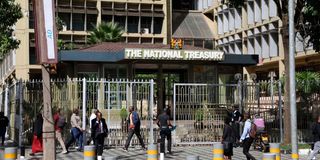
Treasury Cabinet Secretary John Mbadi did not immediately respond to requests for a comment over defective entries.
The budget plans in the portal form the basis for the sourcing of goods and services.
The Treasury says that after budgets are passed in Parliament, it will proceed to upload the documents on e-GP, after which entities will upload procurement plans to be used for the sourcing of goods and services.
“Once all the budgets are ready, they are uploaded to the Ifmis [Integrated Financial Management Information System]. Before you start procuring, that information will be translated from the Ifmis into the e-GP system, then the procuring entity will be required to process the procurement plan, and you are ready to go,” Mr Mbadi said last month.
He said procurement plans uploaded on the e-GP would be central in the sourcing of goods since they would be used to assess if entities have aligned the plans with approved budgets.
The government expects to handle about Sh1 trillion worth of procurements through the platform in the current fiscal year.
The loophole in the system comes amid the Treasury’s hardline position on public entities to use the e-GP for all procurements, despite a court order suspending its implementation.
“If you want to trade with me, trade with me electronically,” Public Investments and Asset Management Principal Secretary (PS) Cyrell Odede said last week while explaining the government’s position.
The Treasury procured the e-GP system in April 2022 for $2.9 million (about Sh375 million at current exchange rate terms) from an Indian firm, i-Sourcing Technologies, which is partnering with SYBYL- a Kenyan firm.
Mr Mbadi last month said the two companies are still running the system with a plan to fully transfer operations to the government by 2028.
“At the end of the three years (from 2025), the system is supposed to be handed over fully with access codes surrendered to the government, during which time we will have enough capacity to run the system independently,” he said.
The Treasury has been on a campaign to defend the e-GP’s ability to handle public procurements in the country, dismissing claims by counties that the system has gaps needing to be addressed before full rollout.
The government rolled out the e-GP in July, with a plan to have all public procurements done on the portal, though the High Court has since suspended a mandatory requirement for all public entities to use it.
At least 272 institutions had uploaded their procurement plans on the portal by Monday, based on a list published on the official e-GP portal.
Among agencies that have uploaded the procurement plans are the Ethics and Anti-Corruption Commission (EACC), State House, independent offices, State departments and some counties.
The Treasury maintains that the full adoption of e-GP will reduce the cost of goods procured by the government by standardising prices. Mr Odede last week said the government looked to save between Sh150 and Sh200 billion from adopting the new procurement system by addressing issues such as overpricing and ghost projects.
“The system is working 100 percent and what we need is just to whip these people so that they can upload their procurement and they start procuring,” Mr Odede said.
By last week, the Treasury said 62 State departments, all the county assemblies and executives and 547 State corporations had been onboarded on the system, with 16,984 suppliers also registered.
“All of them, their budgets have been uploaded into the system. The next step is now for them to publish their procurement annual procurement plan to enable them to start procuring,” Mr Odede said.
The PS explained that after uploading procurement plans, entities are now allowed to advertise for tenders and start sourcing goods. He said 47 agencies had started tendering through the system by last week.