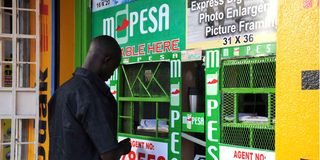
The State is considering introducing insurance for mobile money deposits, such as M-Pesa and Airtel Money, to cover losses should any of the banks holding their e-savings collapse.
The Kenya Deposit Insurance Corporation (KDIC) is in talks with mobile money operators and the Central Bank of Kenya (CBK) about an insurance to cover the mobile money deposits and cut the risk exposure.
The regulators are also looking at the unthinkable chance of the mobile money operators such as M-Pesa, Airtel Money and T-Cash wiping out hundreds of billions in savings.
M-Pesa funds are held in ring-fenced trust accounts at various commercial banks, ensuring customer money is regulated and overseen by the CBK and separate from Safaricom’s operational funds.
Customers holding cash deposits in their mobile phones could lose out in the case of a bank failure because they are not individually guaranteed by the insurance cash, as the funds are pooled.
The government deposit protection insurance guarantees a maximum cover of Sh500,000 per account held in commercial banks, which means mobile phone money service operators would only recover a small fraction of the customer deposits, which run into billions of shillings held in a few banks.
Analysts say the system for protecting mobile money consumers was anchored on the trust customers have in Safaricom, but should now go beyond this.
The KDIC says in a fresh report that excluding mobile money users from the deposit insurance system has left a significant portion of the population exposed.
“Initiate policy dialogue with CBK and mobile money providers to explore regulatory frameworks for insuring mobile money deposits,” says KDIC, a state body that protects depositors in the case of a bank failure.
“With 82.3 percent of the population using mobile money, excluding mobile money from deposit insurance leaves a significant portion of the population vulnerable, hence the need to review the deposit protection framework to include mobile money.”
The electronic money or e-money in M-Pesa accounts is backed by an equivalent amount of physical cash held in pooled commercial bank accounts by an independent trustee.
An earlier report based on a Kenya Bankers Association (KBA) study said customers holding cash deposits in their mobile phones could lose out in case of a bank failure, as the insurance fund does not individually guarantee them.
“The custodial accounts holding the e-float (mobile money deposits) do benefit from deposit insurance on the one hand, however, because the funds are pooled, insured amounts are typically well below the e-float total…. This insurance would do little to cover the mobile payments e-float amount,” said the study.
Safaricom’s M-Pesa controls 89.7 percent of the mobile money subscribers. Its rival, Airtel Money, has a 10.3 percent market share. Safaricom previously said that it has deposited the M-Pesa money in tier-1 (big, stable) banks that have a much lower risk of collapsing, as well as in risk-free government securities.
It said the risk of M-Pesa customers losing their funds is quite remote.
The proportion of Kenya’s population with access to formal financial services has risen to nearly 90 percent from 75 percent in 2016, driven largely by mobile technology.
Kenya is one of the world’s leaders in mobile money services, after telecoms operator Safaricom pioneered its M-Pesa service 18 years ago to cater to Kenyans without access to the formal banking network.
M-Pesa has since evolved from a basic SIM card-based money transfer application into a fully-fledged financial service, offering loans and savings in conjunction with local banks, plus merchant payment services.
Airtel Kenya and Telkom Kenya also operate mobile money services in Kenya, as does Equity Group, a lender that runs a virtual mobile network operator and financial services platform Equitel.
Last month, the total number of registered mobile money accounts in Kenya stood at 89.06 million compared to a paltry 1.33 million accounts in November 2007, reflecting a significant jump.
The value of mobile money transactions has grown from Sh16.3 billion in 2007 to Sh8.69 trillion in 2024.
The earlier the KBA paper noted that the collected M-Pesa funds are stored in a pooled trust account at several commercial banks for the benefit of the customers, but a mechanism is lacking for transferring those funds to customers should an institution holding the funds collapse.
“In the event of insolvency, however, there is no mechanism in place for customers to claim trust assets. This leaves the consumer with no recourse if the said bank becomes insolvent. This further highlights the complexity that these electronically stored values pose,” said the study.