Ruto’s housing push claims bigger share of development budget

Workers on the affordable housing project site in Elburgon, Nakuru County on April 4, 2025

Photo credit: John Njoroge | Nation Media Group

Development spending on housing continued to absorb the largest share of government development expenditure in the first nine months to March, despite increased funding for roads, underscoring President William Ruto's aggressive push to deliver on his affordable housing agenda.

A report by the National Treasury shows that the State Department for Housing and Urban Development recorded the biggest increase in development spending in the third quarter of the financial year ending June 2026, with expenditure surging more than fourfold to Sh90.6 billion from Sh21.1 billion a year earlier, as the government doubled down on its pledge to build 250,000 affordable housing units annually.
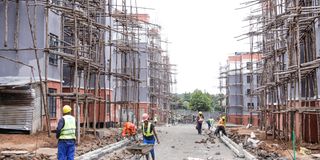
This saw development spending on the construction of low-cost houses surpass road expenditure, a historical heavyweight in development spending.

Although spending on roads also rose by 11.4 percent to Sh88.9 billion, the housing department splurged more cash, making it the single largest development spender during the review period.

"Analysis of development outlay indicates that the State Department for Housing and Urban Development accounted for the largest share of total development expenditure at 19.2 percent, followed by the State Department for Roads at 18.9 percent, the State Department for Economic Planning at 9.7 percent and the State Department for Water and Sanitation at 5.9 percent," the Quarterly Economic and Budget Review Report for the third quarter of FY2025/26 states.

The ranking marks a significant shift in government spending priorities--extending a trend that began in the first quarter when affordable housing overtook roads--which have traditionally absorbed the largest share of development expenditure through major highway and transport infrastructure projects.

The Kenya Kwanza administration aims to build one million affordable housing units by the end of 2027, largely using funds raised through the Affordable Housing Levy, under which salaried workers contribute 1.5 percent of their gross pay, matched by an equal contribution from employers.

Close to 214,057 affordable housing units are currently under construction, according to the housing department. Another 605 units in Bondeni, Nakuru County, 1,080 units in Mukuru, Nairobi, 110 units in Homa Bay and 390 institutional units across various counties had been completed by last year.

Construction of at least 83,044 affordable housing units, which are 32 percent complete, 44,803 social housing units and 11,527 institutional units is also ongoing, the 2026 Budget Policy Statement (BPS) shows.

Ken Gichinga, chief economist at Mentoria Economics, argues that investment in roads delivers a bigger economic multiplier effect than housing. Multiplier effect is an economic term for the extra economic activity created by an initial investment.

"While roads are classified as a public good, homes are predominantly a private good. The multiplier effect of investment in roads far exceeds that of houses. It raises productivity in agriculture, transport, real estate and tourism," Mr Gichinga said in a text message.

He noted that road infrastructure benefits a broader segment of the economy by reducing transport costs, improving market access and enhancing productivity across multiple sectors, whereas housing tends to generate benefits that are concentrated among homeowners and the construction value chain.

A recent study on the economic impact of road and housing development expenditure by Angela Mucece Kithinji, a professor at the University of Nairobi's Faculty of Business and Management Sciences, found that while neither was the primary driver of economic growth, road spending had a significantly stronger impact on the economy.

"Only road construction had a significant influence on economic development (government housing expenditure was not significant)," the study, which examined the relationship between public construction spending and economic growth in Kenya, found.

The findings lend support to arguments by economists that investment in transport infrastructure generates a larger multiplier effect by improving productivity and lowering costs across multiple sectors of the economy.

However, the Ruto administration has recently channelled more funds towards the roads sub-sector, reversing an initial trend in which it had cut expenditure on large road projects, arguing that they were responsible for the huge debt accumulation witnessed under former President Uhuru Kenyatta's administration.

In the review period, development spending on roads increased by 11.4 percent from Sh79.8 billion in the nine months to March 2025 to Sh88.9 billion in the corresponding period this year.

A significant portion of the expenditure went towards the rehabilitation and maintenance of existing roads, activities that are largely financed through the Road Maintenance Levy Fund, which is funded directly by motorists.

Rather than relying solely on borrowing, the Ruto administration has increasingly turned to alternative financing models for major infrastructure projects, including public-private partnerships (PPPs) and securitisation, as it seeks to ease pressure on public debt and the national budget.

Follow our WhatsApp channelfor the latest business and markets updates

PAYE Tax Calculator

Note: The results are not exact but very close to the actual.