Real wages grow for first time in 6 years

 Kenya Union of Post Primary Education Teachers officials march past Presidential dais during this year's Labour Day Celebrations at Uhuru Gardens Nairobi on May 1, 2025.

Photo credit: Dennis Onsongo | Nation Media Group

Salary rises in 2025 surpassed inflation or cost of living measure for the first time in six years despite employers having offered workers a smaller pay increase.

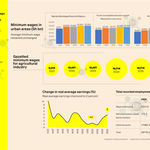
Inflation-adjusted earnings or real wages — a barometer for measuring employees’ purchasing power— grew by 2.0 percent last year, marking the first time since 2020 that growth in workers’ earnings has surpassed the increase in consumer prices, says the Kenya National Bureau of Statistics (KNBS).

Workers’ real wages had fallen for five consecutive years, including a negative 0.3 percent in 2024.

The positive growth, however, masks the impact of increased statutory deductions—including contributions to the Social Health Insurance Fund (SHIF), housing levy and enhanced remittances to the National Social Security Fund (NSSF) — that ate into employees’ payslips for the better part of last year.

This is because the KNBS uses gross income rather than take-home pay that hits workers’ accounts to compute real wages. However, much slower growth in consumer prices—the main factor that erodes the purchasing power of money—helped push real wages into positive territory for the first time since 2020.

The positive real wages came in a year when the economic growth slowed to 4.6 percent, little changed from 2024’s 4.7 percent, pulled down by reduced activity in the agriculture sector. The statistics office on Wednesday forecast GDP ⁠growth of 4.9 percent in 2026, but it said sub-Saharan Africa remained highly vulnerable to shocks caused by the US-Israeli war against Iran.

“Real average earnings depicted a positive increase of 2.0 percent in 2025, in contrast to a decline of 0.3 per cent recorded in 2024,” says the Economic Survey 2026, which was released on Wednesday by Treasury Cabinet Secretary John Mbadi.

Consequently, a regularly paid worker, or wage employee, saw their monthly real earnings increase marginally to Sh56,566 last year from Sh55,450 in 2024.

The earnings are, however, still lower than in 2020, when they stood at Sh62,256. This means workers’ earnings have suffered an erosion of Sh5,690 compared to six years ago.

Public employees continued to bear the brunt of the high cost of living, with their real wages falling further to Sh50,041 last year from Sh51,191.67 in 2024.

Experts reckon that real wages turned positive mainly because inflation—the overall increase in prices of goods and services in the economy—fell faster relative to wages, not because wages surged.

In fact, nominal wages, or the money employees received in their bank accounts at the end of a working period, slowed by 3.5 percentage points, from 7.8 percent in 2024 to 4.3 percent in 2025. This shows employers remained reluctant to offer bigger pay rises.

Inflation, which is measured using a cost-of-living index known as the Consumer Price Index, eased significantly, rising at a much slower rate from 4.6 percent in 2024 to 3.8 percent in 2025. A sharp decline in inflation helped offset slower growth in average earnings among wage employees—those with a regular paycheck—boosting workers’ purchasing power as real wages turned positive.

“The nominal growth rate is actually lower than the previous year, but because inflation has been coming down, it makes the real wage difference go up,” said Ken Gichinga, the founder and chief economist at Mentoria Economics.

Inflation had touched a two-year high of 9.6 percent in October 2024 before it began to stabilise, following a combination of factors including favourable weather that brought down food prices and easing energy costs.

The decline in inflation has also been attributed to lower interest rates, following cuts by the Central Bank of Kenya, which reduced borrowing costs.

REAL

“The government has also been mopping up excess money from the economy by floating bonds, which has stabilised inflation,” said Dr Scholastica Odhiambo, an economics lecturer at Maseno University.

Dr Odhiambo, however, noted that these standardised macroeconomic numbers do not paint a true picture of employees’ purchasing power, as they do not take into account the impact of several statutory deductions on disposable income.

Instead, when computing real wages, sources at KNBS told the Business Daily that they use income reported by employers—or gross earnings—rather than what workers actually take home, or disposable income.

“If you net off, it will not reflect the average earnings,” said a source at KNBS.

This may have overstated the purchasing power of Kenyans in a year when they faced additional statutory deductions.

“What was affected by the statutory deductions was disposable income, which still left households in a precarious position,” added Dr Odhiambo, noting that the increased deductions pushed some employers to breach the one-third rule.

Contributions to SHIF have seen workers whose salaries range from Sh100,000 to Sh1 million part with an additional Sh1,050 to Sh25,800 for the State-backed insurance, making it the second-largest payslip deduction after personal income tax.

These additional deductions, together with the rise in NSSF contributions—from as low as Sh200 to up to Sh4,320 per month under the new rates—and the introduction of a 1.5 percent housing levy on gross pay from July 2023, have significantly cut workers’ take-home pay.

Mr Gichinga also noted that in some sectors such as banking and telecommunications, which have been extremely profitable, there has been substantial growth in earnings that could have skewed the average.

“In such industries, the lower cadres have also been replaced by technology,” said Mr Gichinga, noting that reporting median earnings, as is done in the US, would have given a more accurate picture.

“My main concern is that we are witnessing widening inequality in our economy.” 

The reprieve of positive real wage earnings is less likely to extend to 2026 as the economy starts to feel the impact of the Middle East crisis, which is pushing up prices of fuel and fertiliser as the Strait of Hormuz—a passage through which a fifth of the global fuel supply transits—remains disrupted.

Fuel prices, which carry significant weight in the computation of inflation, have risen sharply in the latest pricing cycle due to supply shocks emanating from the war involving Iran, the US and Israel.

Consequently, inflation in April rose sharply by 1.2 percentage points to 5.6 percent from 4.4 percent in March, reflecting higher fuel prices, according to the latest report by KNBS.

Higher fuel prices have had an immediate knock-on effect on transport costs, with boda boda fares increasing by 6.1 percent. County bus and matatu fares for inter-town travel rose by 9.7 percent, while city bus and matatu fares within towns and surrounding areas increased by 7.1 percent.

Positive growth in real wages also came during a period of slightly weaker economic growth of 4.6 percent compared to 4.7 percent in 2024.

“A lower inflation rate also points to very weak demand in the economy,” said Mr Gichinga.

President William Ruto’s government has cited stable inflation and exchange rates as some of its key achievements, noting that they have laid a sound macroeconomic foundation for growth.

However, the fallout from the Middle East crisis threatens to disrupt his administration’s plans as the country heads into a General Election year.

The World Bank has downgraded Kenya’s growth forecast to 4.4 percent from 4.9 percent for 2026, weakening the economy’s ability to generate jobs and pay higher salaries, even as inflation is expected to eat into workers’ earnings.

Follow our WhatsApp channel for the latest business and markets updates.

PAYE Tax Calculator

Note: The results are not exact but very close to the actual.